
 en
 中文

 Current location:
 Release date: 2026-10-13
 Clicks:
Interactive whiteboard touch technology panoramic contrast: resistance, capacitance, electromagnetic, infrared, optical who is the main ups and downs?
From touch principles and writing experience to cost, maintenance and volume delivery,Qtenboard interactive whiteboard factory directHow to use 20 years of manufacturing experience and Zero-Bonding technology to help education, conferences and OEM projects choose the right touch solution
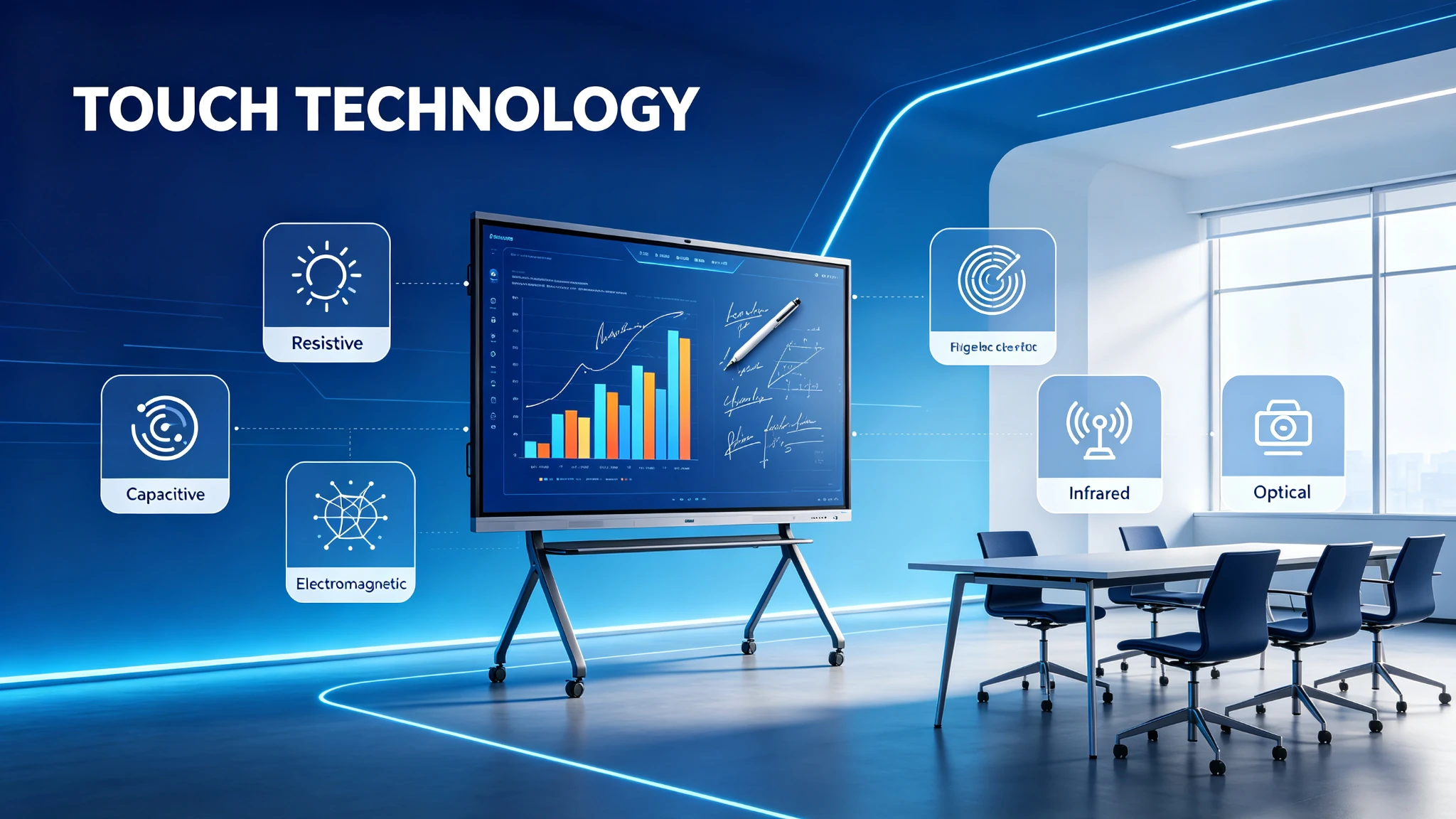
The same is an interactive whiteboard, touch technology is different, the use experience and project cost may be completely different. Can the teacher write naturally with fingers, stylus and pointer? If there are many people marking at the same time in the meeting, will the touch drop points or drift? Can you operate while wearing gloves? Is the edge of the screen prone to touch blind areas? Is the touch performance stable after long-term use? Should the whole panel be replaced or only the touch frame be replaced in case of failure?
Touch technology is not just an option in the product parameter table. It will affect the writing delay of interactive whiteboard, multi-person collaboration ability, palm touch, glove compatibility, display structure, machine cost, after-sales maintenance and project delivery. For B2B customers, choosing touch technology is essentially choosing a long-running interaction solution.
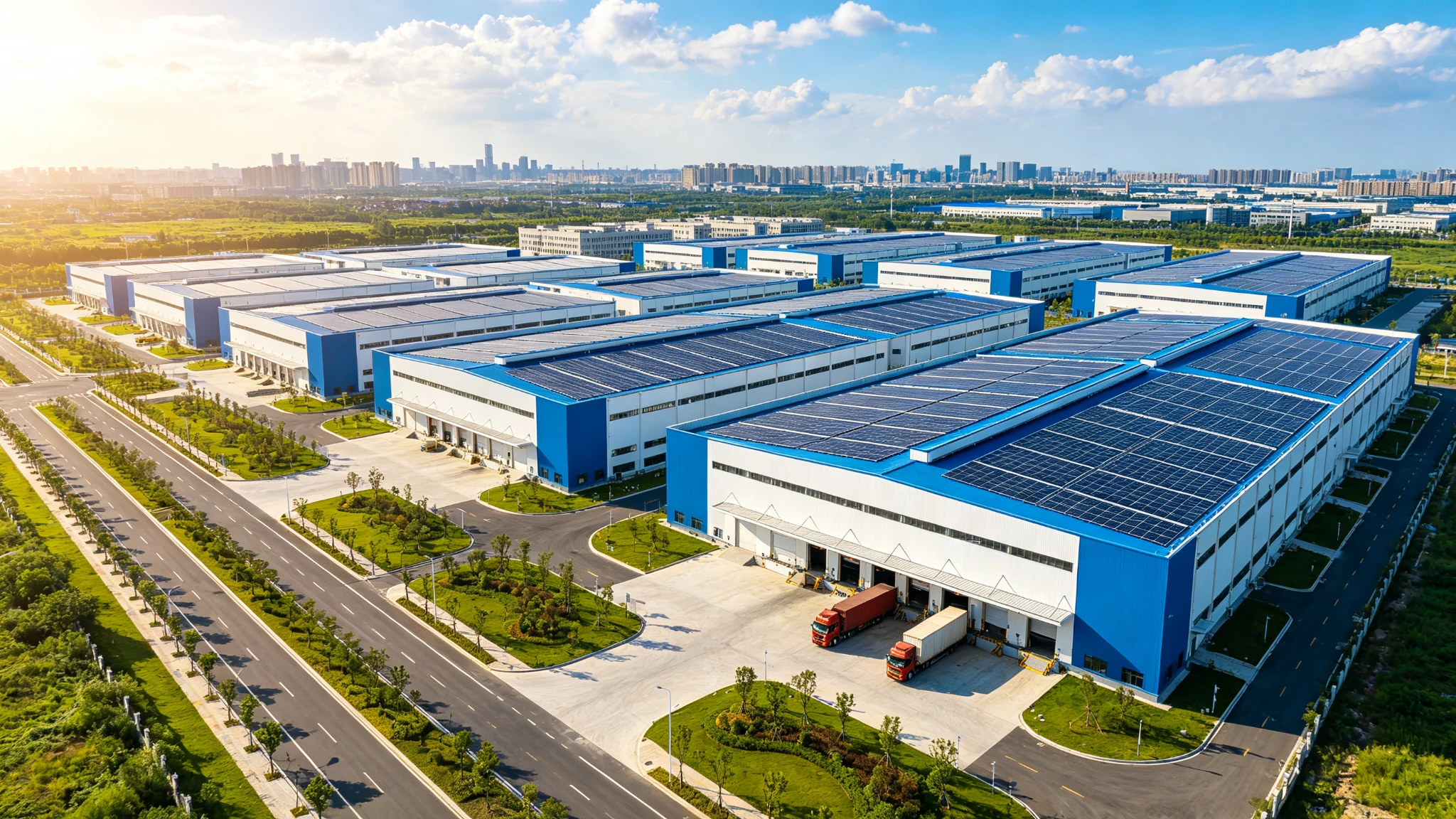
Qtenboard (Shenzhen Qunmao)Founded in 2005, it has been deeply engaged in interactive display manufacturing for 20 years. It has 330,000 ㎡ intelligent manufacturing industrial parks, 16 modern factory buildings, 8 fully automatic production lines and a daily production capacity of 200 units in Shenzhen and Guangzhou, serving 110 countries in the world. This article will provide a complete selection reference for B2B buyers from touch principle, cost structure, scene selection to Qtenboard technical solutions.
How do the 1. five touch technologies work?
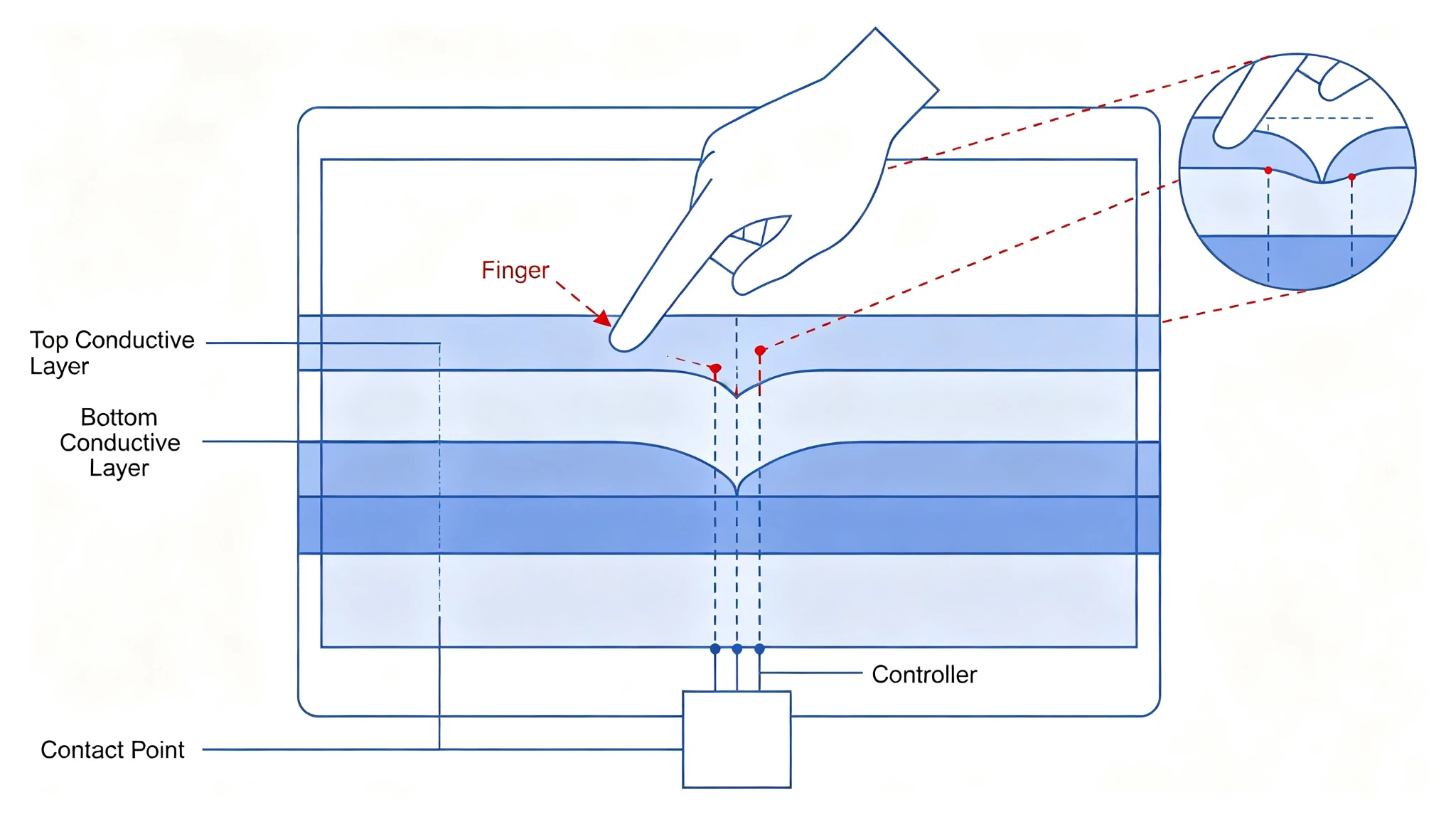
1. Resistive touch: touch by pressure
The resistive touch screen is composed of upper and lower layers of conductive materials. When a finger, stylus or other object presses the screen, the two layers of conductive films contact or change resistance, and the controller calculates touch coordinates according to voltage changes.
- Usually requires some pressure, can use fingers, stylus, gloves or other objects
- Multi-touch capability is generally weaker than infrared and capacitive solutions
- Surface film layer may affect light transmittance and long-term wear resistance
Limitations in large-size interactive whiteboards:The cost and structural difficulty of multi-touch in large size are high, and the touch surface is easy to wear due to long-term pressing and scratching, which is not suitable for multi-person collaborative writing in modern classrooms and large conference rooms. Interactive whiteboards in large sizes above 65 inches are usually not preferred.
2. Capacitive touch: Identify fingers through electric field changes
Transparent conductive electrodes are arranged under the glass for capacitive touch. When a finger touches the screen, the local electric field or capacitance value is changed, and the controller calculates the touch coordinates according to the changed position. This principle is similar to the touch method of smart phones and tablets.
- Fast touch response, natural finger sliding and zooming experience
- Touch accuracy is usually high, the glass surface is complete, the frame is thinner
- Supports multi-touch and palm suppression
- Standard capacitive touch sensitive to gloves, non-conductive stylus and wet environments
Challenges in large size applications:The manufacturing cost of the 65-110 inch large-size capacitor scheme is high, and the consistency, yield and maintenance cost of the large-size transparent electrode need to be evaluated. Surface glass, protective film, moisture and grounding conditions may affect the touch effect, and larger area touch components may need to be replaced during maintenance.
Qtenboard capacitance programme:Support 20 touch, touch delay <20ms, suitable for high-end conference rooms, brand exhibition halls and design review space. Using Zero-Bonding zero-bonding technology and 1mm tempered glass, the touch experience close to that of a tablet computer is realized.
3. Electromagnetic touch: through the special pen to achieve precise writing
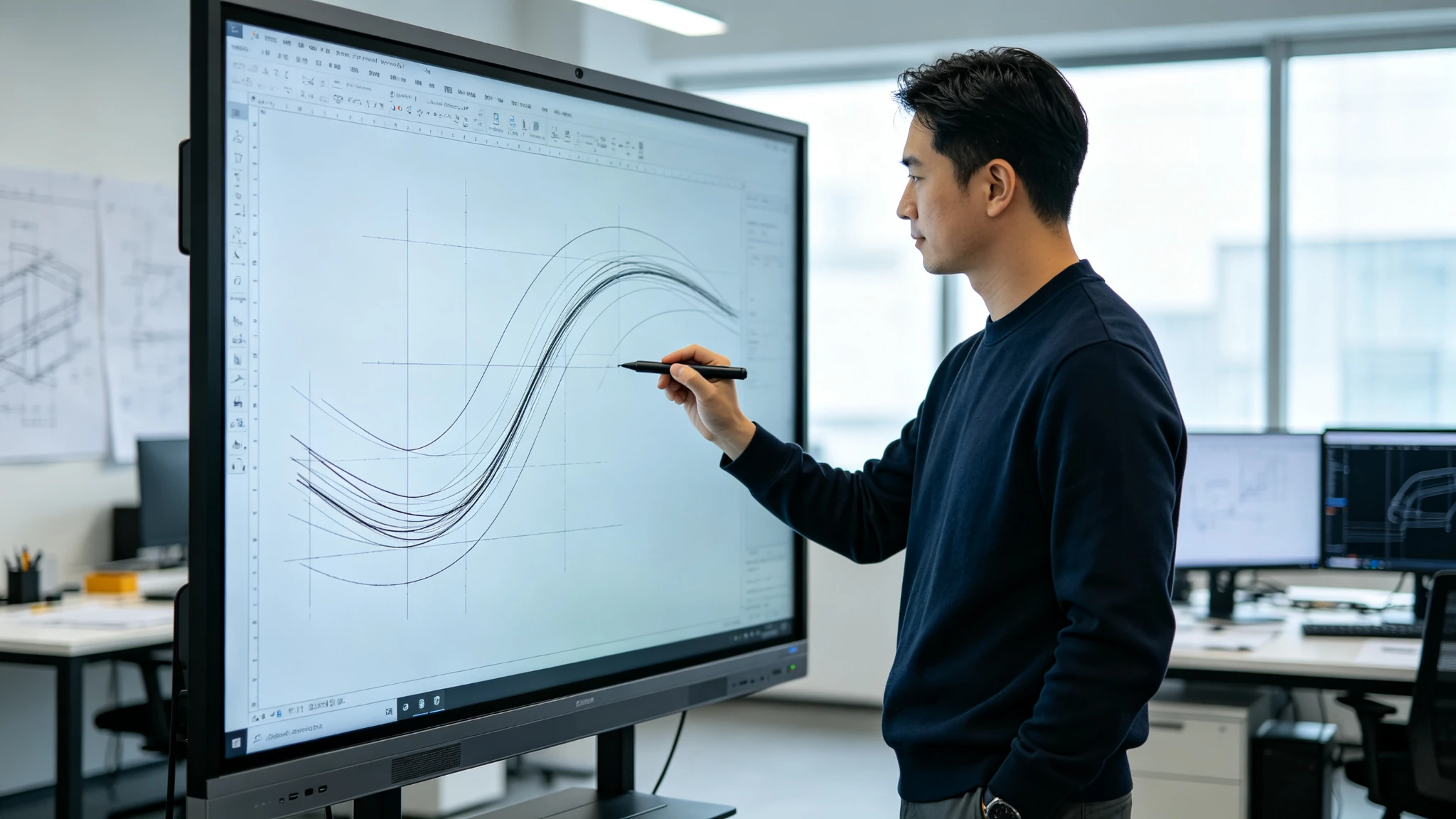
The electromagnetic touch control arranges an electromagnetic induction grid under the screen, the dedicated electromagnetic pen interacts with the induction layer, and the screen can identify the position, movement track and part of the pressure information of the pen. Some systems support nib, eraser, or side key recognition.
- High writing accuracy for fine lines, engineering drawings and professional drawings
- Can support pressure sensing, writing strokes closer to the tablet
- Usually rely on a dedicated electromagnetic pen, finger touch often requires infrared or capacitive technology
Note in large size applications:Electromagnetic touch is usually more suitable for "professional pen writing" rather than completely replacing finger touch. To confirm whether electromagnetic pen finger mixing operation is supported at the time of purchase, it is necessary to confirm the pressure level of the pen, pen tip life, spare pen supply and software compatibility.
4. Infrared touch: the mainstream scheme of large-size interactive whiteboard
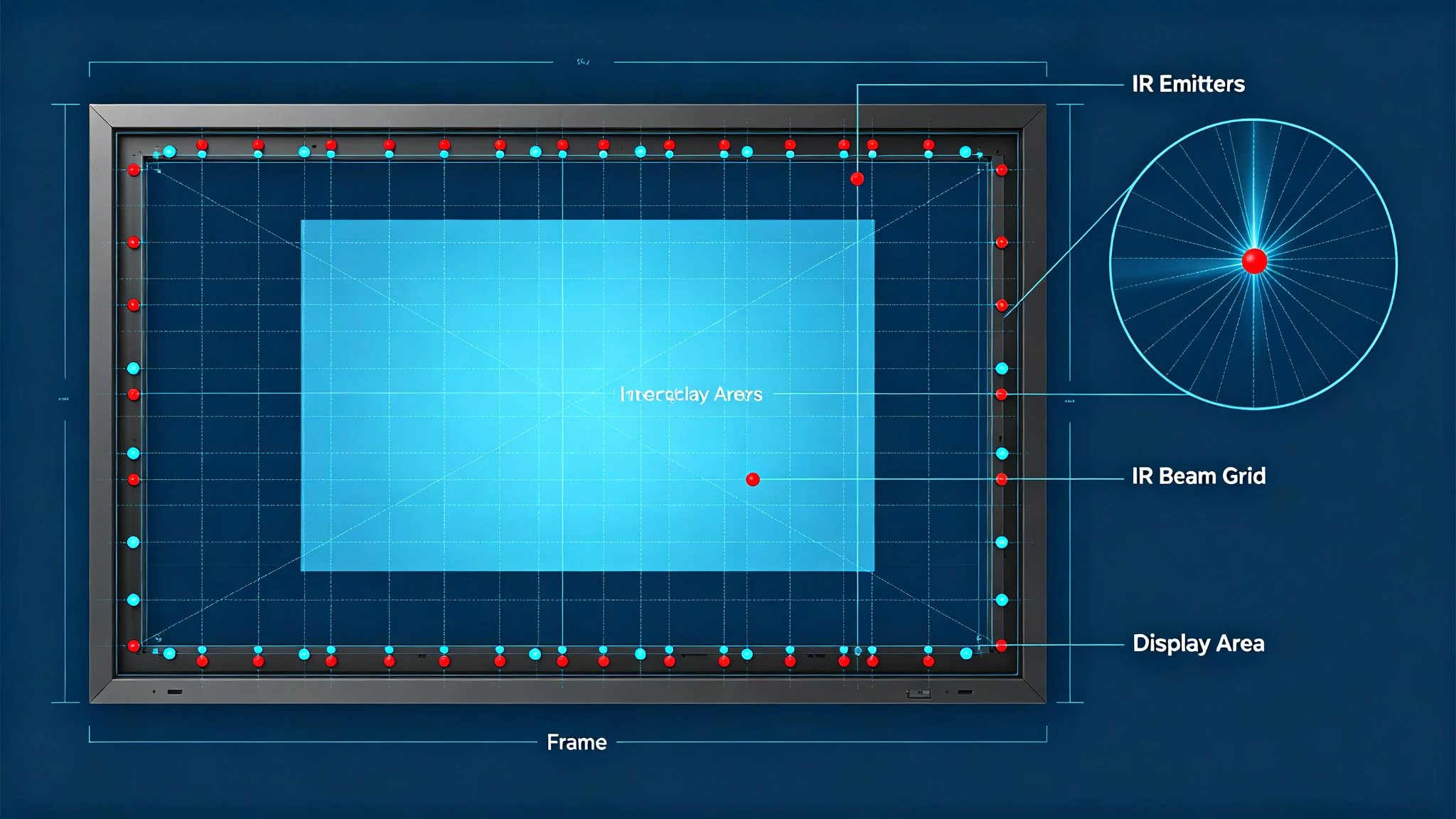
Infrared emitters and receivers are arranged around the screen frame to form horizontal and vertical invisible infrared beam grids. When a finger, stylus or other object touches the screen, part of the light beam is blocked, and the controller calculates the X/Y coordinates according to the position of the blocked light beam.
- Suitable for large display size, can support a variety of touch methods such as fingers, stylus, pointer and gloves
- Strong multi-touch capability and relatively mature structure
- Cost is more suitable for education and volume projects, the touch layer does not necessarily need to cover the entire display glass
- The frame will increase a small amount of structural thickness, and the infrared emitting/receiving area needs to be kept clean and unobstructed.
Qtenboard infrared programme:Support 20-50 point touch, touch accuracy 1.5mm, single point response time 7ms, multi-point response time 10-15ms. Suitable for K-12 classrooms, higher education, corporate conference rooms, training centers and government public projects. The infrared touch frame adopts dust-proof design and supports different touch points and system configurations.
5. Optical touch: through the camera to identify the touch position
A camera or optical sensor is arranged at the edge or corner of the screen. The system recognizes the touch position through image change, infrared reflection or blocking relationship, and calculates the touch coordinates through the viewing angles of multiple cameras.
- Supports fingers, pens, gloves or other objects for larger screens
- The number of touch points can be higher, no need to embed transparent electrodes in the entire glass
- Camera, algorithm and frame structure have a big impact on performance and need to keep the lens and optical area clean
Limitations:Camera calibration and optical environment can affect stability, glare, occlusion, and lens contamination need to be managed, and algorithms and hardware quality vary widely. In mainstream education and conference IFPDs, it is less prevalent than IR programmes.
Comprehensive comparison of 2. five technologies
Parameters are not all, B2B projects depend on comprehensive cost of ownership. The following table compares the five touch technologies from multiple dimensions and indicates the Qtenboard support.
| Evaluation dimension | Resistor | Capacitor | Electromagnetic | Infrared | Optics |
|---|---|---|---|---|---|
| Basic principles | Pressure change resistance | Electric field/capacitance change | electromagnetic pen induction | Shielding infrared beam | camera/optical imaging |
| Finger Touch | Support | Support | Usually a mixed solution is required | Support | Support |
| Multi-point capability | Weak to medium | Strong | Depending on the hybrid scheme | Strong | can be stronger |
| Writing accuracy | Medium | high | Very high | Good | Medium to Good |
| Glove Compatibility | Good | Weak standard scheme | Depend on dedicated pen | Good | usually better |
| Large size adaptation | Weaker | Higher cost | Suitable for professional scenes | Very good | Better |
| Initial Cost | Low to Medium | Medium to High | Medium to High | middle | Medium to High |
| Key maintenance points | Surface film layer | Glass/electrode/protective layer | Electromagnetic pen and induction layer | Border, infrared window, calibration | Lens, algorithm, calibration |
| Educational program | Less recommended | High-end project | professional teaching | Mainstream | Specific project |
| Corporate Meetings | Less recommended | High-end meetings | Design Meeting | Mainstream | Segmented scenarios |
| 65-110 inch compatible | Limited | Cost to be assessed | Professional scene | The most mature | Project Selection |
The technical performance in the table will vary depending on the manufacturer's design, controller, glass, software and calibration method, and should not be understood as a fixed conclusion for all models.
How should 3. touch experiences be truly tested?
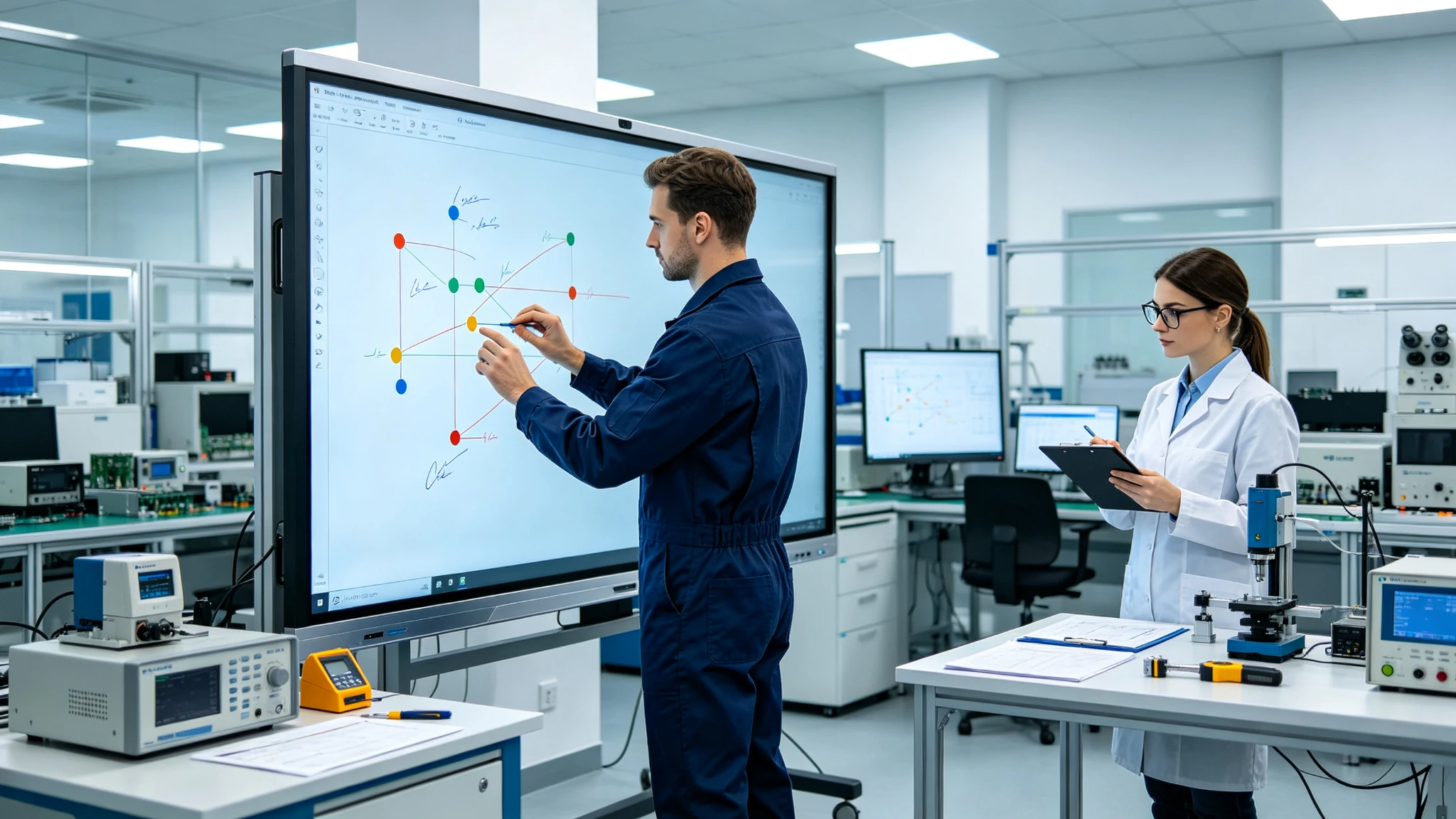
Don't just look at "20: 00, 40: 00, 100: 00", test real interaction. Qtenboard the following touch tests are performed on each interactive whiteboard before shipment:
1. Single point writing test
- Whether the pen is started in time, whether the lines are continuous and whether there is disconnection.
- Whether the fast writing follows the hand, and whether there is any difference in the thickness of different nibs
- Whether there is an error on the edge of the screen
2. Multiple people write tests at the same time
- Is the writing stable when 2, 4, or 6 people write simultaneously?
- Whether sticking occurs when multiple touch points are close together
- Whether the system misses or jumps touch points
- Is Android consistent with performance under Windows
- Whether palm, cuff and stylus operation are supported simultaneously
3. Palm inhibition test
- Does the palm of your hand on the screen cause false touch?
- Does large area contact affect handwriting
- Whether the palm, finger and stylus are stable when used at the same time
4. Edge accuracy test
- Whether the four corners of the screen are written accurately.
- Does edge touch have any offset?
- Is there an obvious dead zone between the front frame and the display area
5. Complex environment testing
- Strong light environment, dust environment, temperature change, humidity change
- Long-term continuous use, external electromagnetic interference
- Touch effect after glass or protective film installation
Qtenboard test data:Touch accuracy: 1.5 mm; single-point response time: 7 ms; multi-point response time: 10–15 ms; supports 20–50-point touch. Each device undergoes a 48-hour high-temperature aging test (72 hours for some items). After aging, the touch, display, heat dissipation, system, audio, and wireless are fully retested.
How does 4. touch technology affect BOM cost and after-sales?
The purchase price is only the first cost, TCO is the complete answer.
Initial BOM Cost
- Resistance:The material and structure are relatively simple, and the cost advantage of the large-size multi-point solution is not obvious, which is suitable for budget-sensitive small equipment or professional terminals.
- Capacitance:Transparent electrodes, control chips and large-size processes are costly, and the cost increases with size, number of touch points and glass structure.
- Electromagnetic:A sensor layer and a dedicated pen are required, and a hybrid touch architecture is required with finger touch, which is suitable for professional scenes but costs more than basic infrared.
- Infrared:Suitable for large size and mass production, touch frame structure is relatively independent, suitable for large-scale procurement of education and conference projects.
- Optics:Need camera, algorithm and optical structure, more suitable for project customization.
Maintenance Cost Comparison
| Technology | Typical Maintenance Focus | Qtenboard support |
|---|---|---|
| Resistor | Surface film, touch layer wear, press failure | — |
| Capacitor | Glass, protective layer, touch electrode and full layer replacement | Zero-Bonding Zero Fit, Class 10,000 Cleanroom Manufacturing |
| Electromagnetic | Induction layer, special pen and drive compatible | Electromagnetic hybrid scheme optional |
| Infrared | Infrared window cleaning, frame maintenance, recalibration | Dustproof design, frame can be replaced independently |
| Optics | Camera cleaning, algorithm calibration, sensor repair | Project-based scheme |
Total Cost of Ownership (TCO) for a Scale Deployment
The TCO shall include: equipment procurement costs, touch accessories and special pen costs, installation and commissioning, maintenance and spare parts, downtime losses, software and firmware support, training and after-sales, equipment replacement and upgrade costs.
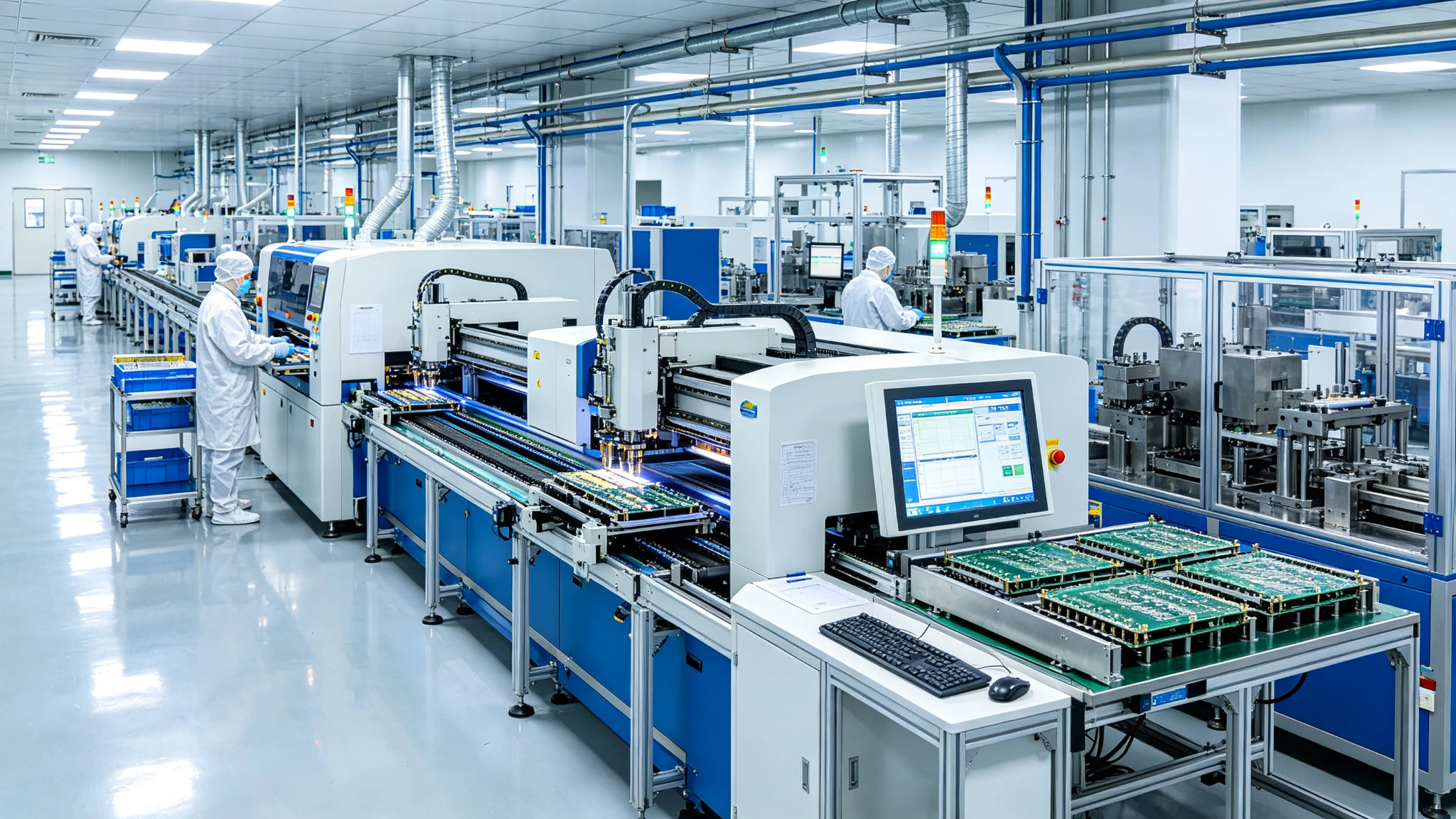
Qtenboard advantages:Vertically integrated manufacturing (metal processing, plastic injection molding, SMT patch and touch bonding are all completed in 330,000 ㎡), reducing outsourcing links, controllable cost of structural parts, shortened material turnover time and higher quality consistency. The first-pass yield of the complete unit is ≥97%, and the aging failure rate is <1.5%.
How to choose touch technology 5. to different application scenarios?
There is no absolute best technology, only the best technology for the project.
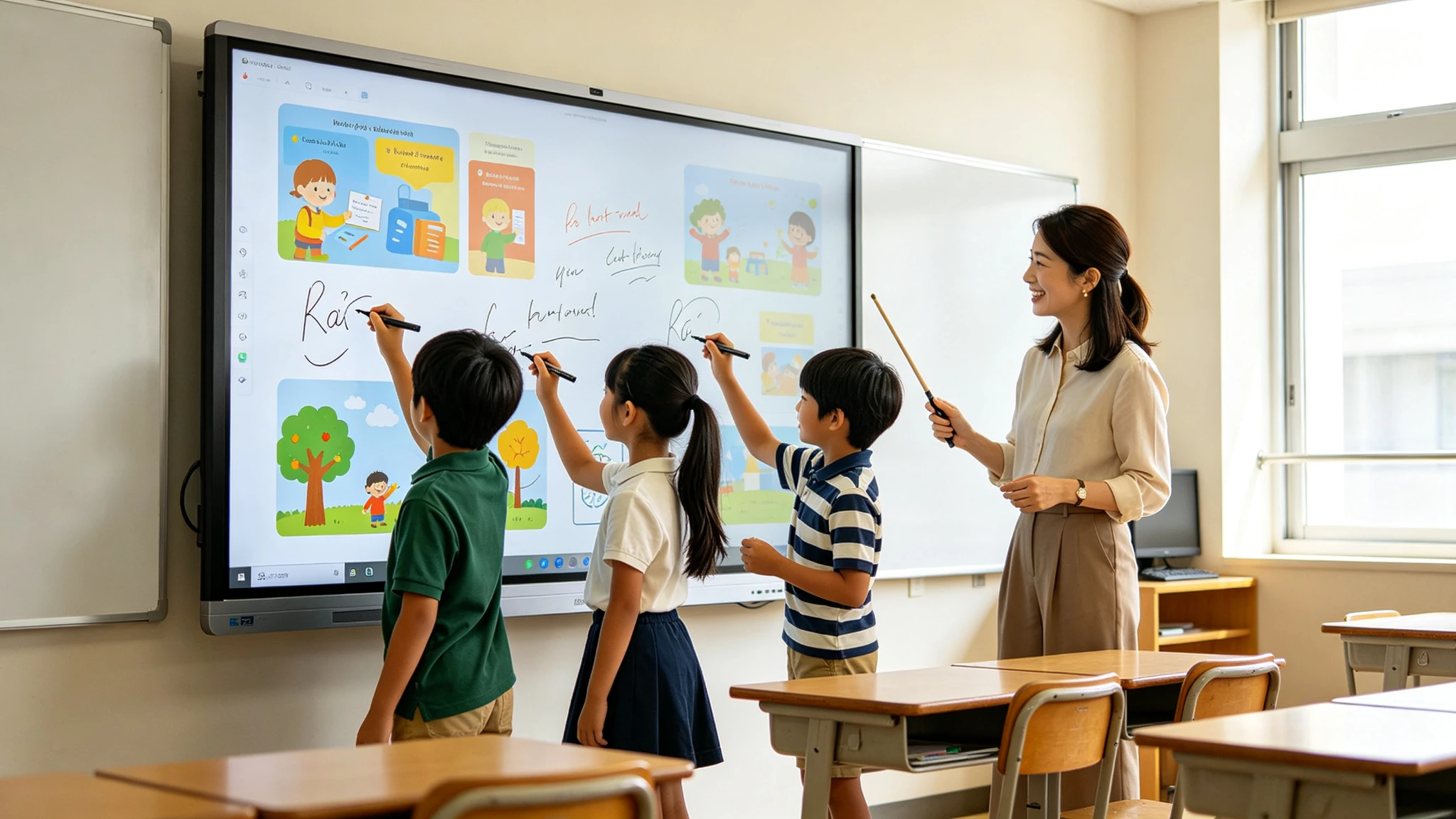
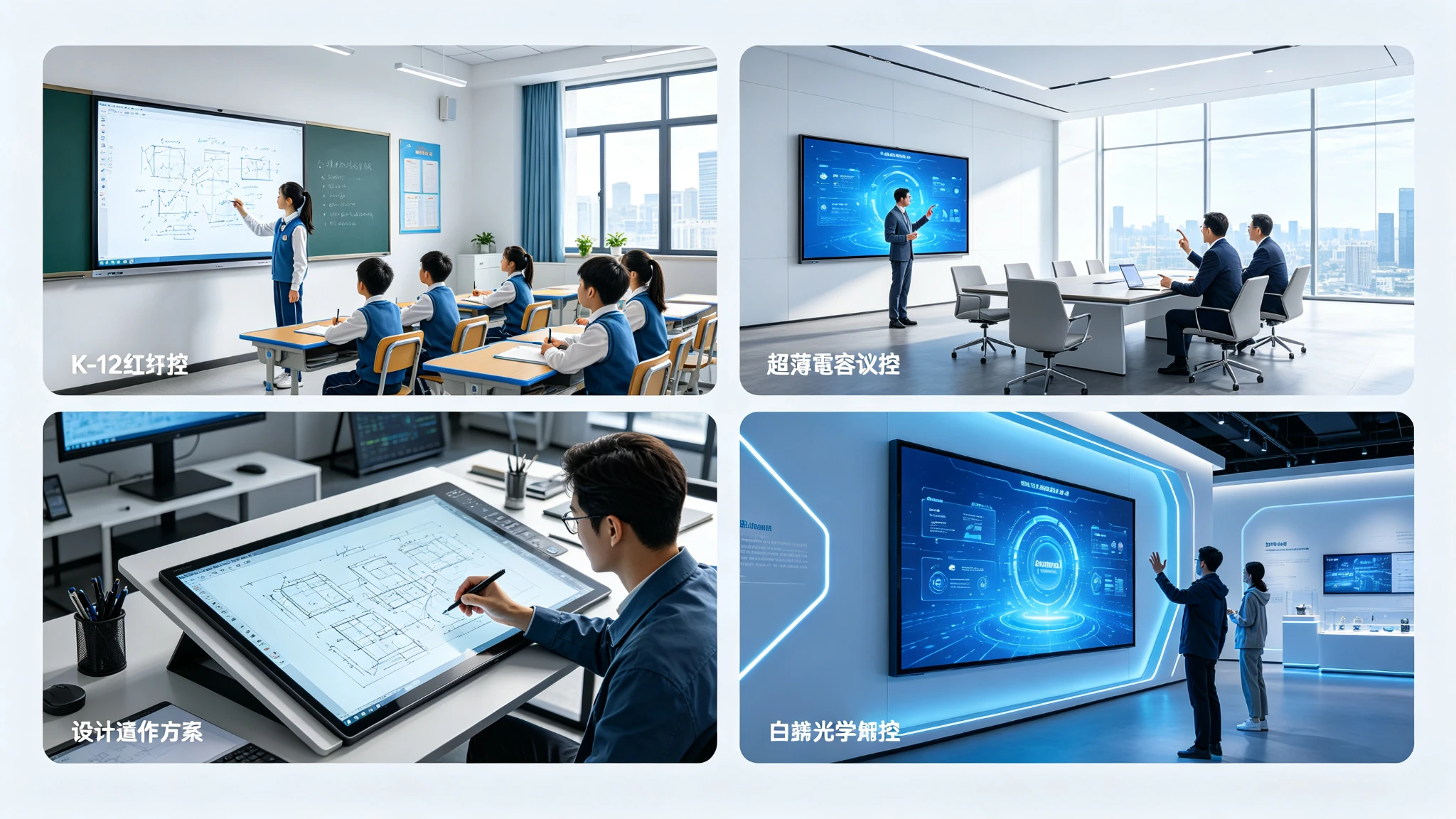
1. K-12 education: infrared priority, capacitor as high-end option
Project Requirements:Teachers write with fingers, pens or pointers, and multiple students participate together. The equipment needs to be used for a long time and at high frequency. It needs to control the cost of bulk purchases, and it needs to be easy to maintain and quickly replace spare parts.
Recommended logic:High-performance infrared is recommended for mainstream classrooms; high-end laboratories and design classrooms can consider capacitive or infrared electromagnetic hybrid solutions; special professional courses can consider the fine writing ability of electromagnetic pens.
Qtenboard education programmes:The 65/75-inch models are designed as an ideal solution for K–12 and small-to-medium-sized classrooms, supporting 20 touch points, a wireless microphone, a teacher-facing camera, and remote device management. A key middle school in a province purchased 50 sets of 75-inch Qtenboard interactive whiteboards, which were delivered in 25 days, with a failure rate of 0 in 1 year.
2. Enterprise conference: infrared and capacitance depends on the conference level
- General Conference Room:Infrared touch has been able to meet the annotation, whiteboard, screen and multi-person collaboration, focusing on conference software compatibility, wireless screen and device management.
- High-end meeting rooms:Capacitive Touch provides a touch feel closer to tablets and phones, for businesses that value appearance, fine writing and advanced collaboration experiences.
- Design Review Meeting:Infrared electromagnetic pen or capacitive professional pen, the choice focuses on pressure sensing, fine line performance, pen delay and professional software adaptation.
3. Medical and scientific research: precision, hygiene and professional software is preferred
- Capacitive touch for fine interface operation
- Electromagnetic touch for medical imaging, drawings and precise annotation
- Infrared is suitable for large-size spaces that require gloves or multi-person discussions
- Gloves, disinfection environment, protective film, software compatibility and long-term stability should be tested when purchasing
4. Industry and design: the value of electromagnetic technology is more prominent
- Focus on pressure sensing, fine lines and stroke performance
- Focus on professional software compatibility, special pen life and spare parts
- Focus on gloves, tools and complex operating environments
5. Public space and exhibition: optical and infrared need to choose according to the environment
- Optical solution supports multiple touch objects and project-based interactions
- The infrared solution is suitable for large-size, multi-person and cost-controllable interactive display
- Need to focus on testing the ability of glare, occlusion, lens cleaning and maintenance personnel
- Public space should consider vandalism, glass strength, cleaning and remote operation and maintenance
Relationship between 6. Touch Technology and Product Structure
1. Touch technology and border
The infrared scheme needs to arrange the transmitter/receiver in the frame, and the frame width, flatness and structural protection affect the touch stability. After the frame is hit, it may need to be recalibrated. The capacitive solution can achieve a more complete glass surface, but the requirements for glass, electrodes and protective layers are higher.
2. Touch technology and optical bonding
The concept must be clear:Optical TouchIs to use the camera or optical system to identify the touch;optical bondingThe touch layer is directly attached to the display panel by the optical adhesive. Infrared, capacitive, electromagnetic can be combined with different bonding structures. Optical bonding can affect reflection, visibility, writing parallax, and overall thickness, but it is not a touch detection method by itself.
Qtenboard Zero-Bonding Zero Fit Technology:The touch layer is attached to the display panel with zero gap, which reduces reflection and refraction caused by the air layer, and improves display definition and writing experience. With 1mm tempered glass, it can achieve high-precision writing and touch feeling close to tablet computer.
3. Touch technology and glass
The Purchaser shall focus on: glass thickness, anti-glare treatment, anti-fingerprint coating, impact rating, light transmittance, reflectance, touch sensitivity, protective film and bonding process.
4. Touch technology and software
Different touch controllers need to match the corresponding drive, and the multi-point protocol under Android and Windows may be different. HID, USB, serial or other touch interfaces should be identified. Software updates may affect touch performance. OEM projects require locking of drivers, firmware, and system versions.
How do 7. B2B buyers evaluate touch technology?
When purchasing, don't just ask "how many points are supported", but also ask the following questions:
Technical issue
- Who are the specific types and suppliers of touch technology?
- How many real touch points are supported?
- Is Android, Windows, or dual system support?
- What is the touch latency, accuracy, and edge error?
- Do you support gloves, special pens and multi-person simultaneous writing?
- Does it support palm suppression and false touch prevention?
- How to combine touch glass, touch frame and display panel?
Reliability issues
- Is it stable under strong light, dust, humidity and long-term operation?
- Can the touch box, controller, or special pen be replaced separately?
- Are there touch calibration tools, test reports and maintenance SOPs?
Supply chain issues
- Is there a stable batch supply of touch modules?
- Is there an alternative touch scheme for the same model?
- Do you need to do the structure, software and calibration verification again after replacement?
- What is the supply cycle of touch spare parts?
- Can OEM customers lock in touch scenarios and key BOMs?
Project issues
- Can a prototype be provided for field testing?
- Can I test multi-person writing in a real meeting or classroom?
- Are customer-specific software and conferencing platforms supported?
- Are custom touch points, stylus, or interactive features available?
- Does the warranty period cover the touch system, glass and controller?
How does the touch scheme of 8. Qtenboard land?
1. Infrared touch as a large size mainstream program
- Facing 65-110 inch interactive whiteboard
- Suitable for education, conferences, training and public programs
- Support 20-50 point touch, touch precision 1.5mm
- Support finger, stylus, pointer, gloves and other operations
- Focus on touch frame dust protection, edge accuracy and factory calibration
- Single point response time 7ms, multi-point response time 10-15ms
2. Capacitive touch as a high-end experience option
- Suitable for high-end enterprise conference room, brand exhibition hall, design review space, high-end education laboratory
- Support 20-point touch, touch delay <20ms
- Zero-Bonding zero-bonding technology with 1mm tempered glass
- Costs and maintenance costs are usually higher, and large-size batch stability needs to be confirmed by prototype and project testing.
3. Electromagnetic hybrid scheme as a professional writing option
- Suitable for engineering design, architectural design, medical imaging, digital art
- Professional spaces that require fine handwriting and pressure sensing
- Can be mixed with infrared or capacitance
4. Project optics scheme
- Suitable for museums, interactive exhibitions, public spaces
- Projects that require special object recognition or a specific way of interaction
5. Manufacturing strength and quality assurance
- Established in 2005, 20 years of manufacturing experience
- 330,000 ㎡ industrial park, 16 factories and 8 full-automatic production lines
- SMT patch speed 120,000 components/hour, main board, sub-board independent production
- Class 10,000 clean room completes touch panel manufacturing and optical bonding
- 48 hours high temperature aging test (72 hours for some items), comprehensive retest after aging
- The one-time pass rate of the whole machine is ≥ 97%, and the abnormal rate of aging is <1.5
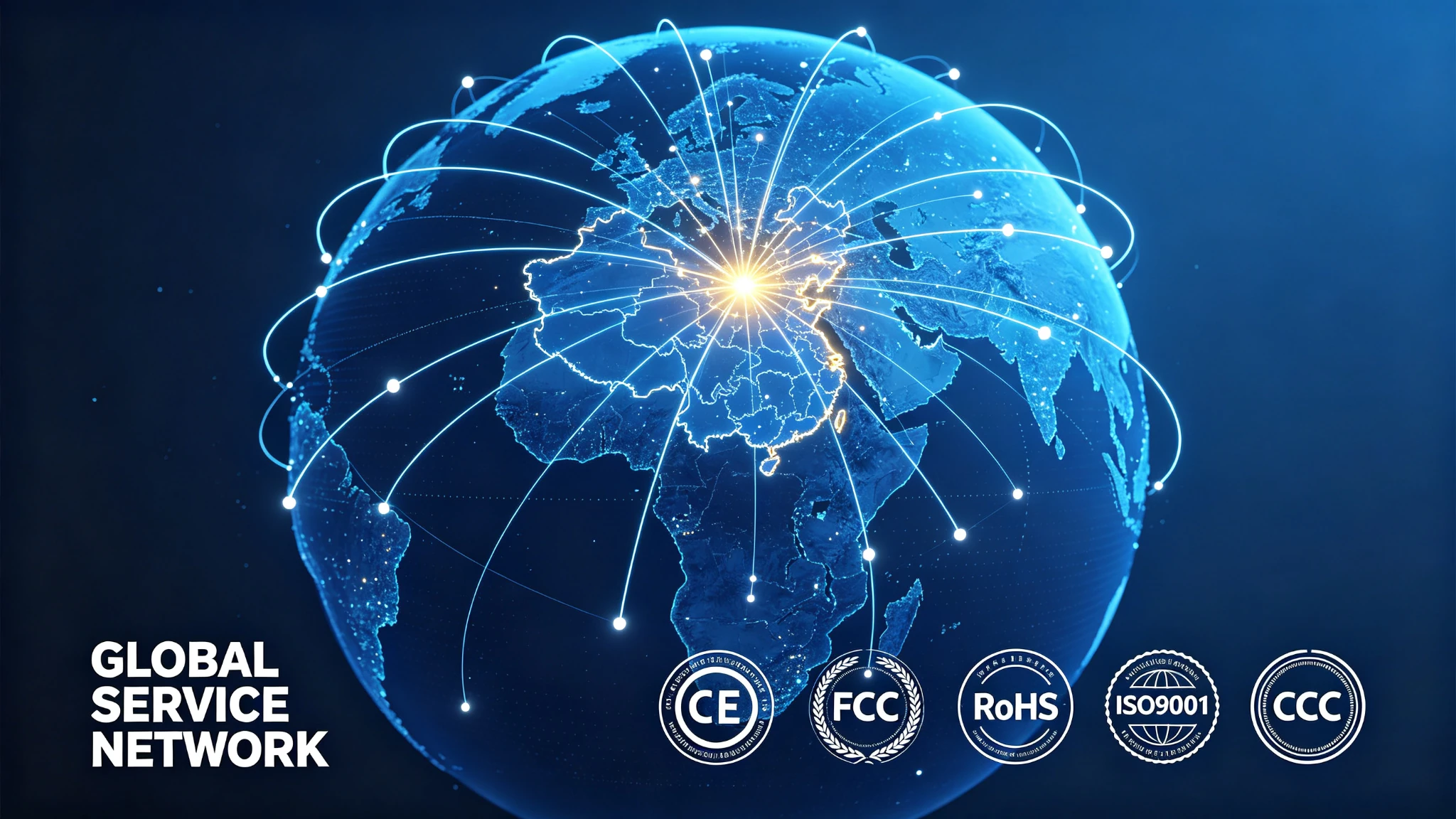
- International Certification: CE, FCC, RoHS, ISO9001, CCC
- Service 110 countries, after-sales response ≤ 4 hours
6. OEM/ODM with customized support
- Touch technology selection, touch point configuration, stylus and accessories
- Glass and anti-glare solution, Android/Windows dual system
- Touch Drive and Software Adaptation, Firmware and Device Management
- Appearance, Logo, Packaging and Launch Interface
- CKD/SKD local assembly and after-sales support
9. who will master the ups and downs?
Infrared mainstream, capacitor growth, electromagnetic specialization, optical segmentation.
1. Infrared: the mainstream solution of large-scale market
Reasons for continued dominance:It is more suitable for large size, supports multi-person collaboration, supports multiple touch objects, is suitable for education and conference batch projects, has relatively controllable cost and maintenance, and has mature supply chain and manufacturing experience.
Future upgrade direction:Higher touch points, lower writing delay, narrower bezels, better dust-proof design, stronger palm suppression, AI gesture and handwriting recognition, and more accurate automatic calibration.
Market data:In 2025, infrared touch will account for 26.8 percent of the global interactive whiteboard market, 72.5 percent in China and 85.4 percent in the export market.
2. Capacitance: a growth solution for high-end interactive experiences
Reasons for continued growth:Touch natural, high precision, glass integrated appearance is better, suitable for high-end meetings and professional space, users have formed expectations for mobile phones and tablet experience.
Key limitations:Large size cost, repair cost, glove and environmental sensitivity, large size supply chain and yield.
Electromagnetics: The Long-Term Value of Professional Writing
It may not necessarily become the mainstream of the mass market, but it is irreplaceable in high-precision scenes such as design, engineering, scientific research and medical treatment. Hybrid solutions with infrared or capacitance are more likely in the future.
4. Optics: technical supplement in specific scenes
Suitable for interactive displays and special projects. Popularity depends on cameras, algorithms, environmental adaptability and maintenance costs. For regular classrooms and conference rooms, commercial penetration may still be lower than infrared and capacitance.
5. Resistance: from the mainstream large screen market retreat to professional segmentation
Still valuable in small size, industrial and special input environments. In the modern interactive whiteboard of large-sized multi-person collaboration, the competitiveness is relatively limited. It is unlikely to be the first choice for mainstream education and enterprise interactive tablets.
| Technology | Future positioning |
|---|---|
| Infrared | Mainstream programs for large-scale education, conferences and government programs |
| Capacitor | Growth solutions for high-end conferences, brand presentations and sophisticated interactions |
| Electromagnetic | Design, engineering, research and medical professional programs |
| Optics | Complementary programmes of public interaction, exhibitions and special projects |
| Resistor | Subdivision of industrial, terminal and special input environments |
Conclusion: The final winner is not a certain technology, but the technology combination that best matches the project.
- Infrared is suitable for large-scale, multi-person collaboration and large-scale education/conference projects.
- Capacitors are suitable for high-end projects that pursue advanced touch experience, fine operation and integrated appearance.
- Electromagnetic is suitable for professional writing, design and engineering applications.
- Optics are suitable for specific public interactions and project-type displays.
- Resistors are suitable for industrial and special input environments, but they are not the mainstream direction for large-size interactive whiteboards.
- There may be more hybrid touch solutions in the future, rather than a single technology completely replacing other technologies.
For B2B customers, the choice of touch technology should not start with "which technology is the most advanced", but should start with the real needs of the project: what is the screen size? How many people use it every day? Do you need multiple people to write at the same time? Do you need to wear gloves? Is professional handwriting concerned? What is the budget and after-sales conditions?
For most education, conference and training programs, infrared is still the mainstream solution that takes into account size, experience, cost and maintenance; for high-end conferences, design reviews and professional applications, capacitive or electromagnetic hybrid solutions can provide a more detailed interactive experience.QtenboardAccording to the customer's space, application, system, budget and volume delivery requirements, to help select the appropriate touch technology and overall configuration.
Backed by 20 years of manufacturing experience, 330,000 ㎡ industrial park, 8 full-automatic production lines and Zero-Bonding zero-bonding technology, the Qtenboard provides a full range of infrared, capacitive, electromagnetic hybrid and project-based optical touch solutions, supports OEM/ODM, CKD/SKD customization, and serves 110 countries around the world.
 Previous:
 Return to list

 Partner Links: