From Parts to Complete Machine: BOM Cost Disassembly Qtenboard of Interactive Whiteboard
Release date: 2026-10-12
Clicks:0
Qtenboard · Cost Guide
From parts to complete machine: BOM Cost Disassembly of Interactive Whiteboard
Display panel, touch module, motherboard, structural parts each accounted for how much?
An interactive whiteboard with a panoramic view of the cost structure to help education, conference and business show customers make rational purchasing decisions
The cost of an interactive whiteboard is not just "screen touch", but the combined result of display, touch, electronics, structure, manufacturing and testing. The global interactive tablet market is about US $5.17 billion in 2025 and is expected to reach US $10.46 billion in 2035. The cost structure changes with technological upgrades.
This article disassemps the BOM (Bill of Materials) cost structure to help buyers understand "where the money is spent", identify cost drivers, and have evidence to build on when negotiating and selecting models. At the same time, QunmaoMeeting Whiteboard OutletThe representative, with the vertical integration of brand Qtenboard manufacturing as a reference, shows how scale and integration can optimize costs.
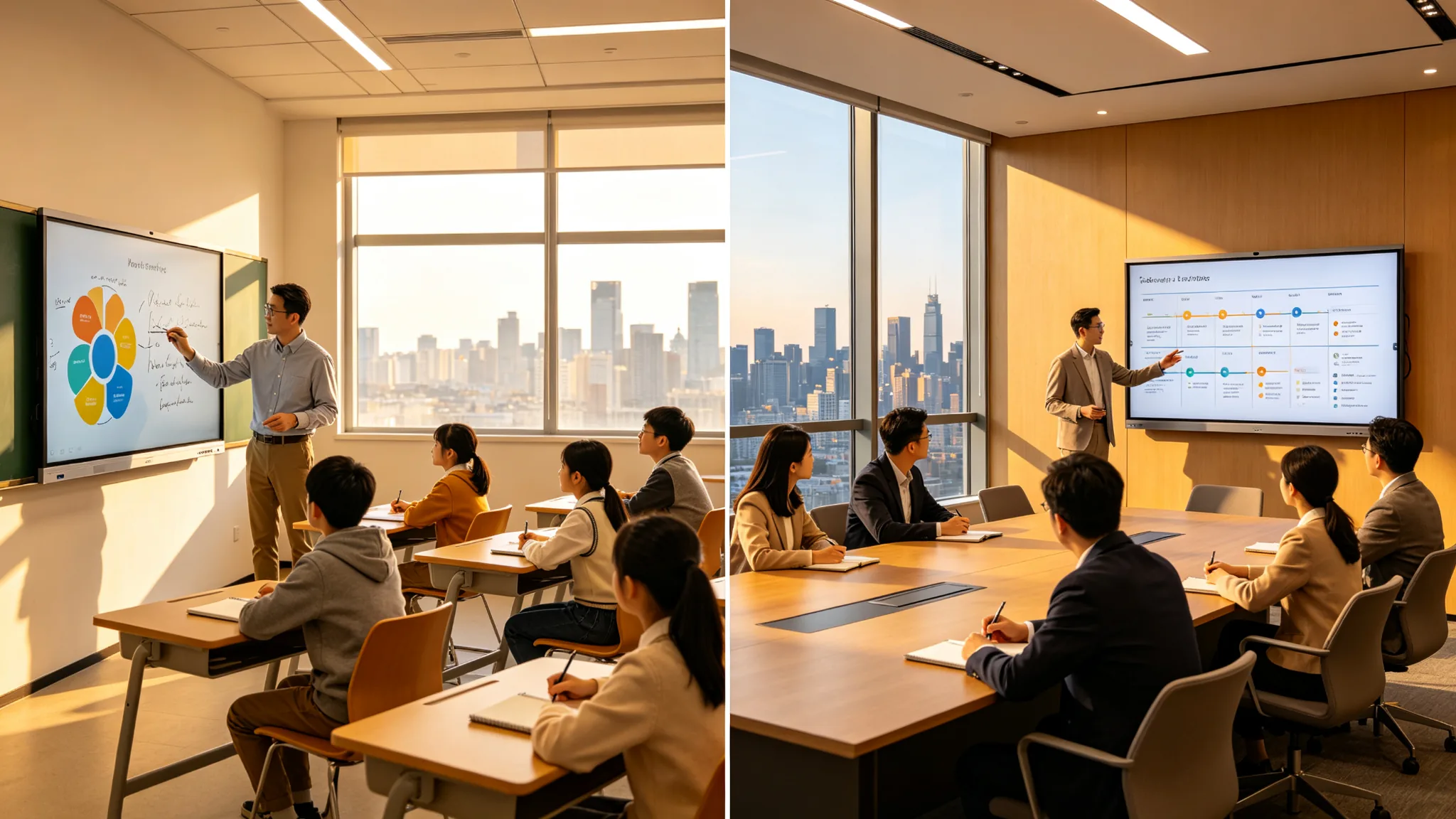
Typical Application of Interactive Whiteboard in Education and Conference Scenarios
500K Annual output (set)
330K㎡ Industrial Park
8Fully automatic production line
3K Global Staff
110+Serve the nation
97%One-time pass rate of the whole machine
1. BOM Overview: The Cost Structure of an Interactive Whiteboard
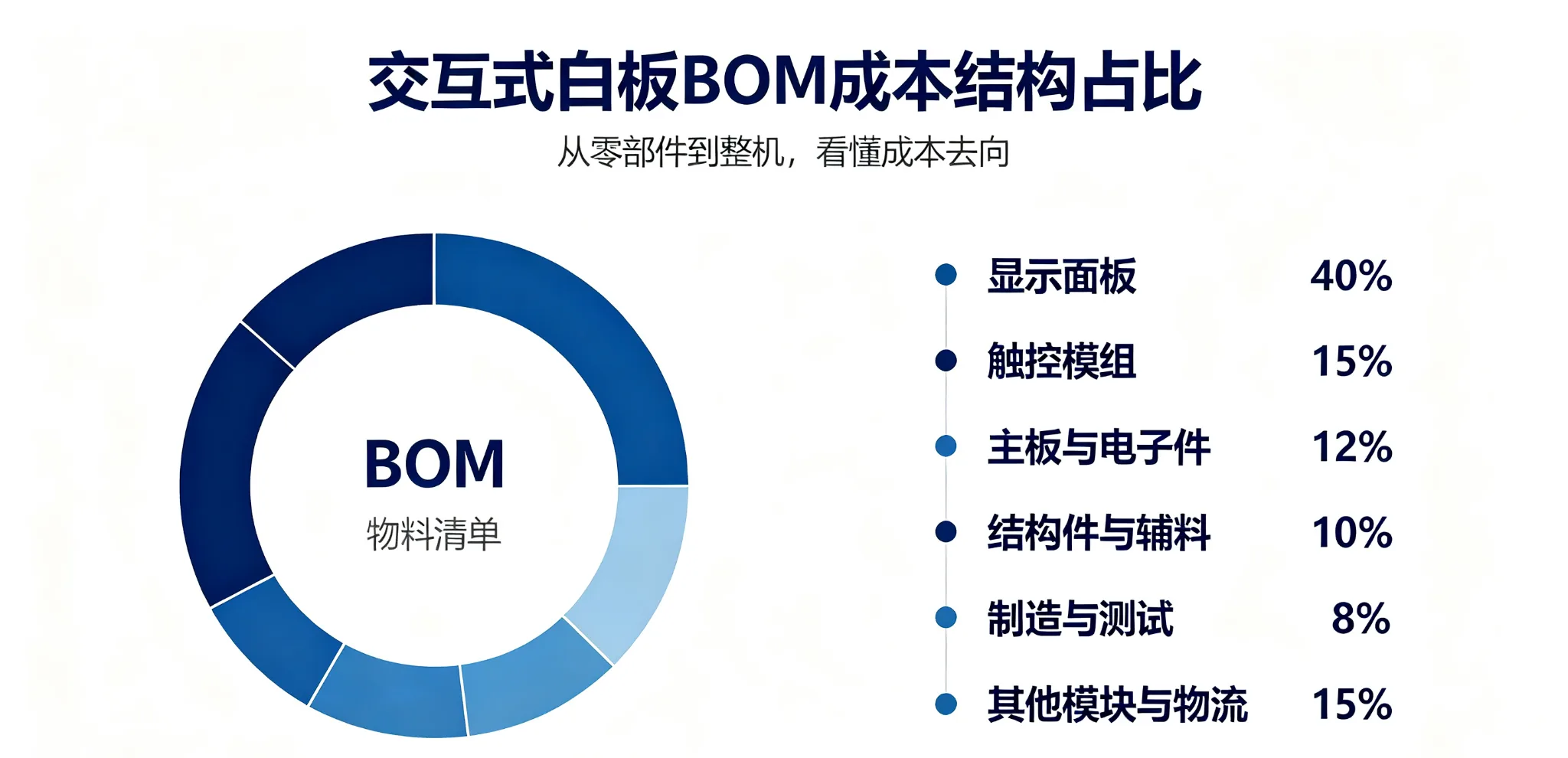
First understand the panorama, then go into the details. The following is a typical industry percentage range, which varies by size, technical route, and brand positioning.
Cost category
Typical proportion
Description
Display Panel
35–50%
Size, resolution (4K/8K), brightness, contrast, panel type (LCD/OLED/mini-LED)
Touch module
10–20%
Significant differences in infrared/resistive/capacitive technology routes, with the number of touch points and accuracy affecting cost
Motherboard and Electronic Parts
10–15%
SoC, memory, storage, interface modules, power boards, wireless modules
Structural parts and accessories
8–12%
Frame, back shell, bracket, wire, packaging
Audio/Camera/Microphone
3–8%
Standard for conference models, optional for education models
Manufacturing and Testing
5–10%
SMT, assembly, aging, quality inspection, labor
Software and Licenses
2–5%
Operating systems, applications, authentication, custom development
Logistics and tariffs
3–8%
Sea/Air, Insurance, Customs, Local Delivery
Interactive whiteboard BOM cost structure percentage (typical industry percentage)
Effect of Size Segment on BOM
55/65 inches: Panel cost ratio is relatively low, suitable for entry/mainstream market
75/86 inches: Panel costs have increased significantly, suitable for high-end conferences/large classrooms.
98 inches and above: Panel costs may exceed 50%, and logistics and installation costs have also risen sharply.
Impact of Technical Route on BOM
Touch technology
Infrared: Lower cost, mainstream education scene
Resistance: Cost-effective still accounts for 42.55 per cent of the share, strong durability
2. core device cost dismantling (accounting for more than 70% of BOM)
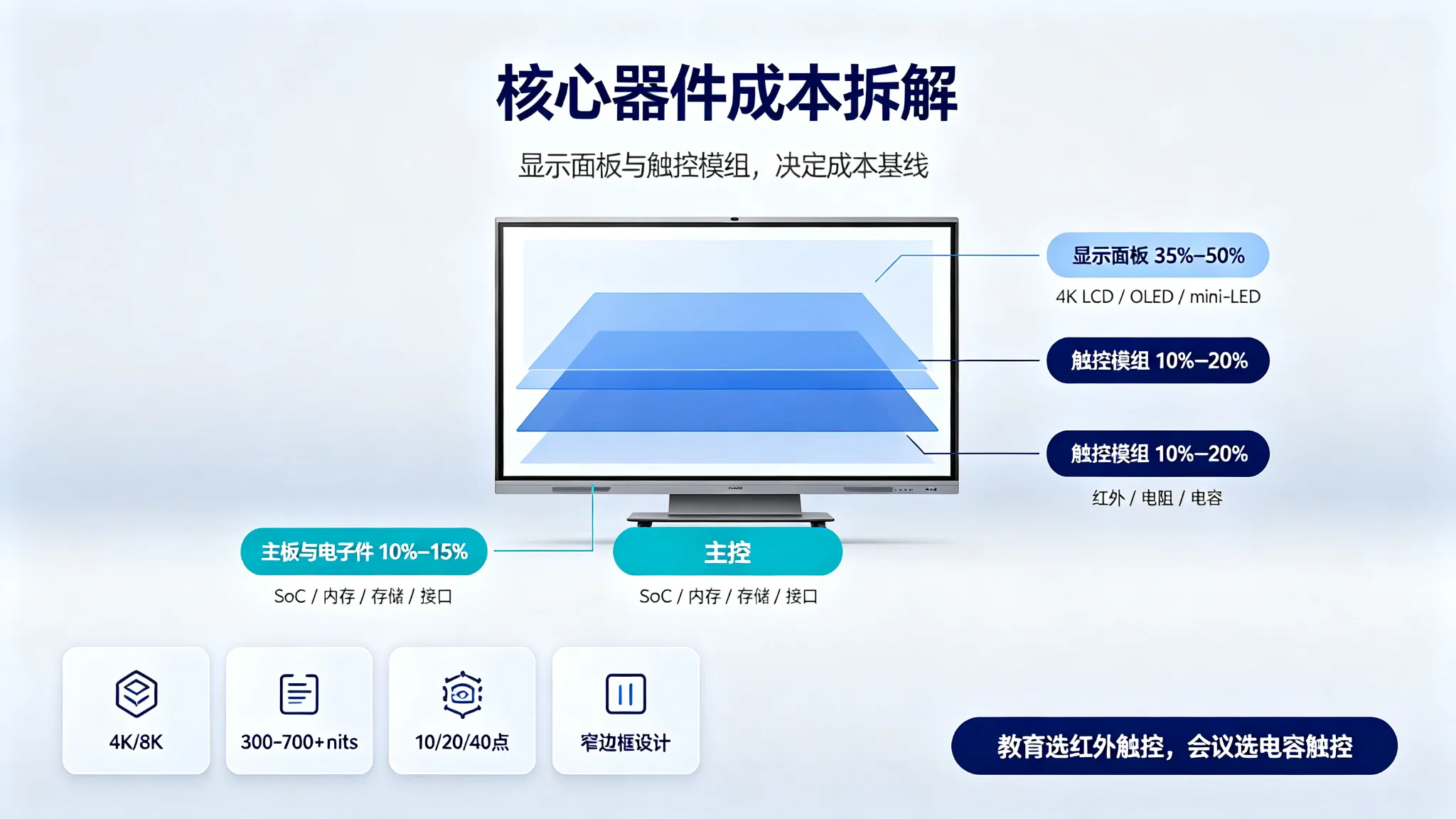
These four types of devices determine the cost baseline for an interactive whiteboard.
Cost dismantling of core devices such as display panels and touch modules
1. Display panel (35-50%)
Cost Drivers:
Dimensions (55/65/75/86/98 inches)
Resolution (FHD/4K/8K)
Brightness (300-500 nits vs 700 nits)
Contrast, visual angle
Panel type (LCD/OLED/mini-LED)
📊Qtenboard procurement recommendations: Education scenarios recommend 4K LCD 300-400 nits, cost-effective; high-end meetings consider 500 nits, high contrast or mini-LED. The supplier is required to provide the panel model and complete specifications to avoid false labeling of parameters.
🏭Qtenboard vertical integration advantages: The structural parts (metal sheet metal and plastic injection molding) are all completed in the own 330,000 ㎡ park, reducing outsourcing price increase, controllable cost and high quality consistency. Education scenarios recommend durable aluminum alloy frame mobile bracket; enterprise meetings recommend narrow frame wall bracket.
3. optional components and function modules (3-8%)
These "optional configurations" can significantly affect cost and experience.
The ex-factory price is not the same as the hand price, and these costs must be included.
Logistics costs: Shipping vs air, package size and weight affect freight, insurance and customs clearance costs.
Duties and Taxes: National tariff policies, value added tax, free trade agreements (RCEP, USMCA)
Localization costs: Local warehouse and distribution, installation and training, after-sales and spare parts support
🌍Qtenboard international certification: CE / FCC / RoHS / ISO9001 / CCC is complete, helping customers quickly pass the compliance review of the destination country, saving certification time and cost. Service coverage 110 countriesIn cooperation with DHL, FedEx, Maersk and other head logistics, the packaging passed the ISTA drop test.
6. Qtenboard as an example: How vertical integration optimizes BOM costs
The cost competitiveness of an interactive whiteboard comes not only from procurement bargaining, but also from the vertical integration and scale effect of the manufacturing system.
Qtenboard (Shenzhen Qunmao) Cost optimization is achieved:
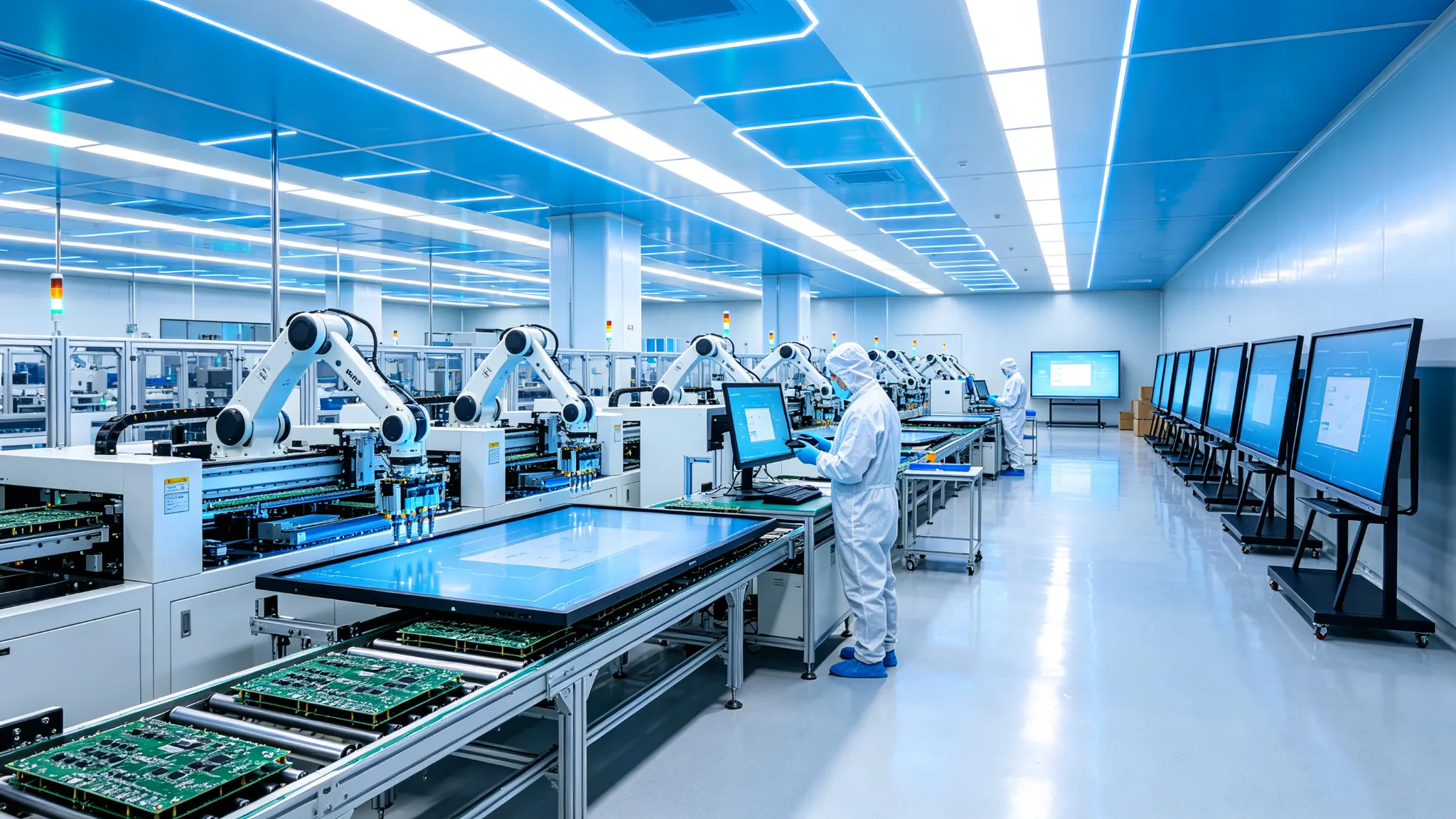
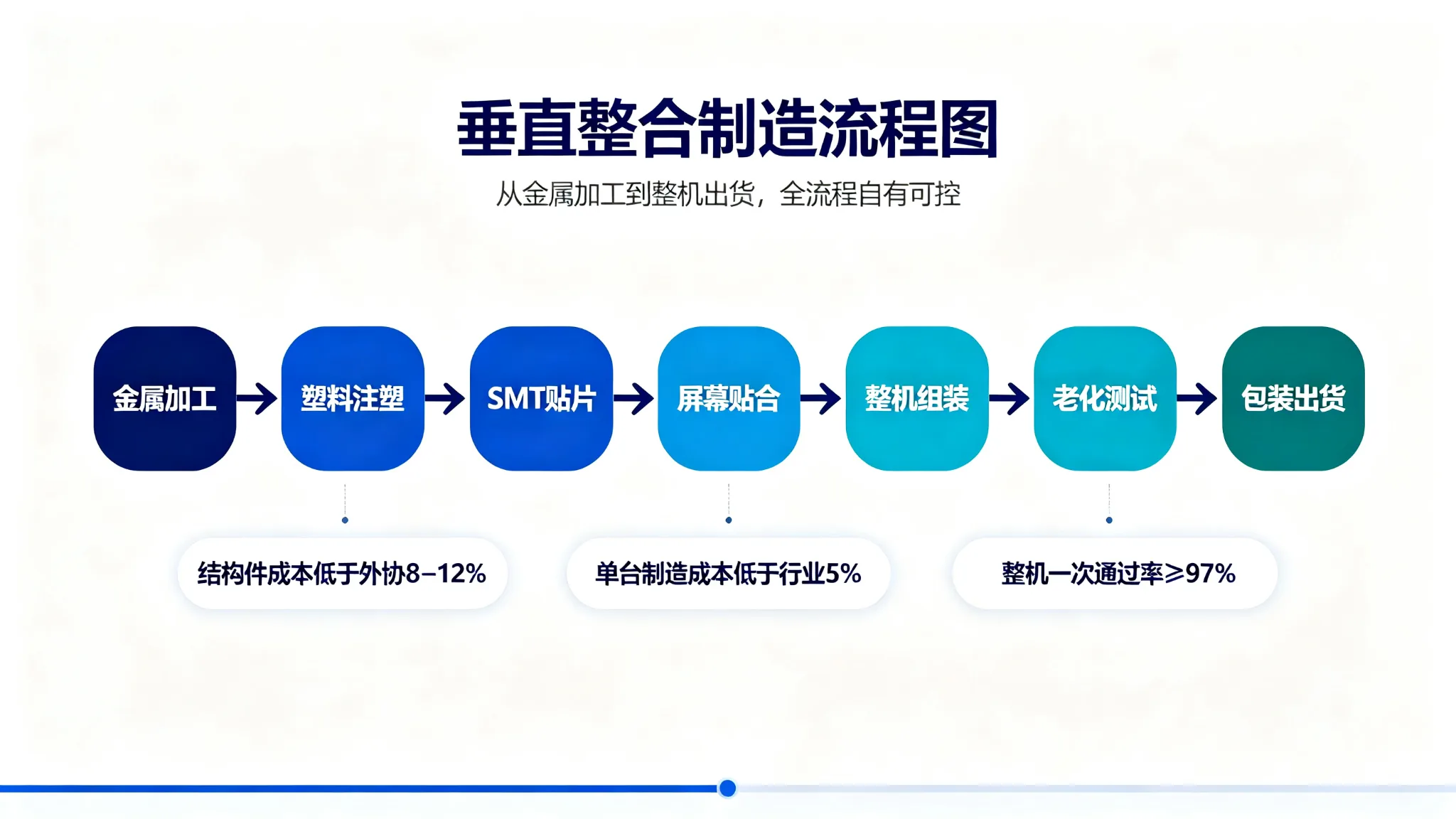
Qtenboard vertically integrated manufacturing process
Cost Drivers
Qtenboard Solutions
Value to customers
Cost of structural parts
Own metal processing (sheet metal, CNC, spraying) plastic injection molding, reduce outsourcing
The cost of structural parts is lower than that of outsourcing procurement. 8–12%
Panel Procurement
Annual output of 500000 units, with a number of panel factory to establish long-term agreements
Panel unit price is better than small and medium-sized factories 3–5%
Take this list to negotiate and avoid being misled by "low prices.
BOM list required -Including panel model, touch technology, motherboard configuration, structural parts material, etc., check item by item
Ask about the cost optimization space -- Which configurations can be downgraded without impacting the core experience? Which must be retained? Volume Discount Ladder?
Calculate Total Cost of Ownership (TCO) -purchase price installation training maintenance repair logistics tariff, rather than just looking at the unit price
Avoid parameter false labels -Require third-party test reports, actual cases, customer feedback, and compare multiple suppliers
Understanding Vertical Integration Capabilities -- Does the factory produce its own structural parts and mainboards? The higher the proportion of self-production, the more controllable the cost.
Confirm customization policy -- Does customization affect the delivery date? Is customization premium reasonable? Is there an independent production line?
Verification of international certification -- CE/FCC/RoHS/ISO9001, etc. are complete, can provide certification
9. Frequently Asked Questions (FAQ)
What is the largest part of the BOM cost of the interactive whiteboard?
Display panel, typical 35-50%. Size, resolution (4K/8K), brightness, contrast and panel type (LCD/OLED/mini-LED) jointly determine the upper cost limit. For models 98 inches and above, the panel cost may exceed 50% of the BOM of the whole machine, and the logistics and installation costs will also increase significantly.
Why is the price of the same 33.33cm-inch interactive whiteboard very different from different manufacturers?
The differences mainly come from the touch technology route (infrared/resistive/capacitive), motherboard and memory configuration, structural material (aluminum alloy vs plastic), audio/camera and other optional devices, as well as manufacturing yield, aging test input and after-sales system. Low price is not necessarily cost-effective, it is recommended to require suppliers to provide BOM details to check item by item, and according to the "purchase price installation training maintenance repair logistics tariff" to calculate the total cost of ownership (TCO) and then compare.
infrared touch and capacitive touch how to choose?
Infrared touch is low in cost, durable and easy to maintain, and is the mainstream choice for educational scenes; capacitive touch has higher precision and more delicate writing experience, but the cost is also higher, which is suitable for high-end conference scenes with high requirements for interactive experience. The touch module accounts for about 10-20% of the BOM as a whole. When selecting, attention should also be paid to the number of touch points (10/20/40 points), accuracy and response speed. Special industrial environment can be considered resistance touch, anti-interference, strong durability.
What are the differences between the configuration recommendations for an education scenario and an enterprise meeting scenario?
4K LCD(300-400 nits) infrared touch quad-core 4GB 32GB basic motherboard is recommended for educational scenarios, with high cost performance. The enterprise conference recommends 500 nits high brightness (or mini-LED) screen capacitive touch eight nuclear 8GB 64GB motherboard, and optional speakers, cameras and microphone arrays, and wireless screen projection modules to meet the needs of remote conferencing and multitasking.
Will ODM/OEM customization be expensive and slow?
Depends on whether the factory has an independent custom production line. Take Qtenboard as an example, standard products and customized parallel production, customized delivery period is only extended by 3-5 days, customized premium control within 10%. It is suggested to clarify the customization scope (Logo, startup interface, pre-installed software, structural material, etc.) first, and then let the supplier quote separately according to the scope to avoid paying for unnecessary customization.
Why does vertical integration reduce BOM costs?
Vertical integration of structural parts (metal sheet metal, CNC, injection molding), SMT patch, screen body bonding, assembly, aging test and other links in its own park to complete, reduce outsourcing price increase and intermediate links. Take Qtenboard as an example, the cost of structural parts is 8-12% lower than that of outsourcing procurement, the unit price of panel procurement is better than that of small and medium-sized factories by 3-5%, and the manufacturing cost of a single unit is lower than the industry average by 5%.
What information should be asked from suppliers when purchasing interactive whiteboards?
It is suggested to ask for: BOM list (panel model, touch technology, motherboard configuration, structural member material), third-party test report and actual customer case, CE/FCC/RoHS/ISO9001 and other certification certificates, description of one-time pass rate and aging test process of the whole machine, and customized policy (delivery date, premium, independent production line). Check item by item and then sign the order, can effectively avoid the parameter false standard and low price trap.
Conclusion: Only by understanding BOM can we make rational purchasing decisions.
The cost structure of the interactive whiteboard is complex, and the purchaser needs to comprehensively evaluate the multi-dimensional aspects of display, touch, electronics, structure, manufacturing, logistics, etc. BOM cost dismantling is not only a cost control tool, but also a window to judge the true strength of suppliers-a factory that can clearly explain its cost composition is often more transparent and credible in quality control and delivery.
Through vertical integration (metal processing, injection molding, SMT, self-produced by laminating) and scale effect (annual output of 500000 units), the Qtenboard optimizes BOM cost on the premise of ensuring quality and provides customers with cost-effective interactive whiteboard OEM/ODM services. We believe that a transparent cost structure is the basis for long-term cooperation.
If you need to obtain a detailed BOM disassembly sheet, arrange a factory visit or request a customized quotation, please contact the Qtenboard sales team.
 Current location:
Home
> News > Product News > Interactive Flat Panel
 Release date: 2026-10-12
 Clicks:0
 Partner Links:

 en
 中文

 Previous:
 Return to list