Current location:
Home
> News > Product News > Interactive Flat Panel
 Release date: 2026-09-28
 Clicks:0
From 2D atlas to 3D models, from organ stratification to case association, how Qtenboard help medical students understand human structure, spatial relationships, and clinical applications
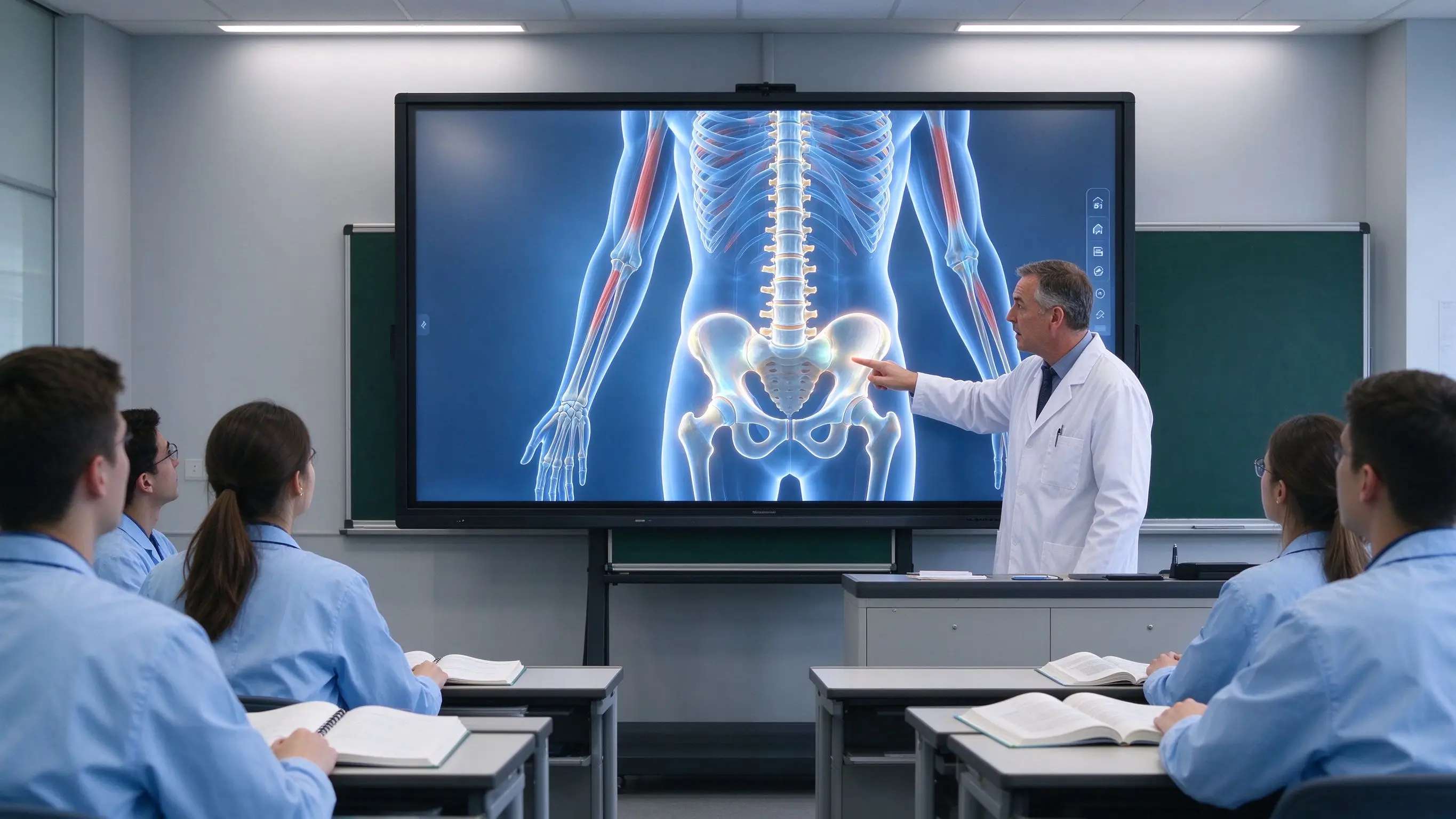
In the traditional anatomy class, teachers show static human body maps through PPT. Students need to imagine the spatial relationships between organs, blood vessels, nerves and bones in the brain. Teachers use different colors and arrows to repeatedly mark, but students face two-dimensional images, still difficult to understand the depth, level and direction. The difficulty of learning is further increased when the content involves CT, MRI, or surgical approaches.
Anatomy teaching is not only to let students remember "what is this", but also to let students understand "where it is, what is adjacent to it, how to move, and what will be the impact of pathological changes". Interactive whiteboards turn abstract structures into instructional objects that can be observed and discussed together through actionable images, models, and cases.
Qtenboard (Shenzhen Qunmao)Founded in 2005, we have been dedicated to interactive display manufacturing for 20 years. We operate a 330,000㎡ smart manufacturing industrial park in Shenzhen and Guangzhou, featuring eight fully automated production lines with a daily output capacity of 200 units. Our solutions serve 120 countries and regions worldwide, and we have provided services to over 15,000 corporate clients to date. The Qtenboard interactive whiteboard covers 55-110 inch full-size segments, is equipped with Q AI system-level framework and MediaTek Genio 520 platform, and has successfully served overseas medical colleges such as Kharkov National Medical University, providing a complete solution from hardware to software for medical anatomy teaching, imaging teaching and clinical skills training.
Before and after the relationship is not intuitive, the deep and shallow structure is easy to confuse, blood vessels, nerves and muscle levels are difficult to show at the same time. Students need to rely on spatial imagination to complete the transformation from two-dimensional to three-dimensional, and the relationship between different facets is not easy to establish. A 2025 study published in Frontiers in Medicine points out that traditional anatomy education relies heavily on two-dimensional images, which often struggle to effectively convey the complex spatial relationships of the human anatomy. The study of 169 medical students found that the continuous integration group of 3D models had significantly higher scores in both assessment stages (p < 0.05) and significantly higher satisfaction scores, especially in learning interest and teaching diversity.
Students can only look at the perspective prepared by the teacher, and cannot rotate and zoom freely. It is difficult to switch from the whole to the part. The relationship between different structures needs to be explained repeatedly by the teacher. In the traditional PPT demonstration, teachers can not adjust the observation angle in real time according to the students' understanding, and the teaching rhythm is limited by the preset content.
Students remember bone and organ names but do not understand clinical localization. There is a lack of correspondence between CT, MRI and anatomical atlas, and the surgical approach and puncture path are difficult to express intuitively. Case discussion usually requires switching multiple data. A systematic review shows that 3D printed heart models have a moderate learning improvement compared to traditional methods in teaching congenital heart anatomy. This suggests that anatomy teaching needs to connect the basic structure with clinical imaging and application scenarios.
The teacher operates the computer, the students just watch, only the front row students can see the details clearly, the students cannot participate at the same time, the remote students cannot directly operate the model, and the content is not easy to save and review after the class ends. These problems are particularly prominent in the anatomy teaching of large classes. The traditional configuration of a computer and a projection has been unable to meet the needs of interactive teaching.
Students can rotate bones and organs on the large screen, observe the front, back, side and oblique perspectives, understand the spatial direction of the structure, and compare anatomical landmarks at different angles. The Qtenboard supports 20-50 touch and 1.5mm touch accuracy, smooth rotation and zoom operation without delay, and is suitable for teaching complex areas such as joints, skull, spine and pelvic cavity. Qtenboard medical industry solutions support smooth scaling, rotation and annotation on 2D/3D diagnostic models, and teachers can use precise touch tracking to highlight anatomical paths and show synchronized 3D structural models.
Switch from human systems to specific organs, zoom in on blood vessels, nerves and tissue details, and show small structures and anatomical landmarks. Qtenboard 4K UHD resolution ensures that CT/MRI slices and small-scale structural labels are clearly readable, and AG anti-glare glass adapts to different lighting environments in anatomical laboratories.
Teachers can display the skin, superficial fascia, deep fascia, muscle, bone, blood vessels, nerves, internal organs and lesion areas by level. Through the hide, show, and transparent modes, students can see "what is under the surface structure". In the application case of Kharkov National Medical University, teachers use touch operation to accurately point out the names and functions of various parts on the image of the human body model, so that students can understand the knowledge points more intuitively.
Mark the structure name, add arrows and colors, circle clinically relevant areas, write down functions and risks, record student questions, and associate the structure in the model with the courseware text. The Qtenboard blackboard writing content can be saved with one click, which is convenient for teachers to organize electronic lesson plans and share review with students after class.
The 3D model is shown on the left, the CT/MRI slice is shown on the right, the case information is shown below, and the procedure or surgical video is shown next to it. Qtenboard supports simultaneous multi-window display and split-screen operation, enabling the comparison of multiple content sources on a single screen.
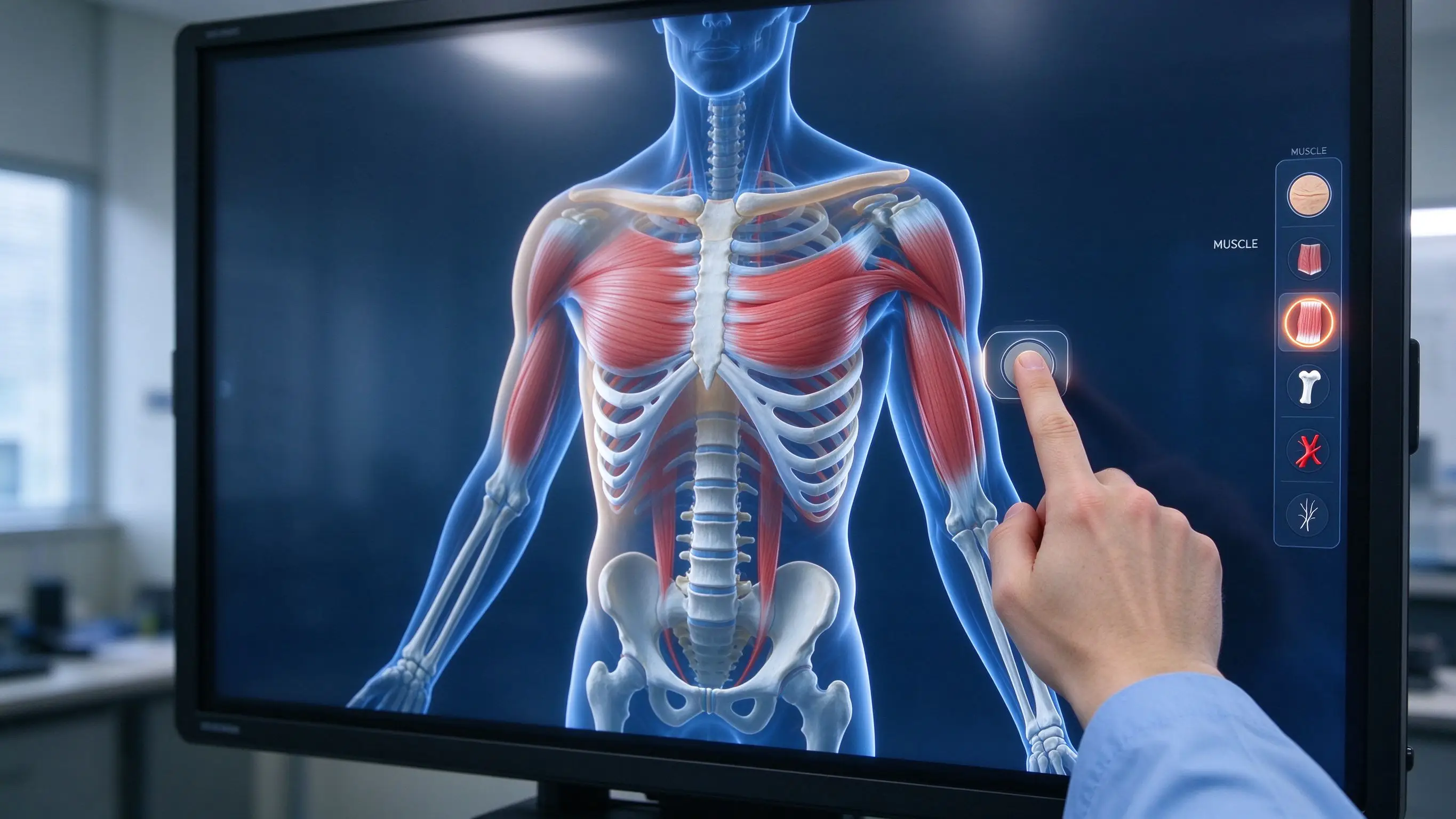
Teaching content:Skeletal system, muscular system, nervous system, circulatory system, respiratory system, digestive system, urinary system, reproductive system.
Qtenboard applications:Display the three-dimensional human body model, stratify according to the system, rotate the observation structure, distinguish different organs by color, let students locate the structure, save the classroom annotation and knowledge points. The Qtenboard's Smart Writing feature supports smart editing of handwritten strokes, converting hand-drawn annotations into digital content.
Teaching content:Head and neck, chest, abdomen, pelvic cavity, limbs, spine, joints.
Qtenboard applications:Zoom in on local areas, contrast superficial and deep structures, show muscle, blood vessel and nerve directions, mark surgical or puncture areas, and perform structural positioning exercises. The Qtenboard has been successfully applied to the anatomy course of Kharkiv National Medical University. The large 75-inch 4K screen ensures that students sitting in the back of the classroom can clearly see the teaching content.
Brain area structure, cranial nerve, spinal cord, nerve conduction path, lesion location, functional area. Interactive whiteboards can help students understand complex neurospatial relationships through color, animation, facets, and path markers.
CT, MRI, X-ray, ultrasound, three-dimensional reconstruction, normal and abnormal contrast. The structure is marked on the image, the three-dimensional model is compared, the different levels are switched, the anatomical structure is connected with the image performance, and the relationship between the lesion location and the surrounding structure is analyzed. The Qtenboard supports the import of real CT, MRI and DICOM data, and compares with 3D anatomical models on the same screen, helping students to establish intuitive cognition from slice to stereo.
Surgical approach, puncture location, catheter path, anesthesia-related structures, trauma area, tumor and lesion location, anatomical variation. Qtenboard Windows OPS module can run professional anatomy teaching software and image analysis tools to support teachers to create interactive courses.
Q AI is not a cloud plug-in, but a native intelligent architecture deeply integrated at the hardware, software, and algorithm layers. Core transcription runs locally on the device and can be used without an internet connection. In anatomy teaching, Q AI supports handwriting recognition and figure recognition, and the anatomical sketch drawn by students can be quickly converted into standard graphics or digital annotation. Q AI also supports real-time translation in 166 languages. For medical schools that accept international students, the anatomical terms explained by teachers in Chinese can be translated into English in real time to help international students understand complex anatomical structures.
The Qtenboard Genio 520 interactive tablet platform is based on the MediaTek Genio 520 (MT8371) chip, and the 8th generation MediaTek NPU is directly provided on the interactive tabletDedicated AI acceleration for 10 TOPS. In an anatomy teaching scenario, this means real-time handwriting recognition, shape correction, and gesture control all run on the device, with zero internet dependency, zero cloud latency, and zero data privacy risks.
Based on TSMC's 6nm FinFET process, the Genio 520 achieves high performance with low thermal output, which enables QtenboardFanless interactive tablet designMake it possible-essential for demanding acoustic environments such as anatomy laboratories and medical simulation centers. Fanless means zero noise, no moving parts and no maintenance cycles. MediaTek’s official commitment to the Genio 520 is10 year standard supply life cycle(EOL 2035), eliminating the risk of obsolescence of consumer-grade SoCs that are usually 2-3 years old, and hardware investment is fully protected for the head of procurement of medical schools who manage multi-year technology contracts.
Qtenboard DMS support for medical schools with multiple anatomy labs, imaging classrooms, and simulation centersCentralized device management. Administrators can monitor the health status, permissions, and updates of all devices in one background, without having to operate one by one. DMS supports management equipment grouping by building, grade or department, remote push system configuration, and unified implementation of usage policies. System updates can be pushed from the background with one click and reach all classrooms within minutes.
DMS also supports AI-driven predictive diagnostics, checking hardware parameters such as panel temperature, internal voltage and color values. If any indicator deviates from the normal range, the system will give early warning to avoid accidental downtime of the equipment during the teaching process.
| Size | Typical teaching scene | Qtenboard configuration |
|---|---|---|
| 65/75 inches | Small teaching group, anatomy classroom, nursing teaching | 4K, 20-50 touch, Android 14 |
| 86 inches | Standard anatomy classroom, imaging teaching classroom | 4K/5K, dual system, 20-50 touch |
| 98/105/110 inches | Large class teaching, medical simulation center, remote anatomy teaching | 4K, high brightness, independent OEM production line |
Dimensions should be confirmed in conjunction with classroom depth, number of students, model details and viewing distance. Qtenboard service support 120 countries and regions, after-sales response ≤ 4 hours.
Kharkiv State Medical University degree in Ukraine, is a well-known medical education institutions in Eastern Europe. In the process of education modernization, the school has made a forward-looking procurement decision-to introduce 10 sets of Qtenboard 75-inch interactive flat-panel displays, equipped with sliding green boards, for the teaching of core courses such as anatomy.
The 4K ultra-high definition resolution Qtenboard a large 75-inch screen ensures that the fine structure and complex pathological images of human organs are presented in extremely fine image quality, and students can capture every key detail. High-brightness and high-contrast screen technology ensures that the content is clear and readable under different lighting conditions, and even students sitting in the back of the classroom can easily see the teaching content.
The touch functionality greatly enhances classroom interactivity. In the anatomy course, teachers can use touch operation to accurately point out the names and functions of various parts on the image of the human body model, so that students can understand the knowledge points more intuitively. The teacher's writing and labeling can be saved in real time, which is convenient to organize the electronic lesson plan after class and share the review with the students.
The design of the sliding green board skillfully combines traditional teaching tools with modern technology-teachers can use the green board to write when a large number of blackboard deduction is needed, and when electronic materials or video courses need to be displayed, the green board can easily slide to reveal the interactive tablet behind. This flexible switching mode meets the diverse teaching needs of teachers.
The anatomy laboratory of a medical university used the traditional configuration of projector and computer before. When the teacher demonstrated the 3D anatomy software, the students could only watch it. The students in the back row could not see the details clearly and the students could not directly operate the model.
After deploying Qtenboard 86-inch interactive whiteboard, teachers can rotate the three-dimensional human model on the large screen, hide the tissue layer and mark the key structure. Students take turns to operate on the stage, rotate and zoom the model with their fingers, and mark possible lesion areas on the image and 3D model. The Qtenboard-supported structured editing function on the blackboard allows teachers to quickly adjust the word order of text through hand-drawn displacers, making it easy to organize anatomical terms and notes. The Windows OPS module runs professional 3D anatomy software smoothly, and the switching time is <3 seconds. Classroom participation was significantly improved, and the frequency of classroom questioning by teachers in the back row of students was significantly increased.
Use real course content for acceptance, don't just play promotional videos. Focus on the details of bone, muscle, blood vessels and nerves, the gray scale performance of CT/MRI slices, the readability of small font structure labels, multi-window display effect, long-distance readability, and the image reflection and color consistency. Qtenboard 4K UHD resolution and AG anti-glare glass stand out in these dimensions.
Test the smoothness of model rotation, scaling and dragging, multi-point operation response, structure selection and hierarchical hiding, annotation and undo, multi-student operation at the same time, and touch consistency under Windows and Android. The Qtenboard touch accuracy is 1.5mm, single-point response time is 7ms, and multi-point response time is 10-15ms, ensuring the accuracy and real-time operation.
Confirm 3D model running fluency, educational software compatibility, medical image import and display, file saving and export, network and offline use, remote conference connection, and account and rights management. Qtenboard Android Windows OPS dual system can run mainstream 3D anatomy software and medical teaching platform.
Whether teachers can quickly switch content, whether students can see clearly the structure, whether many people can participate, whether remote students can view synchronously, whether teachers can save courseware and annotations, and whether teaching content can be reused after the end of the course. The Qtenboard wireless screen projection supports up to 9 devices to connect at the same time, and remote students can directly participate in the model operation through the cloud whiteboard.
The display itself does not automatically produce three-dimensional anatomy teaching. Software, models, licenses, and course content should be identified. The Qtenboard supports pre-installation or configuration of professional medical software entrance, and the software license is provided by the school or software manufacturer.
The virtual model is suitable for spatial observation and structural explanation, and the physical specimen still provides tactile, texture and real organizational experience. The best program is a combination of digital, specimen and teacher guidance. The study also points out that 3D models have limited impact on long-term memory and final exam scores and need to be strategically integrated rather than simply replaced.
3D models, images, and multiple windows require sufficient computational performance. Android not necessarily support all professional software, Windows OPS or external workstation should be tested in advance. The Qtenboard OPS module is based on the Genio 520 platform and is available in i5/i7 configurations.
Real cases and medical images may contain patient information. Teaching data needs to be de-identified and access control. Q AI core transcription runs locally, reducing data privacy risks. DMS supports setting access permissions by classroom.
Classroom performance also depends on touch, software, camera, audio, installation, and teacher training. Complete scene acceptance shall be done. Qtenboard provide OEM/ODM customization and prototype testing, it is recommended to use real anatomy course content acceptance.
Can the interactive whiteboard run 3D anatomy software?
It depends on the software platform, system version, and computing power. Basic content can run in Android environments, but professional 3D models, medical images, and complex renderings should often be evaluated Windows OPS or external high-performance computing devices. Qtenboard Android Windows OPS dual system switching time <3 seconds, support mainstream 3D anatomy software operation.
What size does medical anatomy class choose?
Small teaching groups may consider 65 or 75 inches; large classes, medical simulation centers, and distance learning may consider 86 or 98 inches. Finally, it should be confirmed by combining the depth of the classroom, the number of students, the details of the model and the viewing distance. Sizing recommendations are available Qtenboard covering 55-110 inch full size segments. Kharkiv State Medical University selected 75 inches for the standard anatomy classroom.
Do you need 4K?
If you need to show CT/MRI, complex anatomical models, small structures and multi-window content, 4K is usually more valuable. But input files, software, OPS performance and actual viewing distance are equally important. Qtenboard 4K UHD resolution ensures fine print labels and image details are clearly readable.
Can Qtenboard pre-install anatomy software?
Pre-installed or configured software portals can be evaluated based on software licensing, system compatibility, and project requirements. Professional medical software licenses are usually provided by schools or software vendors and need to be confirmed at the project stage. Qtenboard support OEM/ODM custom pre-installed applications and software entry.
Can an interactive whiteboard connect to a PACS or hospital system?
Connectivity depends on interface, data format, network security, and hospital IT policies. It is suggested that technical verification should be carried out through the identification data first, and the clinical core system should not be directly accessed without approval. Qtenboard Windows OPS supports professional medical image viewing software, and local operation does not affect the hospital network security architecture.
Does Qtenboard support OEM/ODM medical education projects?
Logo, UI, startup interface, language, OPS, camera, microphone, stand, pre-installed applications and device management requirements can be evaluated according to the project. A dedicated OEM production line ensures that customization does not affect the delivery schedule of standard products; the lead time for custom orders is extended by only 3–5 days. The CKD/SKD local assembly model helps partners reduce tariff costs and meet localization requirements in government procurement.
If you are planning a medical anatomy classroom, medical simulation center, or remote anatomy teaching program
The Qtenboard provides 55-110 inch full-size interactive whiteboard, Q AI system-level framework (166 language, local operation, 5-second minutes), Genio 520 platform (10 TOPS device-side AI, fanless mute design), DMS device management and OEM/ODM/CKD/SKD customization services.
Get a guide to Qtenboard medical education options, or book a factory tour and prototype testing.
 Partner Links:

 en
 中文

 Previous:
 Return to list