Current location:
Home
> News > Product News > Interactive Flat Panel
 Release date: 2026-09-29
 Clicks:0
From product display, interactive shopping guide and personalized configuration, to inventory inquiry, customer retention and multi-store content management, analyze how interactive whiteboards promote the transformation of physical stores from display to display.
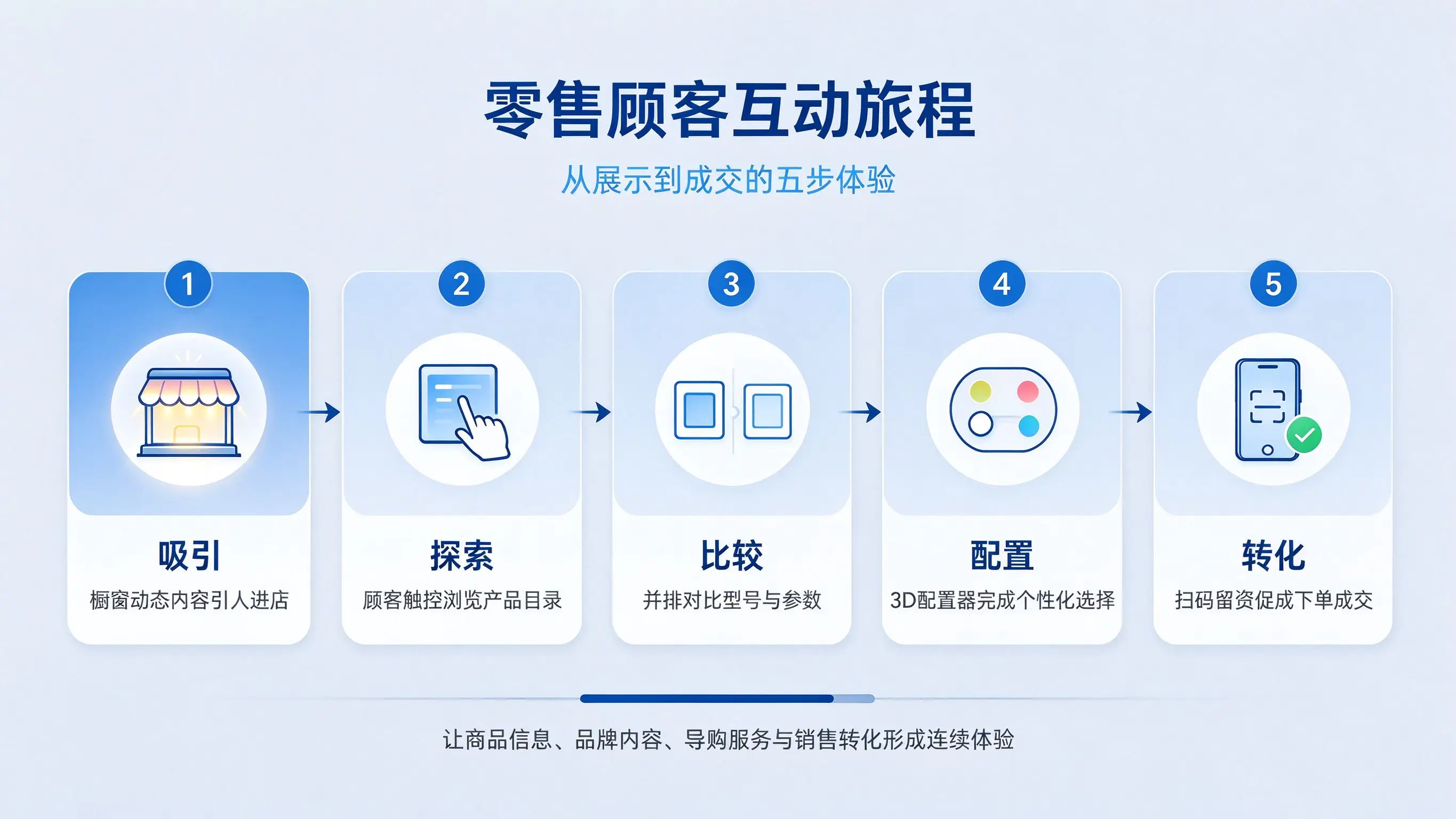
The pain point of traditional stores is not that customers cannot see the goods, but that the information of the goods depends on paper price tags and the introduction of sales personnel. The display space is limited and all colors, specifications and combinations cannot be displayed. Customers need to ask the guide repeatedly to compare different products. The functions and usage of complex products are difficult to explain through static posters. The update of store promotion information relies on manual replacement of materials, and the brand content and activity information of different stores are not uniform.
The value of interactive whiteboards in retail stores is not to allow customers to see one more screen, but to allow product information, brand content, shopping guide services and sales conversion to form a continuous experience. Retail interactive displays can be used for product education, dynamic promotions, real-time inventory, interactive catalogs, endless shelves, and product configurators; their effectiveness should be evaluated by dwell time, number of interactions, code sweeps, retention, and sales conversions. Industry data shows that interactive digital signage can increase participation by up to 47% compared to static images, and digital signage gets 400 percent of the attention of static displays. The global retail digital signage market is expected to reach $21.2 billion billion by 2034, representing a compound annual growth rate of 12.7 percent.
Qtenboard (Shenzhen Qunmao)Founded in 2005, we have been dedicated to commercial display manufacturing for 20 years. We operate a 330,000㎡ smart manufacturing industrial park in Shenzhen and Guangzhou, comprising 16 factory buildings and 8 fully automated production lines, with a daily output capacity of 200 units, serving customers in 120 countries and regions worldwide. The Qtenboard product line covers interactive whiteboards, LCD video walls, digital signage, touch query all-in-one machines, self-service kiosks and transparent OLED displays. It has provided retail display solutions for global brands such as Adidas, Anta, Chanel and DJI, and a complete solution from hardware to CMS content management for retail stores, brand showrooms and commercial spaces.
The display area is limited, the color, size and configuration cannot be fully displayed, complex products need a lot of explanatory text, paper materials are easily outdated, and customers are difficult to screen quickly. In the car showroom, a real car can only show one color and configuration, and customers want to see other options can only be described through the album or sales staff. In furniture stores, the limited exhibition area cannot display all sizes and material combinations at the same time.
Home appliances need to show working principles and usage scenarios, cars need to show configuration, interior decoration and functions, furniture needs to show different space collocation, and digital products need to show software interface and usage methods. Static posters are difficult to convey a dynamic experience, and customers need to imagine the effect of the product in actual use.
Different shopping guides have different levels of product knowledge, long training cycle for new employees, customers need to ask the same information repeatedly, and complex products are prone to parameter interpretation deviation. A shopping guide may face multiple customers at the same time, unable to provide adequate product explanation for each customer, and the information customers get when they arrive at the store at different times may also be inconsistent.
Promotional activities require replacement of posters, price and inventory changes cannot be synchronized in real time, content versions in different stores are inconsistent, and offline material production and logistics costs are high. A national chain brand may need to produce and distribute thousands of items per promotion, and it usually takes 1-2 weeks from design to store shelves.
Customers did not leave data after seeing the products. The brand did not know what the customers paid attention to, could not analyze which products were viewed most, and it was difficult to judge whether the interactive screen really brought sales. Dozens or even hundreds of customers visit the store every day, but brands cannot obtain valuable data such as the products that customers care about, the time they stay and the models they compare.
Product specifications, color and size, function description, use steps, maintenance guide, frequently asked questions, user evaluation, related videos, supporting products. Qtenboard 4K UHD display and 20-50-point touch to ensure product images and video details are clear, customers can touch zoom to view material texture or functional details.
Customers browse by themselves, screen by price, function, size and scene, check the goods not displayed in the store, compare products, generate a list of interested goods, and take away the content through two-dimensional code. The Qtenboard supports vertical screen and horizontal screen installation, and can be flexibly configured according to the store space.
Suitable for car color/model and interior configuration, furniture size/material and combination, kitchen/wardrobe and space customization, computer/mobile phone and digital products, luxury goods and jewelry customization. The interactive configurator allows customers to select colors, materials, features and accessories in real time, and view product changes and prices. The Qtenboard Windows OPS module supports running professional 3D configuration software.
Show solutions, compare models, demonstrate operations, calculate portfolio prices, view inventory, generate quotes, record customer requirements, and connect to CRM. The Qtenboard supports multi-window display, and the shopping guide can display product pictures, parameter comparison and price information at the same time.
Brand development history, production process, material source, design concept, product development story, sustainable development content, flagship product interactive display. Qtenboard LCD video walls and transparent OLED displays can be used to create immersive brand display spaces.
Record interactive products, count clicks and stays, count code scanning and retention, analyze popular models, observe functions that customers are most concerned about, and evaluate the effects of different stores and locations. Qtenboard CMS supports content playback statistics and interactive data logging.
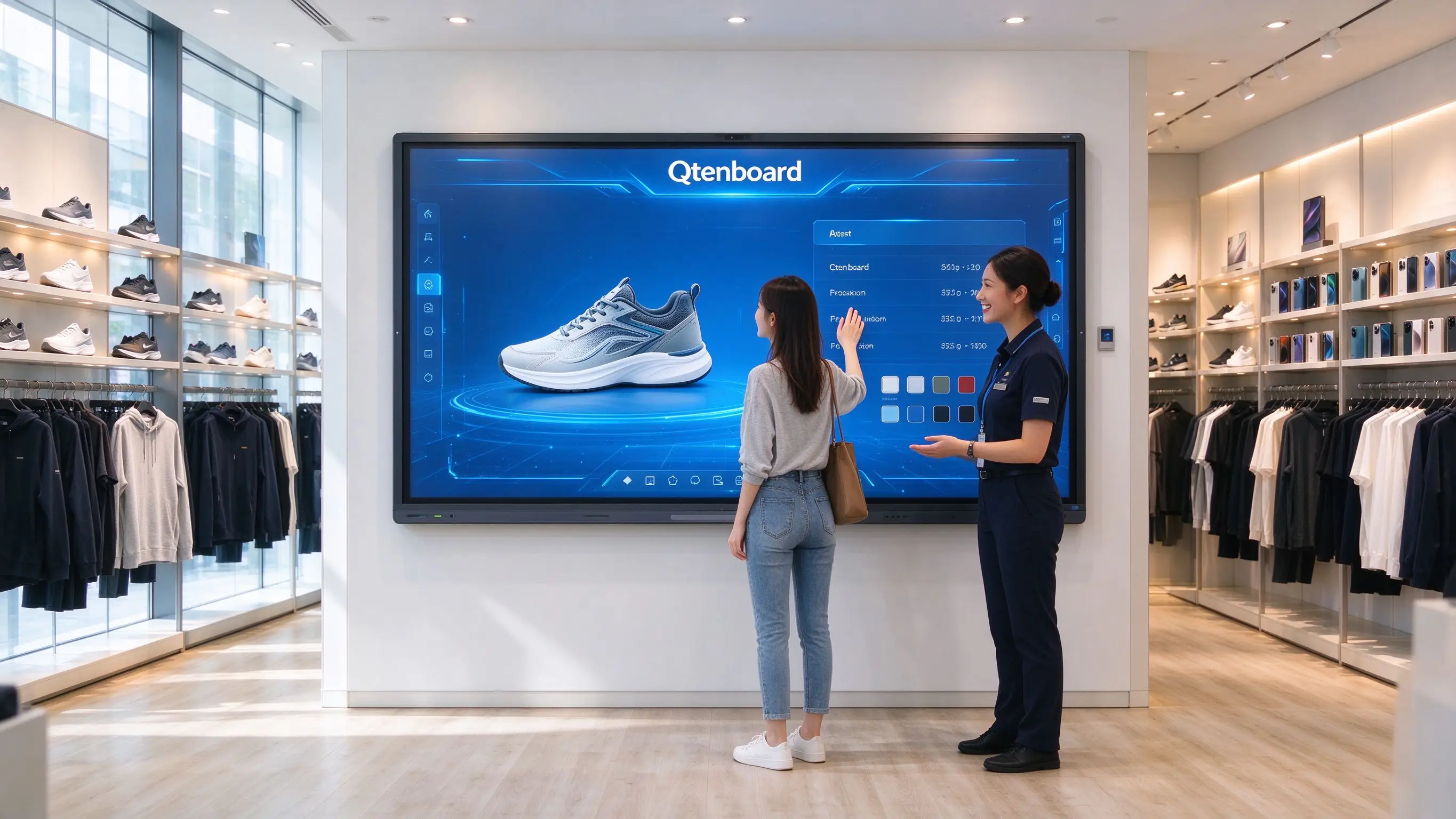
Interactive content:Model comparison, exterior and interior configuration, color and wheel selection, optional package, price and financial plan, vehicle size, endurance and power parameters, test drive appointment.
Commercial Value:Help customers understand complex configurations, reduce sales repeat presentations, improve customer stay time, and facilitate test drives and lead retention. Qtenboard interactive display table has been applied in the scene of automobile exhibition hall. Customers can browse vehicle information by themselves, and sales staff can complete scheme demonstration and configuration confirmation through the same screen.
Interactive content:Furniture size and material, room layout, kitchen cabinet combination, color/door panel and countertop configuration, lighting and space effects, 3D room simulation, budget real-time changes.
Commercial Value:Let customers see customized results, reduce the gap between imagination and actual results, help sales quickly generate solutions, and shorten the time from consultation to quotation. Qtenboard Windows OPS support for running 3D space design software.
Interactive content:Function comparison, product video, use steps, equipment connection, parameter screening, supporting product recommendation, inventory and online order.
Commercial Value:Improve the understanding of complex products, reduce sales pressure, guide joint sales, support online and offline integration. Qtenboard digital signage supports CMS to update prices and promotions remotely.
Interactive content:Different colors and sizes, matching recommendations, virtual fitting, makeup and style display, inventory inquiries, online orders and store self-delivery.
Commercial Value:Improve personalized experience, solve the problem of limited store inventory, promote the purchase of related goods, increase member registration and customer data.
Interactive content:Product story, material and process, design details, limited series, personalized customization, private consultant demonstration, global series display.
Commercial Value:Strengthen brand value, provide a more immersive customer experience, support the explanation of high-cost goods, and integrate digital content with physical products. Qtenboard provides retail display solutions for global luxury brands such as Chanel.
Interactive content:Project master plan, building and unit type, lighting and orientation, decoration scheme, surrounding transportation and supporting, 3D space and virtual roaming, price and payment scheme.
The entrance or window displays dynamic content, uses clear brand vision and product selling points, attracts customers through interactive prompts, and avoids playing only silent circular advertisements. Qtenboard suspended double-sided window digital signage is designed for glass facade and indoor retail space, which can maximize street side traffic and store participation.
Let the customer select the product category, narrow the scope by filtering, use the image/video and animation explanation function, and set a clear "start experience" button.
Display different models side by side, compare prices/functions/sizes and applicable scenes, highlight differences with colors, and allow customers to save and pay attention to products.
Personalized selection is completed through the configurator, real-time inventory is viewed, recommendation combinations are generated, and the shopping guide continues to explain according to the customer's operation results, providing reservation/trial/quotation or purchase entrance.
Scan the code to obtain commodity information, leave your mobile phone or email, make an appointment for a test drive/room or experience, join a member, place an order directly or jump to the e-commerce platform, and generate sales leads. Qtenboard kiosks support built-in thermal printers, QR scanners and POS terminals for direct orders and payments.
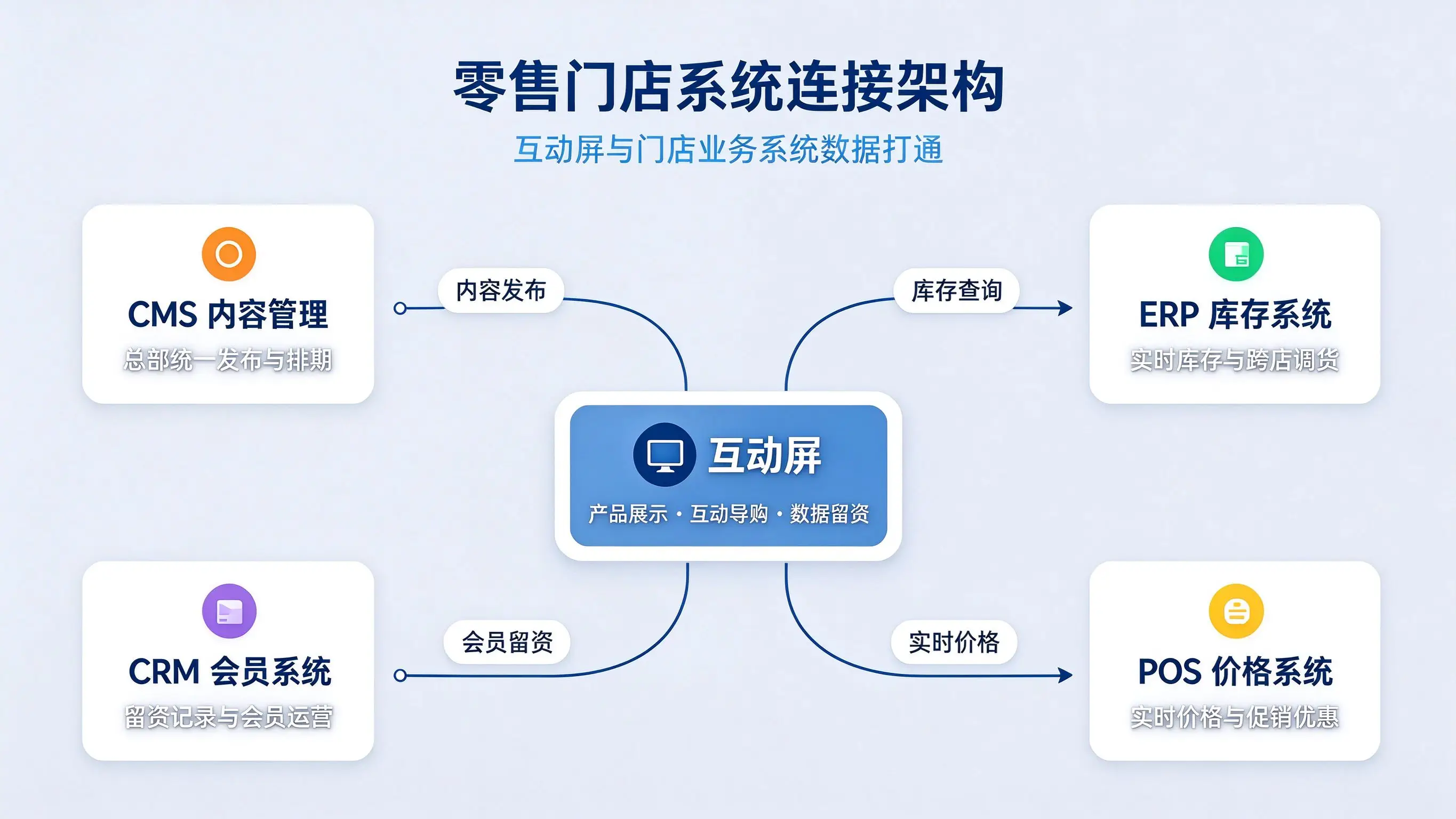
Qtenboard CMS supports the headquarters to uniformly release content, update by store/region and activity, set content playback plan, manage pictures/videos/prices and pages, and record the online status of equipment. CMS supports ambient brightness scheduling, offline playback of local content cache, heartbeat-based fault alarm, and group batch control in unlimited areas. Qtenboard CMS can also be deployed under corporate private brands and domain names, and the login interface and customer reports display corporate logos.
View inventory in real time, recommend products from other stores or warehouses, display products that can be ordered but not displayed, and support online ordering and store self-delivery.
Record customer browsing, provide personalized recommendations, register members, generate sales leads, and connect subsequent marketing.
Display real-time prices, calculate configuration combinations, generate quotes, associate promotions and offers, and reduce the risk of expired paper price tags.
Qtenboard DMS supports remote on and off, batch upgrade of applications, monitoring of screen status, management of store permissions, remote troubleshooting of network and software problems, and unified management of stores nationwide. In a real-world deployment case, a group reduced the IT labor time required to update equipment from 4 working days to less than 20 minutes by Qtenboard CMS, which was completed remotely by a single administrator.
The Qtenboard provides a complete retail display product line: 55-110 inch interactive whiteboard, LCD video wall (43-75 inch, splicing gap 8mm to 0mm), 4K digital signage, vertical and wall-mounted advertising machine, touch inquiry integrated machine (15.6-32 inch, PCAP touch, built-in thermal printer and QR scanner), transparent OLED display (13.3-27 inch, transparency up to 45%), suspended double-sided window digital signage. Qtenboard video walls have been deployed in brand retail spaces such as Adidas, Anta, Chanel and DJI, covering everything from a single flagship feature wall to cross-regional multi-store promotion projects.
The Qtenboard supports brand Logo, splash screen, customized UI, product catalog, multi-language, configurator portal, POS/CRM interface, store-specific content, structure and bracket, and packaging. Qtenboard operates its own injection molding production line, handling everything from raw materials to finished enclosures in-house, and supports in-depth OEM/ODM customization. The CKD/SKD local assembly model helps brands reduce tariff costs.
REWE is one of the largest supermarket chains in Germany. Previously, member loyalty exchange relied on manual counters, with serious queues during peak hours and poor customer experience.
The system integrator deployed Qtenboard retail self-service kiosks for REWE, where customers can independently complete point inquiries, coupon selection and reward redemption through a touch screen. Integrated 80mm thermal printer and QR scanner, support self-printing redemption voucher. After deployment, the member exchange process was shortened from an average of 5 minutes to less than 90 seconds, the counter labor pressure was significantly reduced, and the member activity increased.
Selfridges is an iconic British department store. Customers often need to ask staff when looking for brands, restaurants and services in multi-storey spaces, which is inefficient.
Qtenboard kiosks are installed at multiple entrances and floors, customers can touch the brand location, restaurant information and floor facilities. After deployment, the number of visitor inquiries decreased by 30%, and the efficiency of customer autonomous navigation was significantly improved. This case demonstrates the real value of interactive displays to enhance the customer experience in a high-end retail environment.
Global brands such as Adidas, Anta, Chanel and DJI have deployed Qtenboard LCD video walls in their retail spaces. Qtenboard provide one-stop delivery from display panels, splicing controllers, video processors, installation hardware to CMS software, eliminating the risk of coordination with multiple component suppliers.
With Qtenboard CMS, brand headquarters can manage video wall content across all stores in one dashboard, remotely updating playlists by store, region, and event. The video wall supports multi-zone split-screen synchronization of content, and can play brand promotional videos and product promotional information at the same time. Projects range from a single flagship feature wall to cross-regional multi-store promotion, covering the Asia-Pacific, Europe and the Middle East markets.
| Indicator category | Traditional method | Qtenboard Programme |
|---|---|---|
| Customer interaction rate | Static poster, passive viewing | Increased engagement by up to 47% |
| Content updated | 1-2 week national goods production logistics | CMS remote update, completed in minutes |
| Store consultation volume | Rely on manual solutions | Self-service inquiries, consultation volume down 30% |
| Member Exchange Efficiency | Manual counter, about 5 minutes | Kiosk, 90 seconds to complete |
| Multi-store management | Store-by-store maintenance, IT labor 4 days/time | DMS remote management, IT labor <20 minutes |
| Merchandise display | Limited by store area | Endless shelves show all SKU |
The data is based on Qtenboard typical retail deployment scenarios and industry open research, with actual results varying by project size and usage.
Pilot project proposal:Select the entrance, cash register area, key category area or exhibition hall experience area, set a clear goal (such as code scanning, capital retention or product configuration), run for 30 days, compare the product attention and clue number before and after the interactive screen deployment, and adjust the content, location and interactive process according to the data.
Without touch tasks, customers cannot participate, and the equipment is just high-priced digital signage. The right thing to do: Design clear interaction processes and touch tasks.
Not only want to do brand display, but also want to do inventory inquiry, membership registration and sales quotation, too many functions will make users lost. Correct approach: each point first set a main goal.
After the promotion, the content is still playing, the price and inventory expire, and the store content version is chaotic. A Headquarters content lead and update mechanism should be designated. Qtenboard CMS supports multi-level content management and permission control.
Without CMS, inventory interfaces, and data statistics, interaction value is difficult to measure. Hardware, content, interfaces and operations should be purchased together.
Reflective light, glare, dust, customer touch and peak traffic can affect the experience. Field brightness, support, network and safety tests shall be performed. Qtenboard AG anti-glare glass and 9H tempered glass adapt to retail environment.
Cameras, code scanning, member login and retention will involve personal information. Data collection, consent, retention and access policies need to be clarified.
Should retail stores choose interactive whiteboards or digital signage?
Digital signage may be sufficient if primarily advertising and branded video, and interactive display or interactive whiteboard options should be selected if customer touch, product comparison, configuration, guide presentation and data retention are required. The Qtenboard offers two product lines at the same time, which can be flexibly combined according to the needs of the store.
Does the interactive screen have to be connected to the POS and inventory system?
Not necessarily. The initial pilot can use product catalogs and QR codes first; if the project requires real-time prices, inventory inquiries, online orders and store self-delivery, the interface with POS, ERP or inventory systems should be evaluated. Qtenboard CMS integrates with the ERP system.
Which retail industries are best suited for using interactive whiteboards?
Automotive, furniture, home, appliances, digital, real estate, luxury goods, educational products and customized goods are especially suitable, because these products often need to show a variety of configurations, scenarios and combinations. Qtenboard has provided display solutions for car showrooms, furniture stores, luxury brands and digital retail.
Can Qtenboard provide a 3D configurator?
The interactive display hardware can host 3D configurators, product catalogs, and interactive content. The Qtenboard Windows OPS module supports running professional 3D configuration software. The specific software is developed by the brand, system integrator or third party. OPS, GPU, interface and software authorization need to be confirmed in the project.
Does the Qtenboard support retail brand OEM/ODM?
Qtenboard support OEM/ODM customization of commercial displays, digital signage, kiosk, video walls and interactive tablets to evaluate Logo, UI, structure, system, packaging and localization project requirements. The Qtenboard has its own injection molding production line, from raw materials to the shell all independent production, support the depth of customization. The CKD/SKD local assembly model helps brands reduce tariff costs and meet localization requirements.
How do Qtenboard manage multi-store equipment?
Qtenboard CMS supports centralized cloud management, ads, menus, announcements or event videos can be published from one dashboard and pushed to all screens at once. Support LAN/WiFi and optional 4G/5G modules, support local cache offline playback and heartbeat-based fault alarm. In a real deployment, a group reduced IT labor time required to update equipment from 4 working days to less than 20 minutes by Qtenboard CMS.
If you are planning a retail store digital display or brand experience center project
The Qtenboard provides 55-110 inch interactive whiteboard, LCD video wall (43-75 inches, 8mm-0mm stitching), digital signage, touch inquiry all-in-one machine (15.6-32 inches, built-in thermal printer and QR scanner), transparent OLED display, CMS content management and DMS device management, and supports OEM/ODM/CKD/SKD customization.
Get a selection guide for Qtenboard retail display solutions, or book a factory visit and prototype test.
 Partner Links:

 en
 中文

 Previous:
 Return to list