
 en
 中文

 Current location:
 Release date: 2026-09-24
 Clicks:
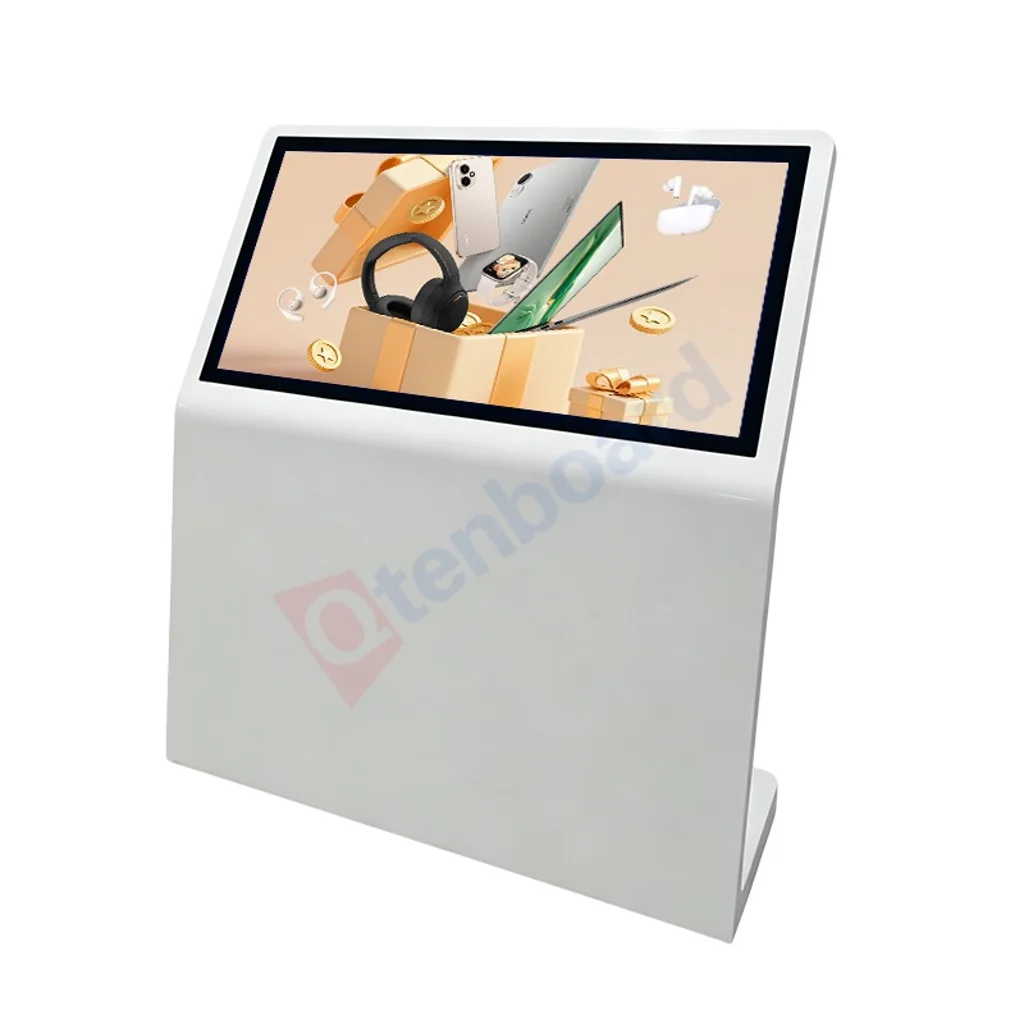
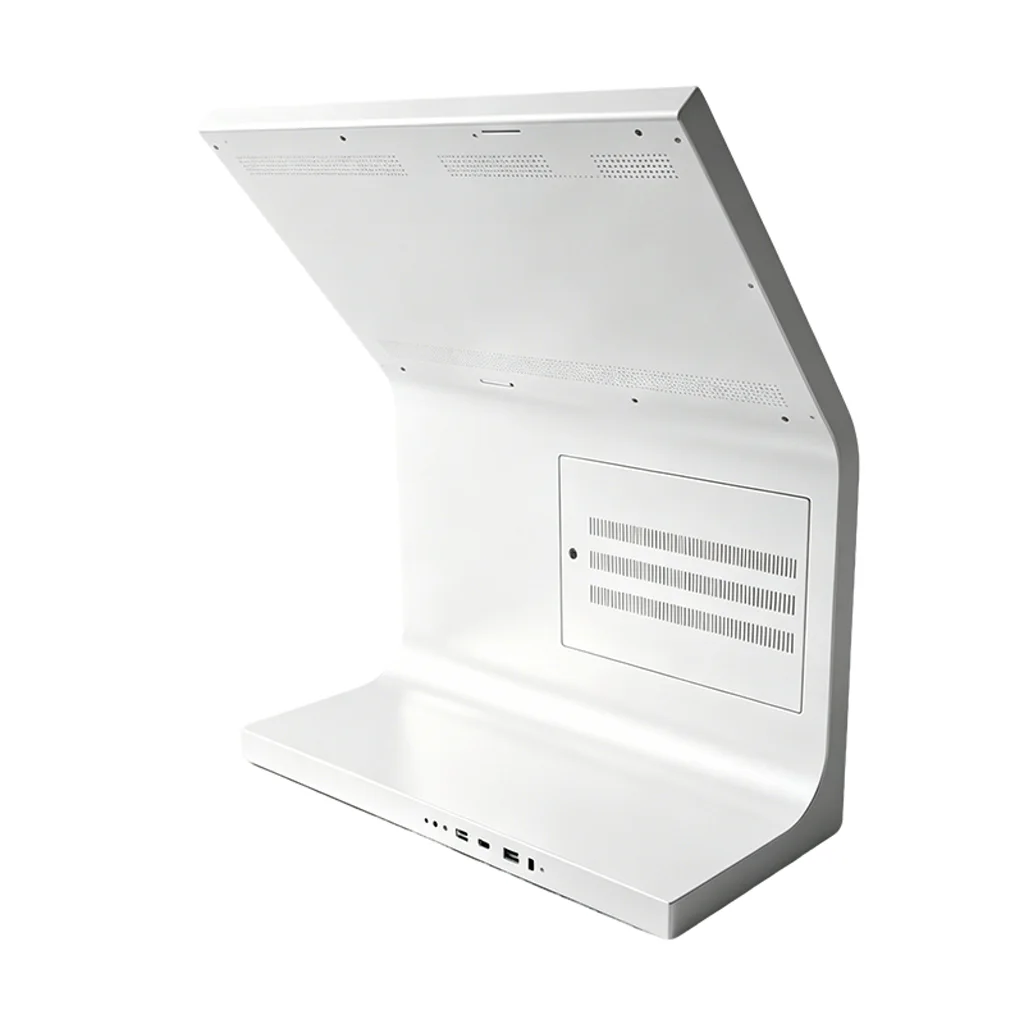
In the outpatient hall of the hospital, patients should find the department, check the expenses and print the report within a few minutes. In the exhibition hall of the enterprise, visitors should also be able to understand the products and leave their intentions when there is no one to explain. The requirements of the two scenes are different, but the same requirement is put forward for the inquiry terminal: the horizontal operation table top, the screen tilted to face the standing user, and the publicity leaflets and handling documents can be placed side by side on the table top. This is QUNMAO's configuration for hospital and showroom customers.L-type horizontal inquiry machineThe common needs observed at the time-also explain why these two types of projects coincidentally chose the L-type horizontal form.
From the perspective of manufacturers, this paper makes clear the functional planning, point design, UI interaction, system docking and procurement logic of the two application lines of hospital (outpatient/inpatient) and exhibition hall (product inquiry/interaction), and attaches a review of QUNMAO's landing deployment in Shenzhen Hospital and Shangchao Project for direct reference by integrators and project parties when writing bids and making plans.
1. Hospital and Exhibition Hall: Common and Different Requirements for L-Type in Two Scenarios
Looking at the two scenes side by side, the difference is clear, but the commonality is also obvious-both rely on a horizontal countertop device that can carry both "touch query" and "paper material. This is also the reason why the L-type horizontal inquiry machine appears most frequently in these two types of projects.
| Comparison dimension | Hospital Scene | Exhibition Hall Scene |
|---|---|---|
| Core demand | Information accuracy, accessibility, privacy (fees/reports) | Content display richness, interactivity, eye-catching |
| Typical functions | Department navigation, expense list query, report printing | Product inquiry library, interactive demonstration, retention registration |
| Target audience | Patients and their families (including the elderly and accompanying persons) | Visitors, potential customers, purchasing decision makers |
| Network Environment | Hospital intranet, docking with HIS/queuing system | Exhibition hall public network, take CMS remote content management |
| Operations and maintenance requirements | Quiet, low power consumption, 7 × 24 hours operation | Content remote update fast, support unattended |
| Countertop use | Put the guide list, payment documents, pens and notes. | Put promotional folds, product books, tablet demonstrations |
Why are both scenes preferred?L-type horizontal inquiry machine, instead of vertical I-type or inclined K-type? The key lies in the L-type horizontal operating platform: the table below the screen can be placed side by side with promotional folds and documents, and touch query is naturally matched with paper materials; while the vertical I-type has no table space, the K-type horizontal body is narrow and the table load is limited. For hospitals (many documents, long process) and exhibition halls (many materials, explanation and coordination), the L-shaped "inquiry table" combination is the form with the lowest experience cost.
2. Hospital Scenario: Point and Function Design of L-type Horizontal Inquiry Machine in Outpatient/Inpatient Department
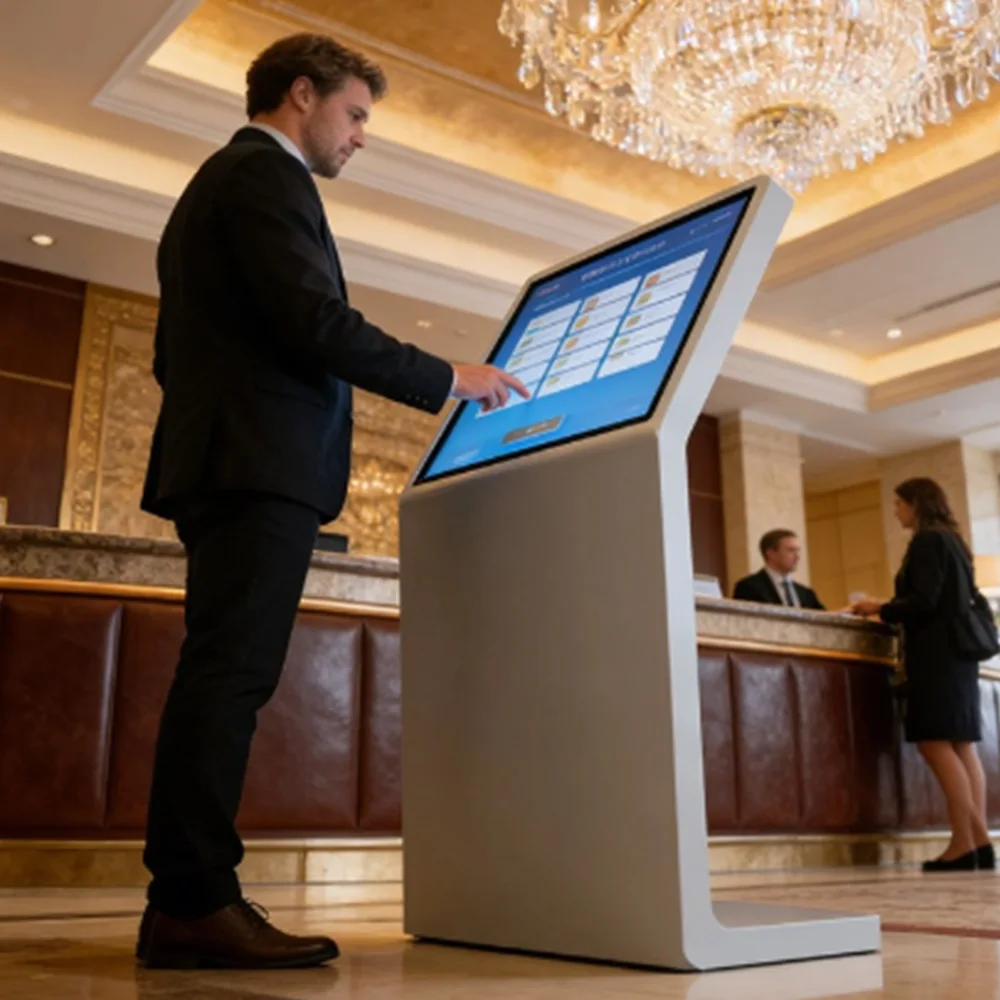
The hospital project is rightL-type horizontal inquiry machineThe acceptance criteria are "accurate information, usable by the elderly and guaranteed privacy". The deployment logic of the L-type horizontal query machine in the outpatient and inpatient scenarios is different, and it is recommended to split the planning by function. Functional design recommendations according to the navigation, cost, report three lines of disassembling planning.
Navigation requirements: floor index, department positioning, and medical path guidance
The first-level entrance is suggested to be organized according to the patient's real question method: "I want to find a department", "I want to have an examination" and "I want to take medicine". On the information architecture, the department index is divided into outpatient/inpatient/medical technology zones, and each department is equipped with floors, directions and walking prompts. When linking the calling number with the status of the clinic, real-time information such as "current waiting number" can be added. The retrieval method should support phonetic initials, handwriting and voice input at the same time-handwriting and voice in hospital scenes are just needed for elderly patients.
Cost inquiry requirements: list retrieval, medical insurance settlement information display and privacy blocking
Cost inquiry involves personal privacy and must be processed at both interactive and physical levels: interactive level, and the cost list will not be displayed until the medical card/ID card is verified. Physical layer, screen inclination and anti-peeping treatment should ensure that adjacent users cannot see the content clearly. When the background space is insufficient, the front maintenance structure should be selected. The height of the table top should be set according to ergonomics for standing operation to avoid bending over or tiptoe.
Report query requirements: linkage between identity verification method and printing
Inspection/inspection report query needs to support three verification methods: medical card, ID card and barcode/receipt. The query result page is directly linked to the printer. It is suggested to design "paper output after confirmation" for printing task to avoid paper waste caused by accidental touch. The contents of the report shall be coded and displayed according to the requirements of the hospital, and the name shall be desensitized.
L-type horizontal inquiry machine point planning recommendations: moving line, clearance and load-bearing engineering details.
Based on QUNMAO's site survey experience, the hospital points are recommended to be located according to four principles:Principle of moving line-- The first choice of the outpatient hall entrance line, within 5 meters of the guidance desk, the inpatient department is arranged according to the floor spacing, 1-2 sets per floor;Clearance principle-Leave no less than 900mm operation area and wheelchair rotation space in front of the equipment, and reserve maintenance access near the wall;load-bearing principle-- The ground of the landing type shall be leveled and load-bearing, and the reinforcement scheme shall be confirmed in advance for the wooden/overhead ground points;Protection principle-Anti-collision corner guards are installed at high-frequency pedestrian flow points, and cables are wired in hidden mode.
QUNMAO Site Methodology (E-Experience Landing):Before the start of each hospital project, QUNMAO engineering team will go to the site to do a point survey, output the point map including moving line, clearance, load-bearing, strong and weak current routing, and then determine the model and table size accordingly, so as to avoid rework of "the equipment is found to be unable to fit in the point only when it arrives.
Deployment content:There are 2 L-type horizontal inquiry machines beside the moving line at the entrance of the outpatient hall, which cover department navigation, expense list inquiry and report printing. One on the first floor of the inpatient department, responsible for floor index and hospitalization expense inquiry.
- System docking: through the hospital intranet and HIS interface docking, medical card/ID card verification after the retrieval of data, query and print log marks, data will not be discharged from the intranet.
- Interactive adaptation: large font mode is enabled by default, supporting handwriting and voice input, and navigation results with floor and direction guidance.
- Effect tracking: After going online, the hospital will make its own statistics according to the three indicators of utilization rate, average stay time and help-seeking rate. QUNMAO will provide background data export caliber.
Note: The customer name and specific acceptance data shall be desensitized according to the project file. If you need public supporting materials, please contact QUNMAO project team to provide them.
3. exhibition hall scene: L-type horizontal inquiry machine as product inquiry and interactive entrance
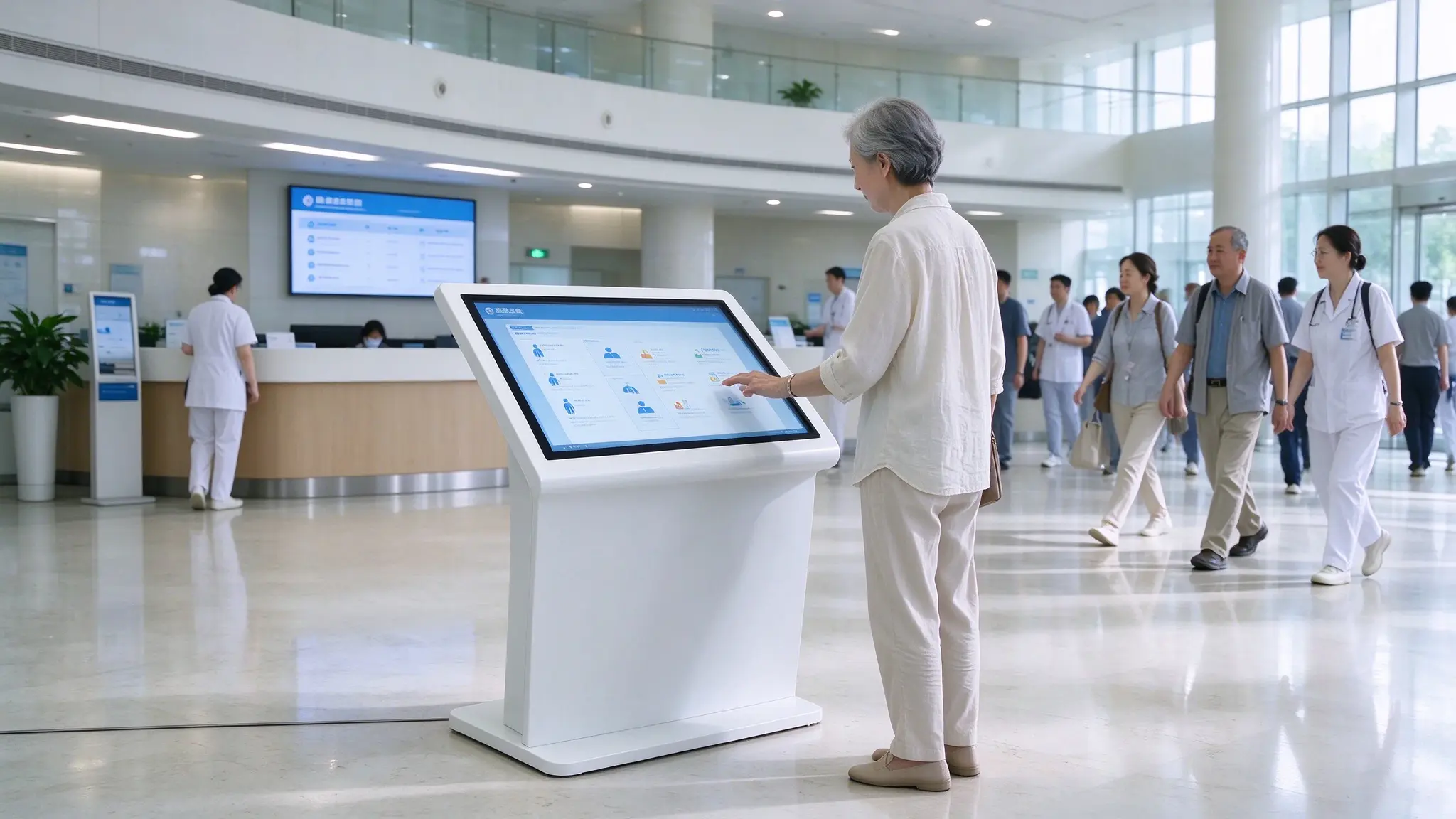
in the exhibition hallL-type horizontal inquiry machineWhat is undertaken is the "product entrance when no one explains": visitors check, see and save their own money, while the commentators concentrate on serving high-intention customers. An L-type horizontal inquiry machine is often the starting point of the interactive dynamic line of the entire exhibition hall.
Content Structure of Product Query Repository: Classification Tree, Retrieval and Multimedia Call
The product library is recommended to be organized according to the three-tier classification tree of "series → model → details". Each model is equipped with three types of materials: pictures, parameters and application cases. Search supports keywords, model codes and scene labels (such as "hospital" and "business super"). On multimedia calls, video and 3D presentation are prioritized for local caching to avoid showroom network fluctuations causing Caton.
Interactive Content Design: Touch Guide Rhythm and Retention Form Location
Touch dynamic rhythm suggests "light guidance, no competition": the first screen highlights the product entrance, and the second page only demonstrates the dynamic effect, so as to avoid waiting due to each screen moving. The retention form is placed at the node of "want to know more after checking"-I .e. the bottom of the product details page and the comparison result page. the fields are controlled at 3-5 items (address, company, phone/wechat), lowering the filling threshold.
Cooperate with manual explanation process
Two modes are available in parallel:Guide mode-The commentator first demonstrates the product with the L-type machine, then guides the scanning code to take away the data, and the machine assumes the "understandable" part;Unattended self-service mode-- Make scene-oriented navigation on the machine entrance page (such as "What kind of products do you want to know?"), and cooperate with the poster QR code to connect the online reserved capital back to CRM. The two modes share a set of content background, and the switching cost is close to zero.
Deployment content:One L-shaped horizontal inquiry machine at the entrance of the store and beside the fresh food area, which carries product inquiry, promotion activity display and member interaction.
- Content management: access to the supermarket CMS background, promotional posters and product information remote update, material version unified management.
- Interactive design: touch guides members to scan codes, and page stay data is counted by the background for operation and adjustment of content scheduling.
- Engineering details: floor-to-floor punching-free, ready-to-use in vertical placement, table top double as active material display position, power consumption reduced by timing shutdown at night.
Common Methodology of 4. Functional Planning and Content Design
No matter the hospital or the exhibition hall, the functional planning of the L-type horizontal inquiry machine can share a set of "information level" methodology:First screenOnly put high-frequency tasks (navigation/query/main product entrance), and control it within 6 entrances;Secondary PagePut task branches and detailed lists;Level 3 PageDetails and operations. Multi-language configuration according to the project area (common Chinese and English bilinguals in hospitals, common Chinese, English, Japanese and Korean in exhibition halls), switch the entrance fixed in the upper right corner. Barrier-free and suitable for aging are just needed by hospitals: the default font size is not less than 20px, the hot area is not less than 44 × 44px, and high contrast mode and voice broadcast are supported.
QUNMAO will provide the information architecture template and page copy specification simultaneously when it is delivered. The project party or integrator can directly fill in the content according to the template, and then submit it to QUNMAO to complete the interface adaptation and joint adjustment.
Key Points of UI and Interaction Design of 5. L-type Horizontal Query Machine
The interaction details determine the project acceptance perception, and the following points are recommended to be written directly into the technical response table:
- Touch Hotzone:Large fonts and large buttons are standard, and the hot area of the main button is not less than 44 × 44mm in physical size to avoid accidental touch;
- Anti-glare:Add anti-glare film to the window/window point to ensure that the picture is readable under strong light;
- Multi-angle visual:The tilt angle and height of the screen are designed according to the standing user, the tilt angle and table height of the L-type horizontal inquiry machine are factory adjustable, and the site is fine-tuned according to the point position;
- Silent mode:The hospital point turns off the prompt tone, leaving only the necessary vibration/light feedback.
Taking QUNMAO 43-inch model (QM-C43XJ-P,Android Edition) as an example, the touch and display parameters are: capacitive G + G touch, 20-point touch, precision ≤ 2mm, touch life 60 million times; 43-inch 1920 × 1080 resolution, brightness ≥ 300cd/-, contrast 3000:1, visual angle 89/89/89; the system RK3566S quad-core A55 (up to 2.0GHz), 2GB +32GB, Android GB; The standby power consumption of the whole machine is ≤ 1W, and the rated power consumption is ≤ 85W, which is suitable for 0c -55 c/10%-90% RH environment. The above are the real mass production parameters, and the specific configuration can be selected and upgraded according to the project.
System docking and content management of 6. L-type horizontal inquiry machine
Hospital side:It is recommended to adopt standard interfaces for docking with HIS and queuing and calling systems (database view/API/intermediate table are selected according to the safety requirements of the hospital) to query and print records and leave marks. On the data security boundary, the cost and report data are only read in the intranet of the hospital, the equipment does not cache sensitive data, and the cache content is not displayed in the offline state.
Showroom side:The content is updated remotely in the background of CMS, which supports grouping push and regular release by equipment. Material version management suggests "one version, one review, one archive" to avoid misdistribution of old materials online. QUNMAO's experience in system docking projects is:Confirm interface documentation and permission process in advance-- The interface opening cycle of the IT department of the hospital/Party A is often longer than the equipment production cycle. The earlier the docking evaluation is started, the more controllable the online time is.
7. Evaluation Dimension of L-type Horizontal Query Machine Deployment Effect
It is recommended to use assessable indicators instead of subjective feelings for the effect evaluation, and the project party will follow up on its own after going online:Utilization rate(daily query times/point stream of people),Average length of stay(The duration of a single interaction reflects whether the content is easy to understand),Error reporting/help seeking rate(The number of failures and on-site help, reflecting stability and ease of use). QUNMAO background can export query log and page stay data, aligned with the above indicators caliber; specific customer performance data based on project acceptance records, can apply to the QUNMAO project team for public support.
8. L-type horizontal inquiry machine procurement matters needing attention
The cost composition of the L-type horizontal query machine is recommended to be disassembled according to four logic to avoid only the screen price:Screen Specifications(size, resolution, brightness, touch type),Table body material and process(cold rolled steel/aluminum profiles, spraying, silk screen),System docking complexity(interface development, joint debugging cycle),Customized point transformation(Size, color, LOGO, cutouts). Each block has a clear price impact and should be itemized on the quotation.
QUNMAO fuselage adopts cold-rolled steel plate metal spraying process and aluminum profile frame to support customization of the whole machine size and appearance. Batch projects support factory pre-assembly and factory full inspection. Integrators can make an appointment for factory inspection, check the production process and quality inspection on the spot, and then sign batch orders.
9. L-type horizontal inquiry machine FAQ
Is it more appropriate to choose L-type horizontal inquiry machine or K-type horizontal inquiry machine for hospital scenes?
Depends on countertop purpose and functional complexity. If the hospital mainly focuses on navigation, cost and report inquiry, and needs to place documents and guidance materials on the table top, the horizontal table top of the L-type horizontal inquiry machine is more suitable. If registration and payment are the main factors and the table top demand is small, the operation experience of the K-type inclined plane machine can be compared. Both forms of QUNMAO have mass production models, and the specific selection can be combined with point and process evaluation-also welcome to compare our collation.Application Scheme of K-type Horizontal Inquiry Machine in Hospital(Self-service registration, payment and report query) for cross-form reference.
Does the L-shaped inquiry machine for the exhibition hall scene need an additional printer or visitor registration function?
According to the retention and material requirements, a thermal printer module can be installed if on-site ordering is required. If visitors need to register, they can add ID card reading or two-dimensional code scanning components, and the interfaces can be reserved at the factory. If the online retention is the main, it is recommended to take the form CRM return, do not add hardware. QUNMAO's L-type horizontal inquiry machine supports customization of peripheral reserved positions and openings according to projects to avoid damage to appearance by later installation.
What are the links involved in system docking from confirmation point to equipment launch?
The standard process is: point survey and scheme confirmation → L-type horizontal inquiry machine model/appearance customization production (including pre-assembly and factory full inspection) → interface docking (HIS/calling system in hospital and CMS in exhibition hall) → on-site installation and joint adjustment → content online and acceptance. The hospital project is recommended to advance the approval of interface documents and authority in parallel during the equipment production period. The overall cycle is longer than that of the exhibition hall project and needs to be reserved in advance. QUNMAO provides full process project follow-up and acceptance data support.
 Previous:
 Return to list

 Partner Links: