Current location:
Home
> News > Product News > Query machine
 Release date: 2026-10-21
 Clicks:0
A passenger arriving from overseas dragged his luggage out of the arrival hall. For the next 8 minutes, he will ask at least five questions to the people or equipment around him. The value of the inquiry machine is hidden in these problems.
| Time | Problems encountered by passengers | The answer that the query machine needs to provide. |
|---|---|---|
| The first minute | Out of the arrival hall, I don't know which way to go. | Current location and main destination: baggage pick-up, transfer, exit |
| Third minute | I would like to know when there is a bus for the rail transit to the city. | The departure time and platform of the last few shifts |
| The 4th minute | Not sure which exit to take, which route to take | Transfer route, exit number and surrounding facilities |
| The 6th minute | Do not understand the local language tips | Switch to your familiar language and use icons to understand the process. |
| The 8th minute | Find a restroom, mother and baby room or accessible elevator | Location of facilities and route available |
Each question is small on its own, but at the peak of passenger flow, hundreds of passengers ask questions at the same time, and there will be a long queue in front of the information desk. A query machine that is placed in the right place, has accurate information and can understand the language of passengers, which can "solve" most repeated problems on the spot ".
AsSource manufacturer of China touch query all-in-one machineQUNMAO Qunmao has long provided inquiry terminals for airports, stations, shopping malls, hospitals and other public places. We not only manufacture our own equipment, but also participate in the system docking and on-site delivery of the project. The following content comes from the practical experience of these two aspects.
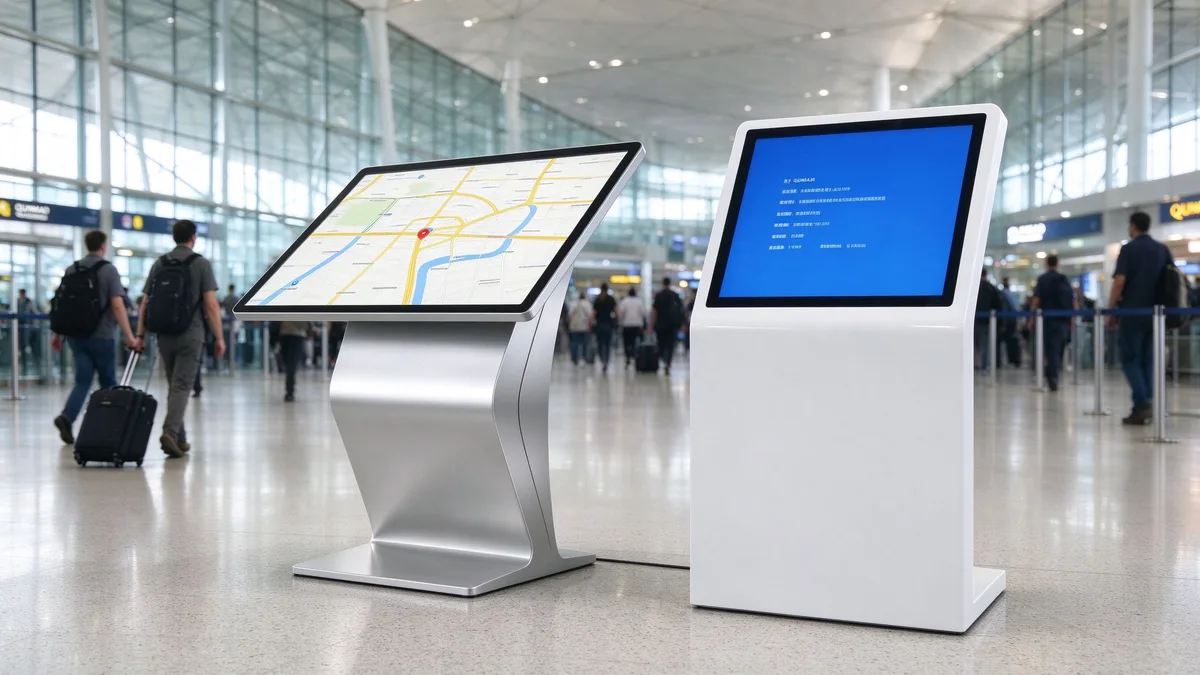
For overseas purchasers (operators, system integrators, equipment traders), the following table can quickly determine where a project should start.
| Decision Point | Recommended Practice | Common omissions |
|---|---|---|
| 1 What to check? | High-frequency problems for first-line passengers: shifts, transfers, exits, facility locations | Select the screen size first, then think about the content. |
| 2 Where does the data come from? | Interfacing with the operator's shift or scheduling system through API | Relying on manual entry, information is quickly outdated |
| Where to put it? 3. | Press the line to select the point position, and then select the shape and indoor and outdoor specifications according to the point position. | Place indoor-only equipment in semi-open air |
| 4. Can long-term operation | Distinguish the operation mode of the model, supporting monitoring and alarm | Just look at the words "7 × 24" and ignore heat dissipation and operation and maintenance. |
| 5. Who responds to the problem | Quality assurance, spare parts, remote support and response methods are specified in the contract | After-sales discussion only after the equipment arrives |
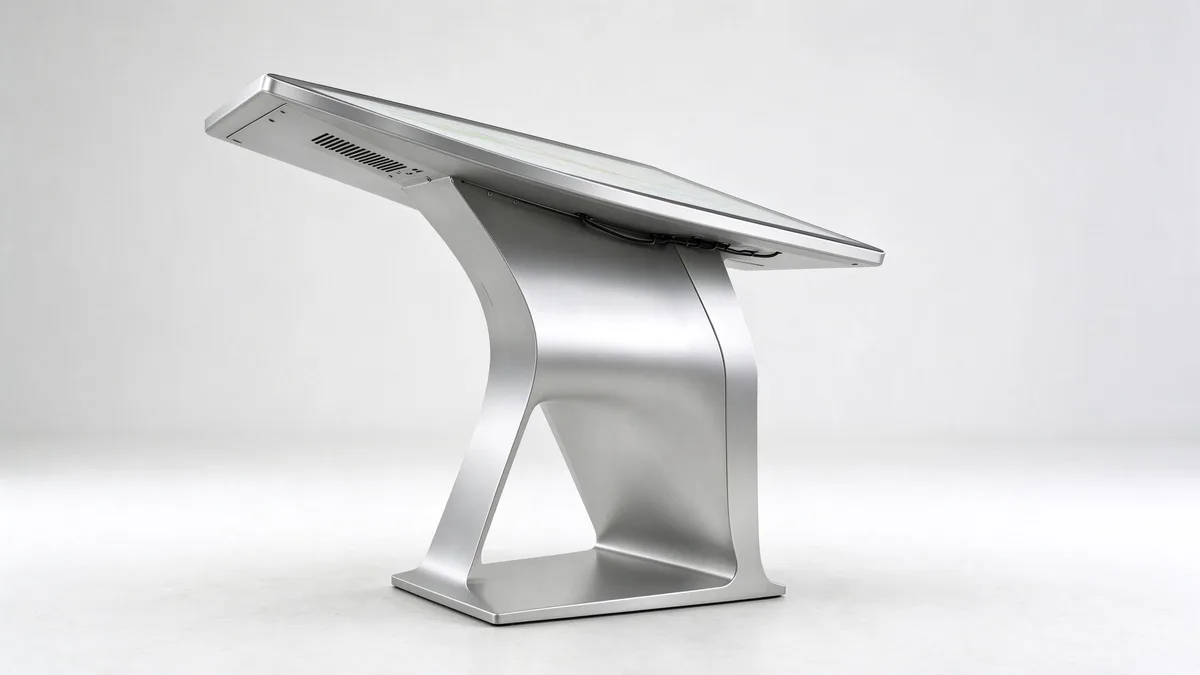
QUNMAO is the source manufacturer of inquiry terminals in China's transportation hubs. The equipment is designed, manufactured, tested and shipped in its own system, so the appearance, configuration and software can be adjusted according to the needs of the project. Basic product information can be referred "Touch query machine product details", can also be viewed directly K-type inclined plane touch inquiry machine (horizontal self-service inquiry terminal)Product details.
All three types of hubs have to check the frequency, transfer and exit, but the status of passengers, the rhythm of information and the constraints of the environment are not the same.
Passenger Characteristics:There are many international tourists with large luggage and high dependence on language and icons.
Information focus:Flight status, boarding gate, baggage claim, transportation connection.
Equipment recommendations:Multi-language interface, L-shaped query machine with vertical self-service terminal.
Passenger Characteristics:Passenger flow is concentrated in the peak travel, ticket purchase and ticket demand is large.
Information focus:Train number, ticket gate, waiting room, transfer and exit station.
Equipment recommendations:The inquiry machine is used in conjunction with the ticket purchase and ticket collection terminal for the diversion window.
Passenger Characteristics:The residence time is short and you need to get answers quickly.
Information focus:Line, transfer, exit number, peripheral facilities.
Equipment recommendations:The interface is streamlined, vertical or wall-mounted, paying attention to the safe distance of the channel.
The inquiry machine itself does not generate flight information, it is the "display window" of the operator's system ". Whether the information is real-time depends on the data link.
In actual projects, docking is usually divided into three steps: first inSandbox EnvironmentIn the test interface;User Acceptance Test (UAT), the operator confirms whether the data display is accurate; Finally, select a small amount of equipment to doPilot programAfter verification and stability, it will be fully promoted. This keeps the risk before going online.
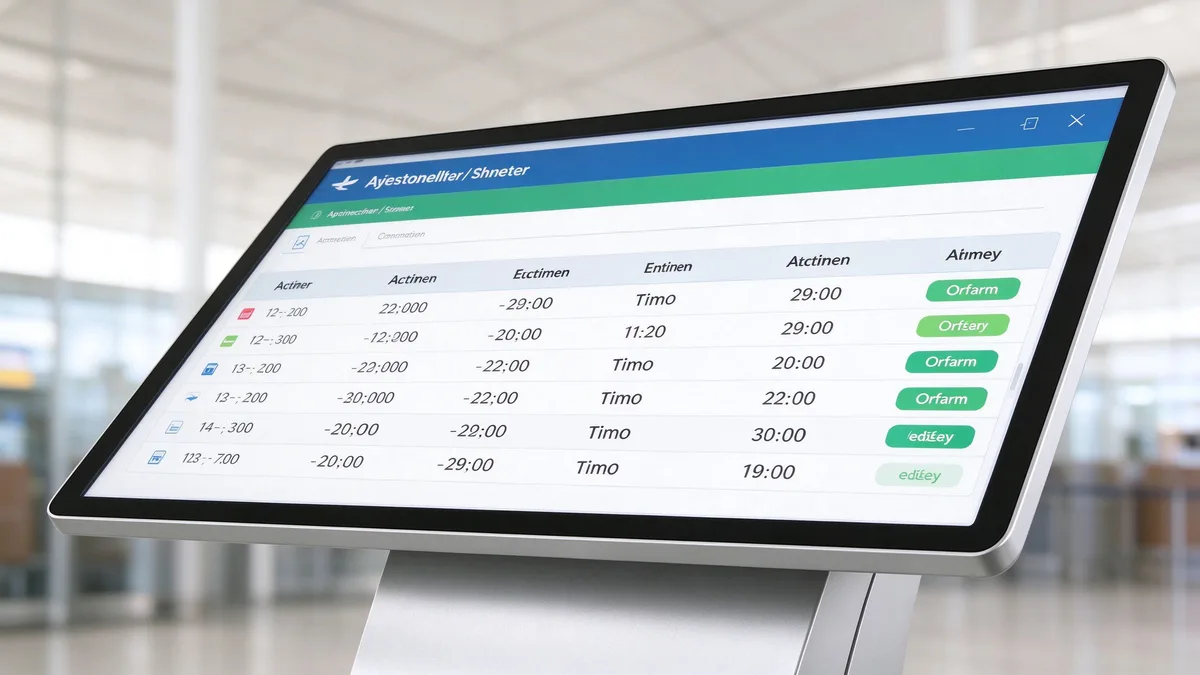
Changes such as delays, cancellations, and changes are the most needed information for passengers. The interface should clearly distinguish the status and keep the basic information available when the network is unstable: the system supports offline mode, the basic query can still be provided when the network is interrupted, and the transaction function is suspended and a clear prompt is given.
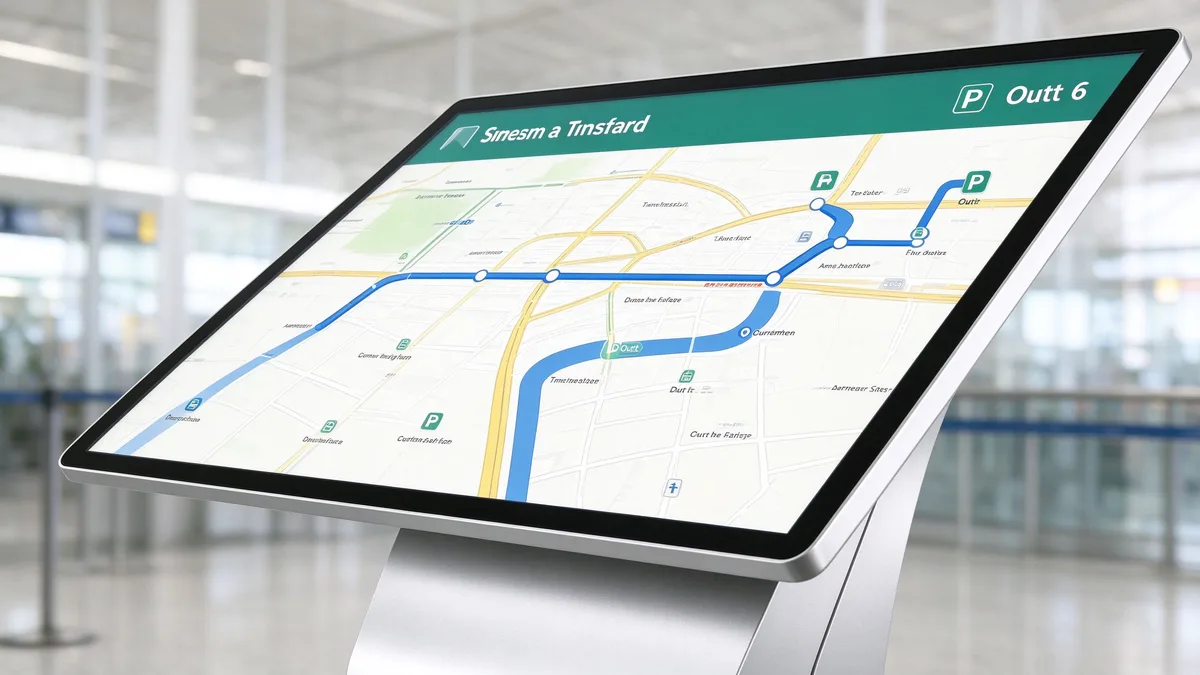
What passengers need is not a static map, but a specific route from "current location" to "destination": which channel to pass, where to transfer, and which exit to leave. The inquiry machine can provide guidance information on transfer routes, exits and surrounding facilities, and support in-station navigation for guidance in the station hall, entrance and information desk.
When large-scale hub complexes are connected to commercial spaces, 3D indoor guidance capabilities can be further used. For details, see "Mall Wayfinding soft and hard integration scheme"。
Misunderstanding one:The larger the screen, the better the query machine.
Facts:The hub has a large flow of people and high information density. What really affects the experience is the interface level, font and contrast, and point position. The size is to serve the viewing distance and the flow line of people.
Misunderstanding two:All equipment can be "7 x 24 hours" operation.
Facts:Different models operate in different ways. The self-service terminal supports 7 × 24 hours of continuous operation; The L-shaped inquiry machine supports self-starting and time switch machine, which is more suitable for management according to operating hours and is only for indoor use.
Misunderstanding three:As long as the interface "can pass", the information is real-time.
Facts:Look at the frequency of data updates, field definitions, and exception handling. The sandbox, UAT and pilot must be passed to confirm that the information seen by passengers is consistent with the operating system.
Misconception Four:Multilingual is the translation of the text.
Facts:Also consider font support, text length changes, iconization processes, and typesetting of languages written from right to left, which are to be verified during the prototype phase.
Misunderstanding 5:Buy the equipment and talk about it after sale.
Facts:Spare parts, remote support, software upgrades and training should be clearly written at the contract stage. The hub scenario has a low tolerance for downtime, and the operation and maintenance mechanism can determine the success or failure of the project more than the price of a single unit.
| Location point | Function | Recommended Form |
|---|---|---|
| Arrival Hall Exit | The first information point of the passenger after landing | L-type inquiry machine |
| Departure Hall | Flights, Gate and Facilities Enquiries | L-type inquiry machine |
| Transfer and transit area | Route and Exit Guidance, Passenger Decision Concentration | L-type or vertical self-service terminal |
| Baggage claim area | Passengers check connection information while waiting | L-type inquiry machine |
| Rail transit connecting channel | Transfer line and direction, need to read quickly | Wall or vertical |
| Before the information desk | Divert routine consultation and cooperate with staff | Vertical self-service terminal or L-type |
| Entrance and exit, semi-open area | Higher requirements for environmental adaptability | Outdoor K-type infrared touch model (IP65) |
The L-type inquiry machine is mainly used indoors, and the working environment is 0 to 55 ℃ and the humidity is 10% to 90% RH. It is not suitable for direct exposure to the outdoor. For entrances and semi-open areas, special outdoor models should be selected, such as outdoor K-type horizontal inquiry machines with infrared touch control and IP65 protection grade.
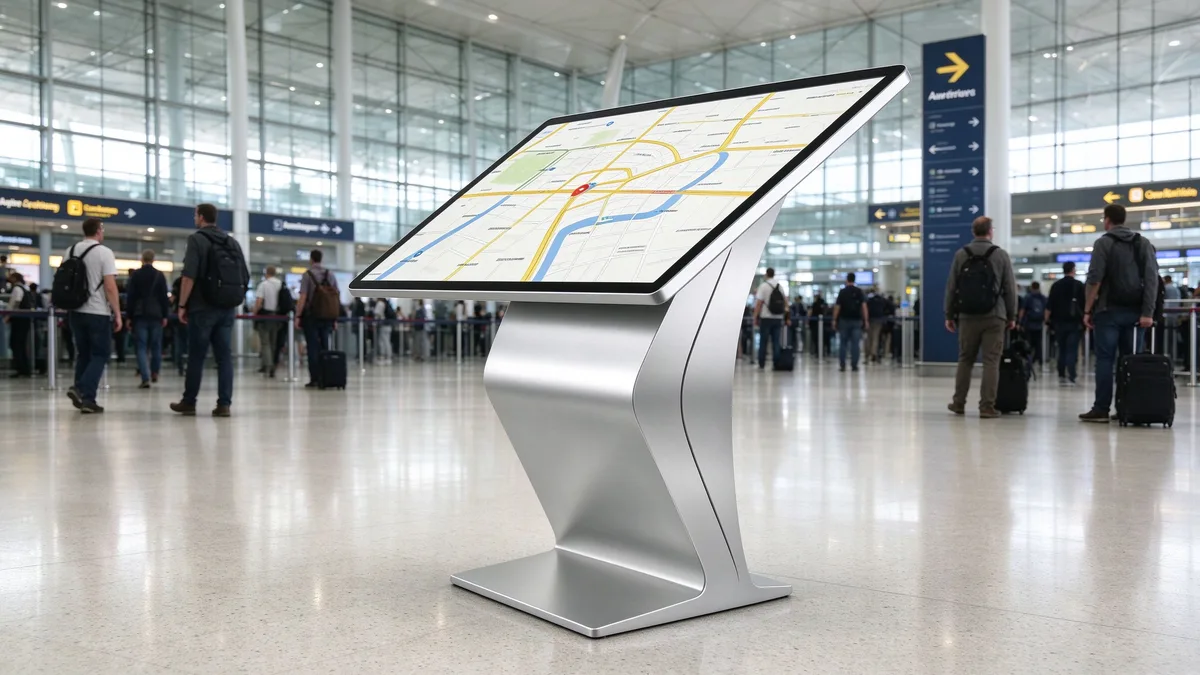
QUNMAO manufactures L-shaped, vertical, wall-mounted and outdoor equipment at the same time. Different points in the same hub can be supplied by the same source factory with unified management in the background. Related products and programs:Station Information Inquiry Machine Solution、Outdoor K-type inquiry machine horizontal infrared touch integrated machine、55 inch wall-mounted digital advertising machine, and Inventory of Applicable Scenarios of L-type Horizontal Inquiry Machine。
Long-term operation, high-frequency touch, and luggage collision are the three tests of the hub scene on the equipment.
Take the 43-inch L-type inquiry machine (QM-C43XJ-P) as an example, it adopts capacitive 20-point touch, with a service life of 60 million times, a resolution of 1920 × 1080 IPS, a brightness of not less than 300cd/m, a power consumption of not more than 85W, and a standby of not more than 1W. Parameters are subject to actual shipment and project configuration.
The L-shaped structure has the characteristics of anti-dumping, concealed routing, stable ground placement, etc., and is suitable for scenes with luggage carts and people passing through. See details L-type horizontal query machine structure design analysis. At the same time, the interface is closed, the shell is tamper-proof and single-application locking to reduce the risk of misoperation or damage.
| Plan | Processors and Storage | Suitable scenarios |
|---|---|---|
| Android 版 | RK3566S quad core, 2GB memory 32GB storage | Lightweight deployment with a focus on content release and APK apps |
| Windows 版 | Intel i5 4th generation, 8GB RAM 128GB SSD | Projects that require running existing Windows station software, or more peripherals |
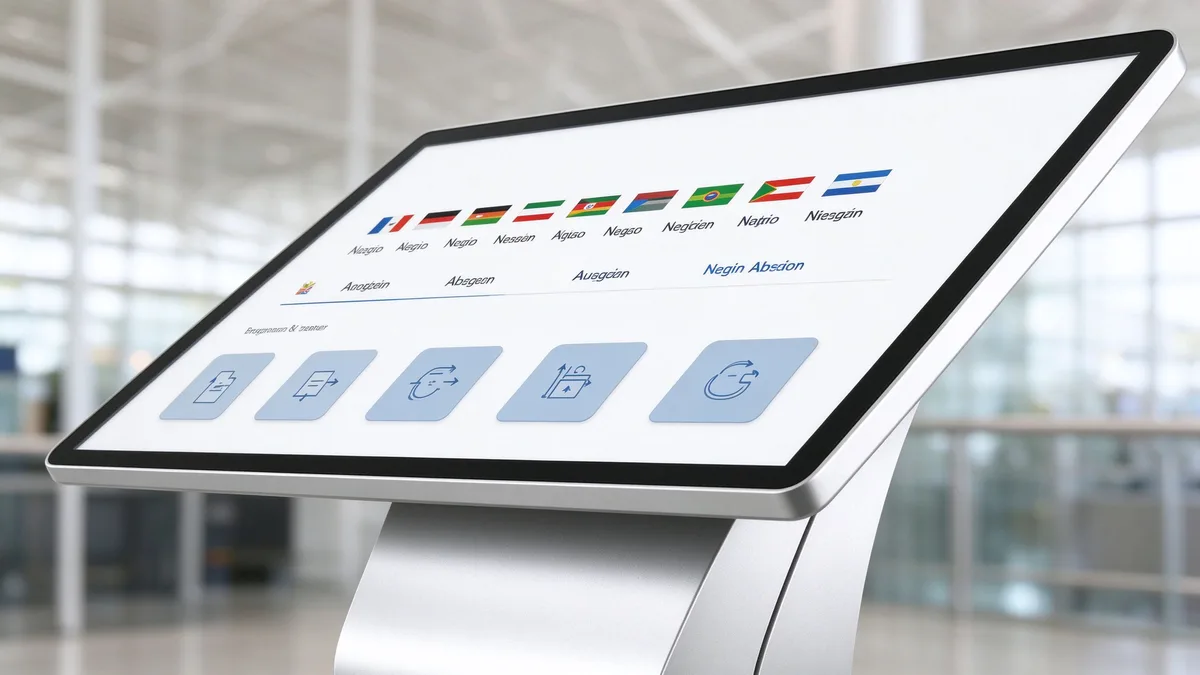
Airports and large hubs have passengers from different countries and language skills vary widely. The equipment should support multi-language interface, and reduce the understanding threshold through the icon process, so that the first-time visitors can also successfully complete the operation. Shift pages and announcements can be uniformly published as multilingual content by the CMS.
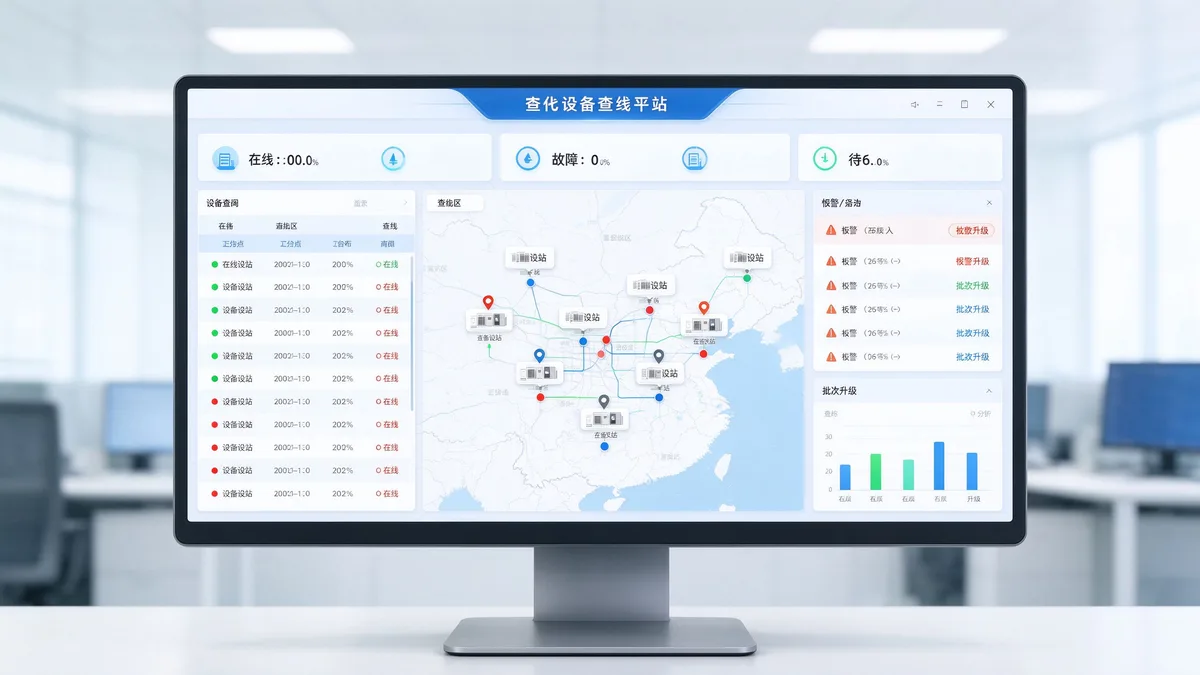
The number of hub equipment is large and widely distributed, so it is difficult to find problems in time by manual inspection. Cloud management platform can move operation and maintenance forward:
| Level | Typical phenomenon | Handling method |
|---|---|---|
| Level 1 | The whole device is offline or cannot be started | Remote diagnosis, if it cannot be restored, replace the spare machine on site. |
| Level 2 | Peripheral failure, such as printer out of paper or paper jam | Alarm and notify on-site personnel to supplement or replace |
| Level 3 | Content error or display exception | Fix and republish via background |
| Level 4 | Software version to be upgraded | Schedule Maintenance Window, Batch OTA |
The response time limit and warranty period at all levels (generally 1 to 3 years) are agreed in the contract.
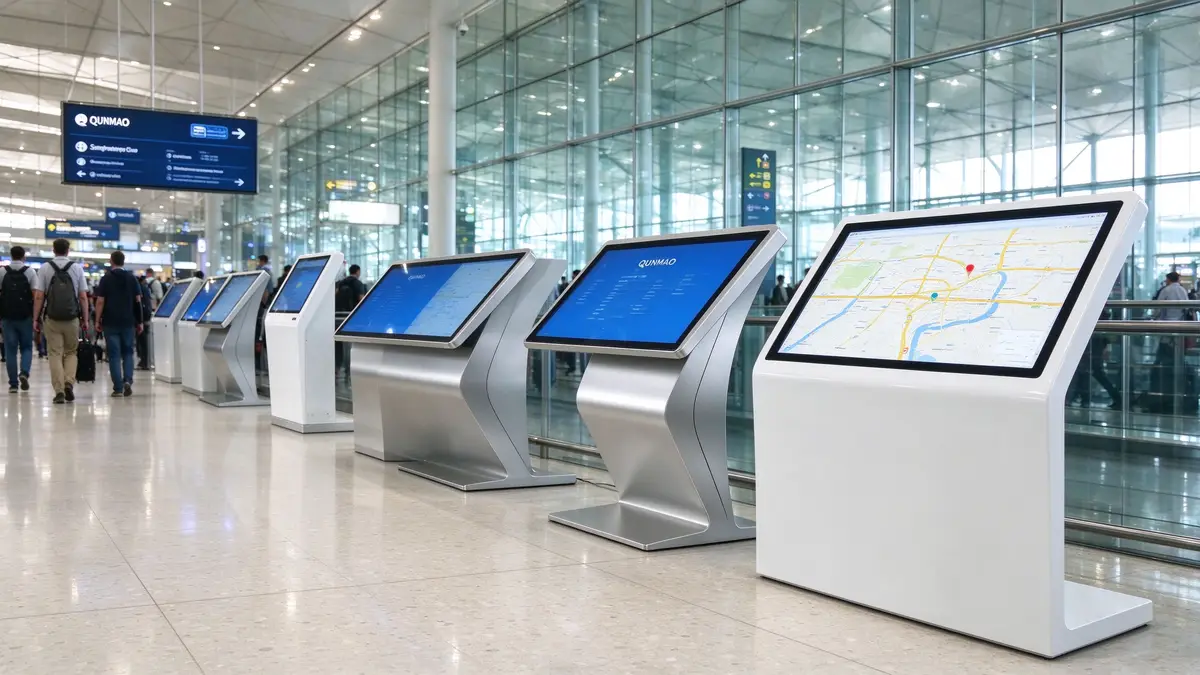
This is a project completed by QUNMAO at an international airport in Singapore: 40 inquiry terminals, covering the main passenger routes of the terminal, taking a month from confirmation of orders to on-site acceptance.
| Project | Content |
|---|---|
| Location and Type | Singapore International Airport Terminal |
| Number of devices | 40 units |
| Delivery cycle | 1 month (order confirmation to site acceptance) |
| Equipment composition | 26 sets of 43-inch L-type inquiry machines, 6 sets of 50-inch L-type inquiry machines and 8 sets of 27-inch self-service terminals |
| Software and Content | Flight query, transfer and export navigation, facility location, multi-language interface; cloud CMS unified release |
| System integration | Interfacing with operator shift information system via API |
| Scope of delivery | Production and testing, interface joint adjustment, export packaging and shipment, on-site installation, training and acceptance. |
Customers want to respond to high-frequency questions from international passengers: flight status, transfer routes, exits and facility locations without increasing the number of enquiries. The three hard requirements are: the interface supports multiple languages; The shift information must be consistent with the operator's system; The equipment needs to operate stably in the terminal for a long time and is convenient for remote management. In terms of construction period, the customer hopes to complete the delivery within one month.
| regional service department | Quantity | Function |
|---|---|---|
| Departure Hall | 10 units | Flights, Gate and Facilities Enquiries |
| Arrival Hall | 8 | First stop after landing, transfer and exit guidelines |
| Transfer and transit area | 8 | Line and direction decision concentration point |
| Baggage claim area | 6 | Check connection information while waiting for luggage |
| Rail transit connecting channel | 4 units | Transfer line and direction |
| Before the information desk | 4 units | Divert routine consultation and cooperate with staff |
| Week number | Main responsibilities | Need customer cooperation | Risk control |
|---|---|---|---|
| Week 1 | Site requirement confirmation, point list, interface evaluation, multi-language prototype interface confirmation | Provide interface documentation, points and language requirements | Use a confirmation list to set the configuration at one time to reduce later changes. |
| Week 2 | Interface development and sandbox testing, simultaneous batch preparation and production | Open sandbox environment and test account | Software and hardware parallel propulsion |
| Week 3 | Overall aging test, interface joint debugging and UAT preparation | Arrange data verification personnel | Test one by one and keep records |
| Week 4 | Export packaging and shipment, after the arrival of a small number of pilot equipment, after confirmation of the full installation, training and acceptance. | Coordinate installation area and night construction window | Pilot first, reserve spare machines and spare parts |
The shift status in the operator's system has multiple internal codes and is not friendly to the traveler. We collated the status comparison table with the operator in the sandbox phase, converted the internal codes into words and icons that passengers could understand, and checked them item by item in the UAT phase.
The length of text varies greatly in different languages, and the same button will wrap or overflow in some languages. In the prototype stage, we repeatedly tested typesetting with real copy in multiple languages, adjusted the button width and font size rules, and then mass produced.
The terminal has a large flow of people during the day, and the installation can only be arranged at night and other limited time windows. We split the installation into two stages of "pilot first and then comprehensive", and packed the equipment according to the point number in advance, and installed it point by point according to the list after arriving at the site, thus reducing the assembly time on site.
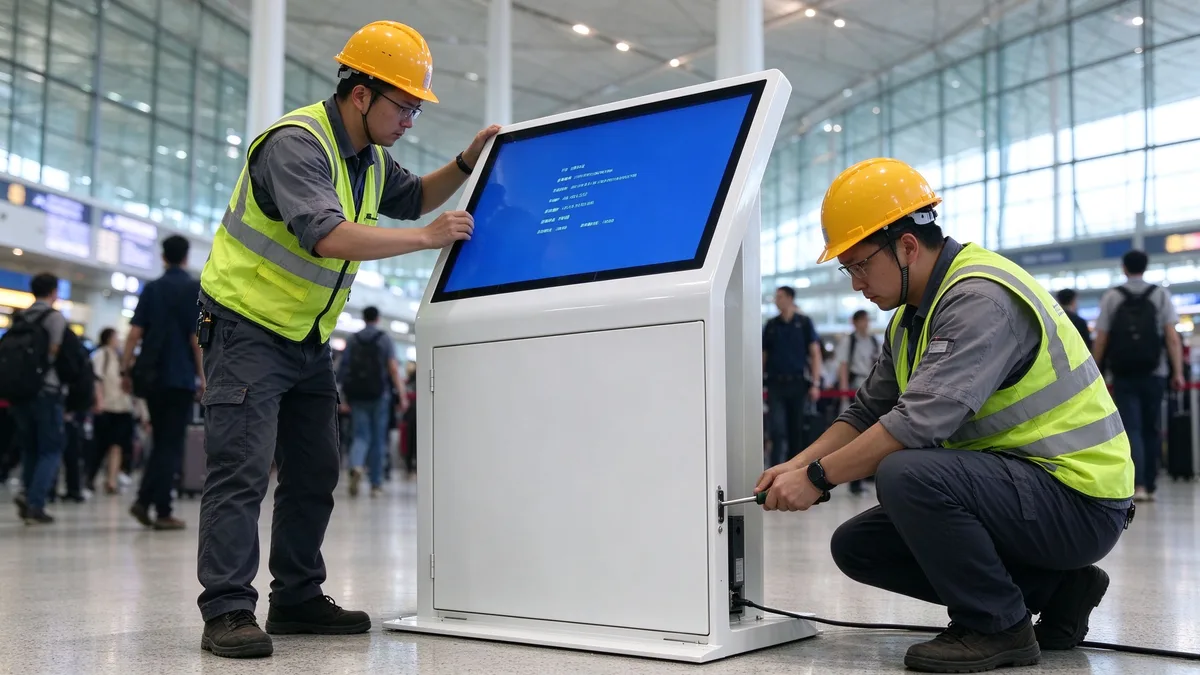
40 sets of equipment were installed and accepted on site within one month and put into use.
Airport Operator (Information Department):The focus is on interface docking and delivery rhythm. Feedback believed that a clear coordination list was obtained from the first week, the links of sandbox testing and UAT were clear, the shift information display was consistent with the operation system, and the online process was relatively smooth.
Inquiries and Ground Crew:Feedback After the equipment was put into use, the number of passengers asking "how to transfer" and "which exit to take" decreased, and they could spend their time on more complex issues.
Operation and maintenance team:Remote monitoring and alarm functions are recognized, equipment status can be viewed centrally, and batch upgrades can be scheduled to be completed within the maintenance window. It also puts forward the direction of further optimization: gradually refine the wording of some status prompts according to the usage habits of the operators.
Source manufacturers from China can push forward the "factory delivery capacity" and "project site demand" at the same pace: production, testing, interface and packaging delivery are carried out simultaneously, and 40 units are completed in a month. For similar station and airport schemes, please refer Station Airport Self-service Terminal Solution。
For overseas buyers, the equipment from the Chinese factory to the local and smooth acceptance, in addition to the product itself, but also involves a set of processes. Below are the checkpoints we have summarized in the export project.
Source manufacturers can provide by item OEM (OEM) and ODM (Custom Design) Services, including appearance, brand identity, interface language, peripherals and software functions. It is recommended to confirm all customized content at the prototype stage, and then mass production after the prototype is confirmed.
The self-service terminal equipment supports AC 110-240V input, which can adapt to the voltage standards of most countries and regions. Before arriving at the site, the plug type, installation environment temperature and humidity and network conditions should be confirmed.
The warranty period is generally 1 to 3 years, depending on the contract. Spare parts, remote diagnosis, software upgrade and training are recommended to be written into the contract, and the communication method and docking person are clearly defined to reduce the time difference and communication cost in multinational projects.
To learn more about the company, you can visit About Us. For content management capabilities, see Digital Signage CMS Solutions。
The hardware platform can be the same, the difference is mainly in the content, language and point. There are many international passengers at the airport, with more emphasis on multilingual and iconic processes. High-speed railway station has a large demand for ticket purchase and collection, which is often matched with self-service ticket collection terminals. The subway has a short stay time, the interface should be streamlined, and attention should be paid to passage space.
It is necessary to interface with the operator's shift and scheduling system through API, and the interface mode is confirmed in the scheme evaluation stage. In the project, sandbox testing is usually done first, then UAT and pilot, and finally fully promoted. This ensures that the information seen by the passenger is consistent with the operator's system.
The L-shaped inquiry machine supports self-starting and time switch machine, manages according to operating hours, and is limited to indoor use. If you need 7 × 24 hours of continuous operation, you can choose Self-service terminal (K-type horizontal inquiry machine). For entrances and exits and semi-open areas, outdoor models should be selected, such as IP65 outdoor K-type infrared touch inquiry machine.
The interface supports multiple languages, which are configured according to the project, and can help first-time visitors through the icon process. Languages written from right to left, such as Arabic, can be configured and verified during the prototype phase.
QUNMAO is the source manufacturer of touch inquiry all-in-one machine and self-service terminal in China. It has its own production base and supports OEM and ODM. Appearance, brand logo, interface language, peripherals and software functions can be customized according to the project, and the prototype can be mass-produced after confirmation.
Through the cloud management platform, you can monitor the online status of the equipment and give an alarm for faults and consumables (such as paper shortage). General problems can be diagnosed and handled remotely, and spare machines or spare parts can be used when replacement is required. Warranty and response time limit as agreed in the contract.
Depending on the area of the terminal or station, passenger flow lines and points. Take the Singapore Airport project as an example, a total of 40 units are deployed, distributed in the departure hall, arrival hall, transfer area, baggage claim area, track connection channel and information desk. We can give point and quantity suggestions based on the plan.
Back to the passenger at the beginning: what he needs is to get an accurate frequency, a clear route, a language he understands, and a device that can always be used in 8 minutes. For the operator, this corresponds to four things:Accurate information, stable operation, language understanding, fast response。
As the source manufacturer of China's touch inquiry all-in-one machine, QUNMAO Qunmao has verifiable project experience from equipment manufacturing to interface docking, multi-language configuration and overseas delivery. Singapore Airport 40 units, delivered in one month, is one example. Choosing a source factory that can both manufacture equipment and deliver projects can give overseas projects less links and more certainty.
Whether you are planning an inquiry terminal for airports, stations, shopping malls or other public hubs, you are welcome to communicate directly with us for product solutions, quotations and prototype support.
Contact Us · Contact Us Telephone 86 137 1431 7162 Partner Links:

 en
 中文

 Previous:
 Return to list