
 en
 中文

 Current location:
 Release date: 2026-10-21
 Clicks:
Quick answer: how to choose and use the shopping mall inquiry machine and shopping guide screen
Shopping malls deploy inquiry machines to solve four things at the same time:Customers can find the store(floor navigation),Brand information can be found(Brand and member inquiries),Promotional content updates quickly(Content Management),Data can be used for operations(Anonymous statistics, and do not touch personal privacy).
QUNMAO Qunmao provides a software and hardware integration scheme of "3D floor guide software inquiry machine and shopping guide screen hardware cloud content management", which has been completed in a shopping mall in Singapore.The layout of the whole store: 14 sets of equipment, 14 days to complete the delivery. Combined with this project, this paper explains the functional design, point configuration, content operation and maintenance, data boundary and procurement acceptance points of the shopping mall scene.
Main points of this paper
- There are three types of people: customers, merchants and operators, with different demands.
- The key to floor navigation is 3D maps, shop search, shortest paths and cross-floor guidance.
- Interactive marketing should take "inquiry" as the entrance, and string coupons, activities and member services into conversion paths.
- The value of mall data is in anonymously aggregated statistics, not in tracking individual behavior.
- The 14-unit, 14-day project in Singapore can be used as a delivery reference for overseas commercial projects.
- Introduction: Why do the inquiry machines in shopping malls often "only have advertisements"
- The inquiry demand in the shopping mall: three kinds of people, three kinds of demands
- Floor Navigation: From Plan to 3D Guide
- Brand Inquiry and Member Service
- Interactive marketing: let the inquiry machine become the entrance of transformation
- Point location and equipment configuration: how to divide the work between inquiry machine and shopping guide screen
- Content Management: How Promotional Information is Updated in Real Time
- Data Value: What to See and What Not to See
- Interfacing with the existing system of the mall: compliance and system compatibility
- QUNMAO Singapore Mall Case: Whole Mall Layout, 14 sets, 14 days
- Effect evaluation: what indicators to use to judge
- Procurement and Acceptance Checklist
- Why choose QUNMAO QUNMAO
- Frequently Asked Questions
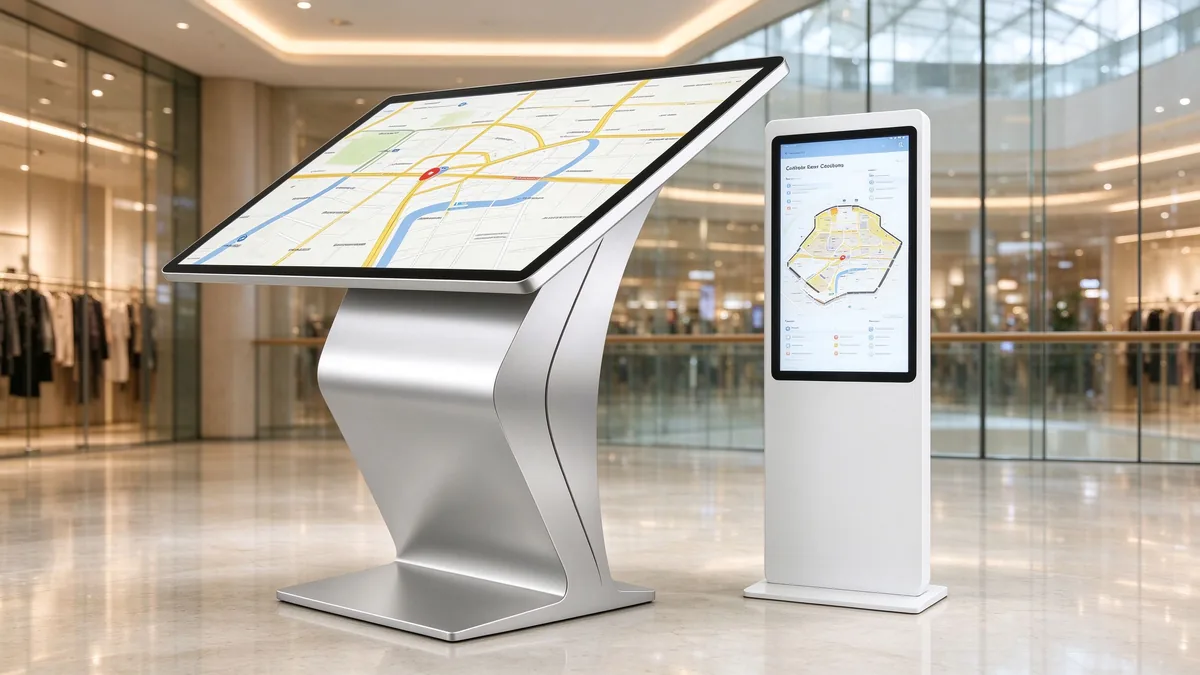
Introduction: Why do the inquiry machines in shopping malls often "only have advertisements"
In many shopping centers, you can see a similar situation: customers turn around the atrium with their mobile phones twice, but still can't find the store they want to go to, so they have to go to the service desk to ask; the shop location on the paper guide board is outdated, the merchant has moved to a new address, and the old location is still written on the board; the promotion has already started, and the content of last month is still on the screen.
There are also some shopping malls equipped with inquiry machines, but regard them as a "touching advertisement screen": there are only carousel advertisements in the interface, the navigation function is simple, and the information update is operated manually one by one. Over time, customers no longer use, equipment has become a decoration.
The value of the shopping mall inquiry machine lies not in the size of the screen, but in the accuracy of navigation, whether the content is new or not, whether the inquiry can be converted into consumption, and whether the data can be operated in compliance.
QUNMAO Qunmao was established in 2005. It has long provided touch inquiry all-in-one machines, digital signage and self-service terminals for public places and business scenes, and delivered many projects for overseas customers. The following content comes from our experience in the design and delivery of solutions in the mall scenario.
The inquiry demand in the shopping mall: three kinds of people, three kinds of demands
The shopping mall inquiry machine serves not only customers, but also merchants and operators. If the demands of the three parties are not unified, the system will be difficult to use for a long time.
| Character | Core demand | Method of use | Focus on indicators |
|---|---|---|---|
| Customer | Quickly find stores, learn about activities, and receive discounts | Search, browse, scan code, print route on the device | Whether the search for the store is smooth and the information is accurate |
| Merchant | Let more customers see their own brand and promotion | Provide brand information and activity content, reviewed and released by the operator | Exposure, queried times, activity attention |
| Operator | Enhance customer experience, reduce consultation pressure and master operation basis | Unified management of content, devices and data through the back office | Device usage, content update time, popular stores and features |
QUNMAO puts three types of roles into the same system: the customer side is the query machine and the guide software, and the merchant and the operator manage the content and permissions through the cloud background. The morphological classification and technical parameters of the equipment can be referred. "Touch query machine product details"。
Floor Navigation: From Plan to 3D Guide
Navigation is the most basic and easily inspected function of the shopping mall inquiry machine: it will be reused only if it is found.
3D indoor map and shop search
The floor plan is not friendly to most customers, especially in shopping centers with many floors and mixed formats. The 3D indoor map can visually display the floor structure, passageway, elevator and store location. With store search, customers can see the destination by entering the name or clicking on the classification.
Shortest path and cross-floor guidance
The really useful navigation is not just marking the end point, but giving an executable route: starting from the current equipment location, via which channel, in which elevator to transfer, and to which floor. QUNMAO's guide scheme supports shortest path guidance, cross-floor and cross-building navigation, and can automatically recommend the nearest straight ladder.
Optional Features
- Reverse search:Combined with parking lot information, help customers find the location of the vehicle.
- Multilingual:Support multi-language interface switch, suitable for international passenger flow more shopping malls.
- Route printing or scanning code to take away:Let the customer take the route with him.
How to Turn Drawings into 3D Maps
The mall only needs to provide PDF or CAD drawings, which are converted into 3D maps by QUNMAO's team, and provide installation guidance and software teaching. Software buyout, no annual fee, within a year to provide free updates. The more standardized the drawing, the faster the conversion.
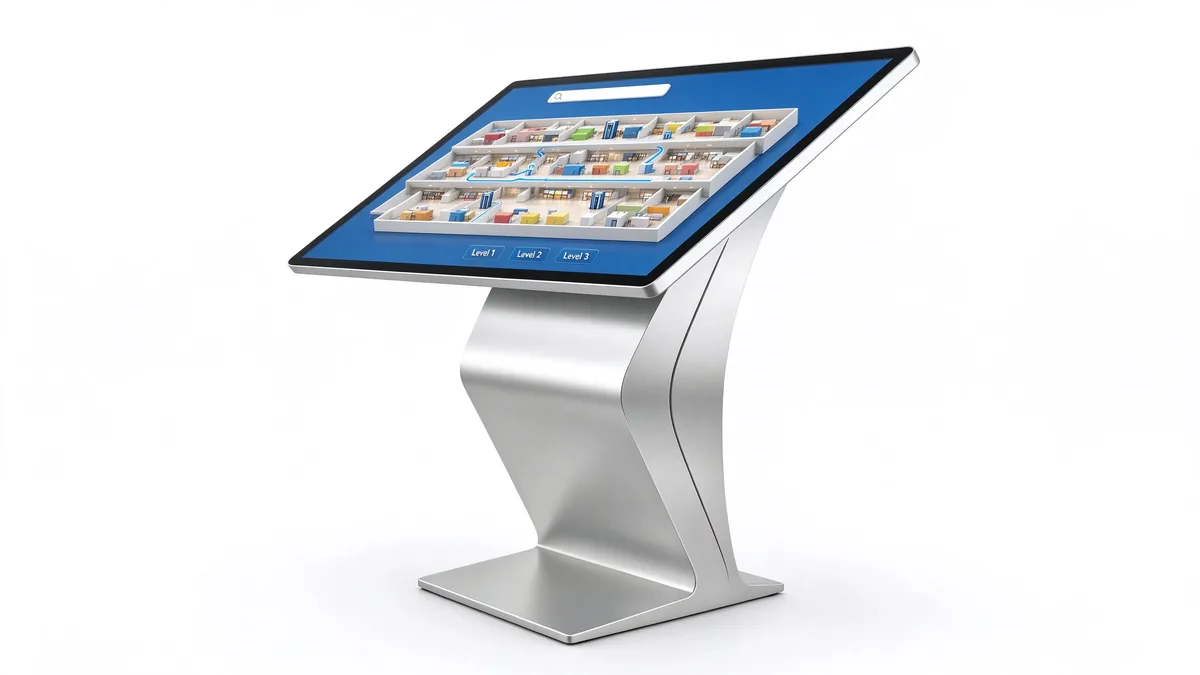
QUNMAO provides a hard and soft shopping mall guide scheme, covering 3D guide, digital signage and cloud content management. For details, please refer "Mall Wayfinding soft and hard integration scheme"。
Brand Inquiry and Member Service
The way customers find a store is not consistent: some people remember the name of the store, some people just want to eat, and some people just want to see a certain floor. The query path should be as diverse as possible.
Multi-Path Brand Search
- By name:Enter the brand name or keywords, suitable for targeted customers.
- By Category:Food and beverage, clothing, children, digital, etc., suitable for shopping mall customers.
- By floor:Browse all the shops on a certain floor, suitable for customers who have reached a certain floor.
Membership and Benefits Services
On the inquiry machine, customers can bind members by scanning codes, inquire about points and rights, receive coupons, and print vouchers when needed. This kind of function needs to interface with the member system and small program of the store to keep the data consistent with the line.
Peripheral Configuration
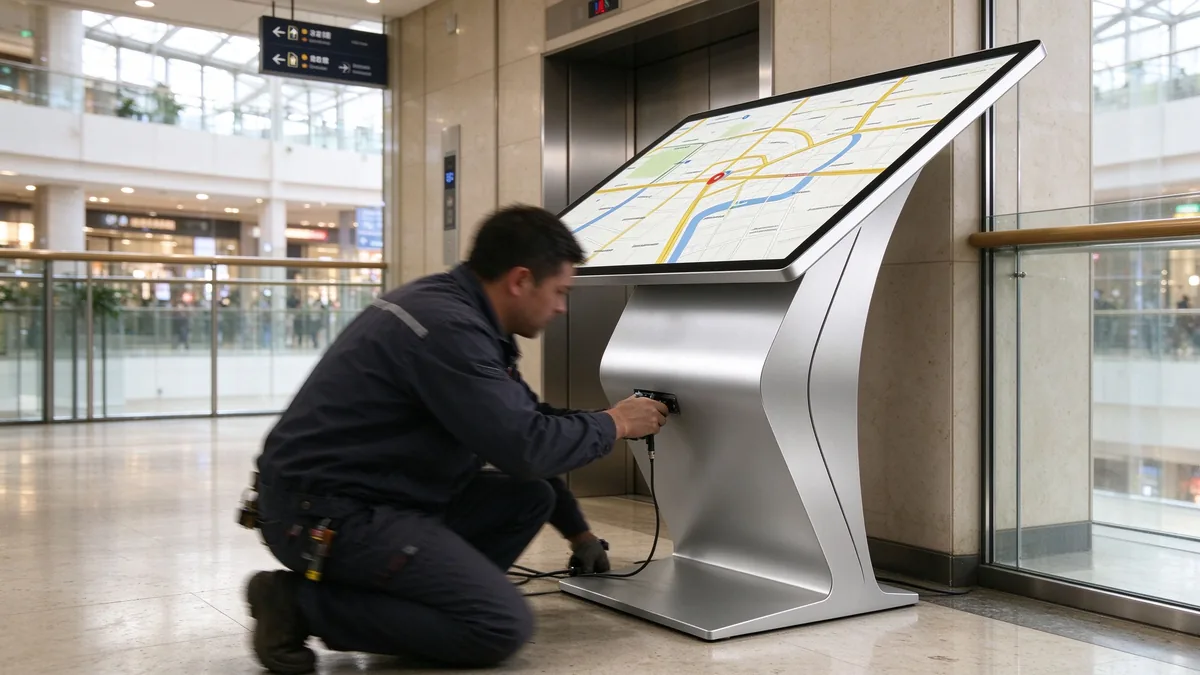
For locations where membership services and slip printing are required, a 27-inch high inquiry terminal with two-dimensional code scanning, card reader and thermal printer can be selected. In the need for depth of the location, the K-type horizontal query machine.
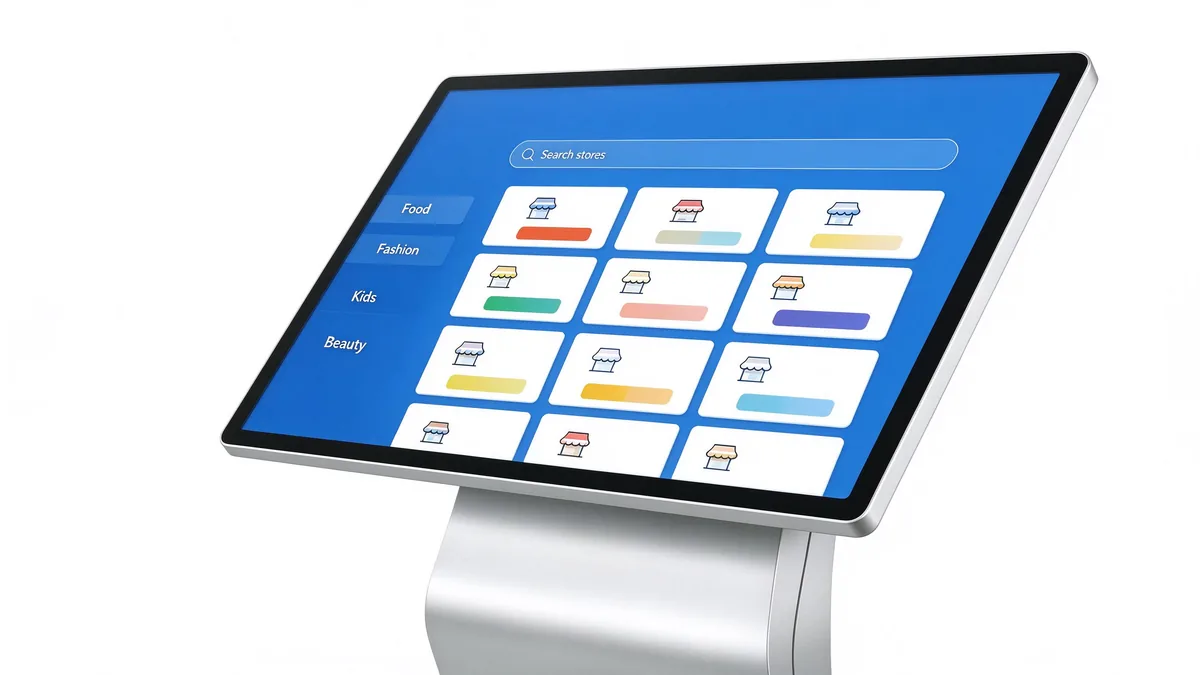
QUNMAO 的27 inch touch self-service inquiry terminal Can be integrated ID card identification, scan code, slip printing and other peripherals, suitable for member service points.
Interactive marketing: let the inquiry machine become the entrance of transformation
The moment the customer checks the store is the most natural contact point for the store to interact with the customer.
Common interactive play
| Gameplay | Trigger scenario | Implementation method | Docking system |
|---|---|---|---|
| Coupon collection | After the customer inquires the store, push the store discount | Scan the code to collect, or print the slip. | Member system, small program |
| Activity Calendar Query | Customers want to know about recent activities | Show the activity content and location by date, and support navigation to the activity area | CMS, Guide Software |
| Merchant Promotional Display | While in standby and while browsing | carousel promotional content, support for regular shelves and shelves | CMS |
| Sweep code drainage | Customers need more information or online services | The page displays the two-dimensional code and guides you into the applet or APP. | Small program, APP |
Connection between standby content and touch content
When the device is not operated, it can play promotional content to attract attention; once the customer touches it, it immediately switches to the navigation and query interface. In this way, the same device can "attract people" and "retain people".
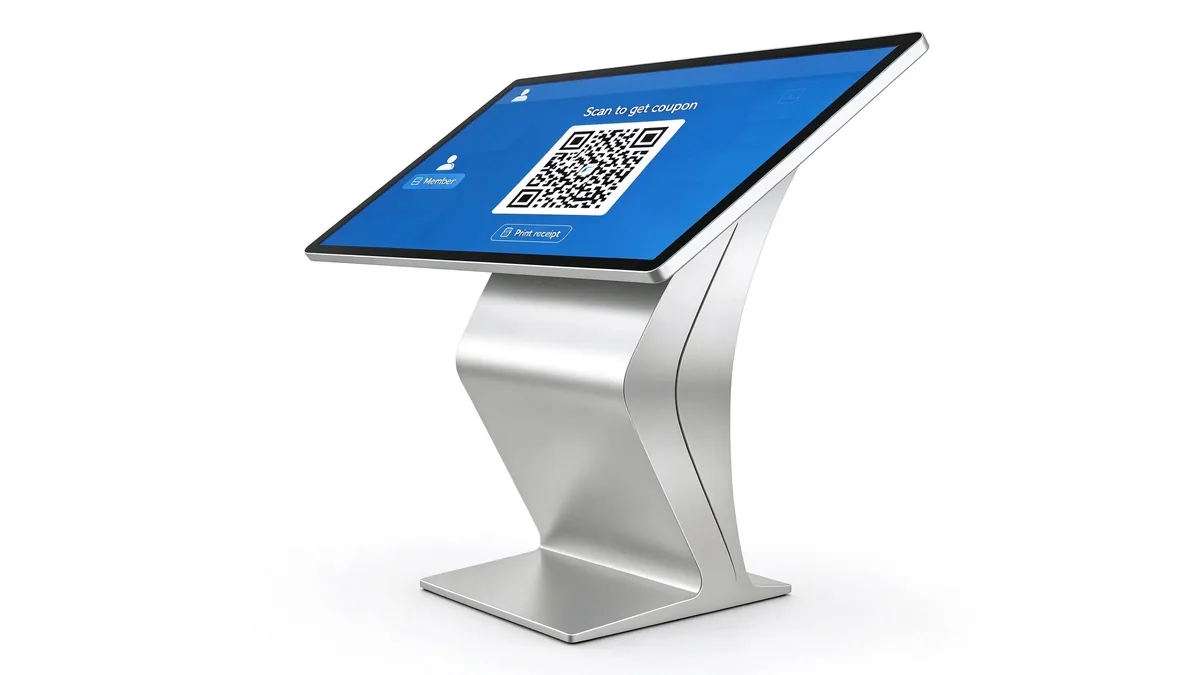
QUNMAO allows the inquiry machine and the shopping guide screen to use the same set of content background, display promotions when standby, and enter navigation and inquiry after touching. To understand the configuration of different models in various scenarios, please refer Inventory of Applicable Scenarios of K-type Horizontal Inquiry Machine。
Point location and equipment configuration: how to divide the work between inquiry machine and shopping guide screen
The inquiry machine is responsible for "in-depth inquiry" and the shopping guide screen is responsible for "display and diversion". The division of labor between the two is clear, and the information system of the mall is complete.
Typical points and equipment recommendations
| Location point | Function | Recommended equipment |
|---|---|---|
| Main entrance | The first stop for customers to enter the store is to solve the problem of "where am I and where am I going" | K-type horizontal inquiry machine, with vertical advertising machine display activities |
| Courtyard | People flow concentration, both navigation and activity display | K type horizontal inquiry machine, large size vertical advertising machine |
| Elevator hall | The decision point when the customer changes floors and needs to quickly confirm the floor information. | K-type horizontal inquiry machine or wall-mounted screen |
| Passage | On the way to guide, show merchants promotion | Vertical or wall-mounted advertising machine |
| Service desk | Undertake complex consulting, but also assume membership services | High-end inquiry terminal with scanning code and printing |
| Parking connection | Guide customers to enter the mall from the parking area, or provide car search | K-type horizontal inquiry machine |
Form selection: horizontal, vertical and wall
The K-type horizontal inquiry machine adopts an inclined plane structure, which is suitable for scenes that require a long time to browse and search, and the common size is 32 to 55 inches.Vertical typeSmall footprint, suitable for passage and entrance; wall-mounted machine type suitable for elevator hall and wall space. Three types of forms can be used together in the same shopping mall.
Requirements of the mall scene for reliability
- The mall usually runs all day, and the equipment needs to be suitable for long hours of work 24/7.
- Industrial grade panel, metal body and 3mm tempered glass, both durable and appearance.
- The hardware supports 110-240V voltage, which is easy to deploy in different countries and regions.
- Capacitive multi-touch support, system optional Android or Windows.
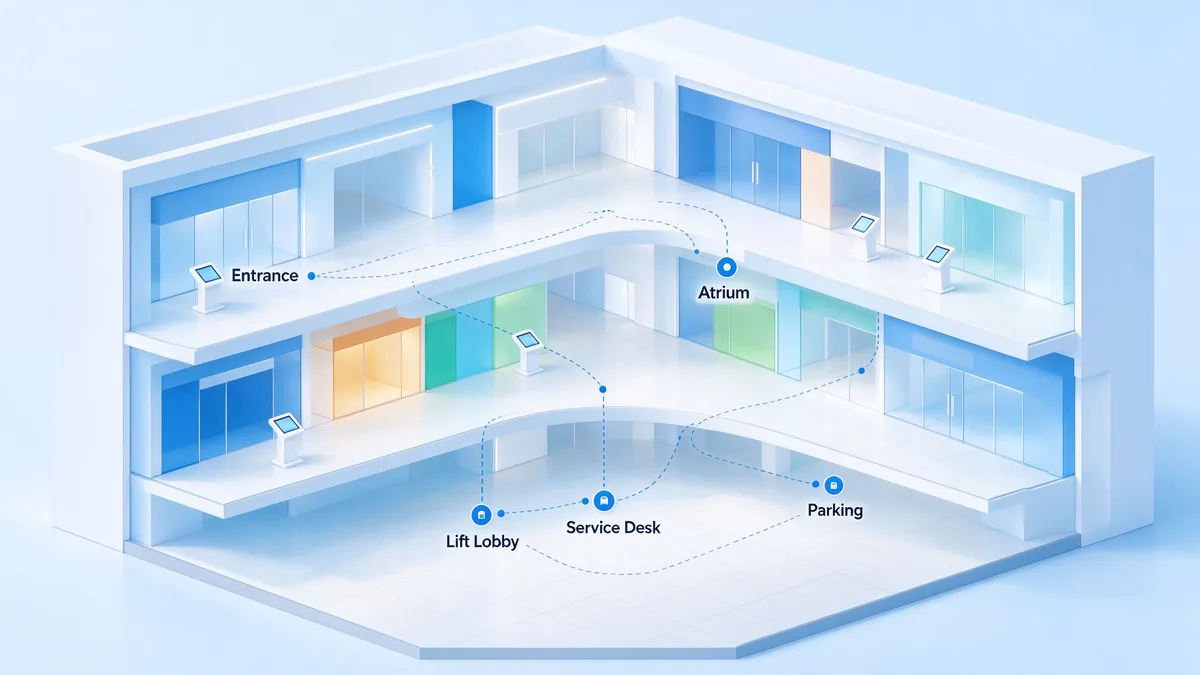
QUNMAO In the same shopping mall, the inquiry machine, vertical advertising machine and wall hanging screen use unified background management. The equipment that can be referenced includes:K-type inquiry machine vertical touch inquiry all-in-one machine、Vertical double-sided glass advertising machine、4K narrow frame full screen vertical advertising machine with 55 inch wall-mounted digital advertising machine. Selection ideas can be read How to choose the horizontal, vertical and wall-mounted type of inquiry machine。
Content Management: How Promotional Information is Updated in Real Time
The content of the mall is alive. Updating a slow screen is worse than no screen at all.
Core Capabilities of Cloud Content Management
- Playlists and scheduling:Playback schedule can be preset by time, date, period.
- Split screen display:The same screen can display video, pictures, text and real-time data at the same time.
- Emergency Interluding:Emergency notifications or limited-time events that can be updated in real time and played immediately.
- Remote management:Remote restart, volume adjustment, system upgrade, switch screen scheduling, and can view the online or offline status of the device.
- Permission rating:You can create sub-accounts and assign permissions according to Content Editing, Device Management, and Hierarchical Management.
Updated example of division of responsibilities
| Content type | Source | Person in charge | Update frequency | Reviewer |
|---|---|---|---|---|
| Store information and location | Investment Promotion or Operation Department | Operations Specialist | When the merchant changes | Operations Manager |
| Promotional event | Merchant & Marketing | Marketing Specialist | Before the event begins | Head of Marketing |
| Notice and Announcement | Mall Management Department | Customer service or publicity post | On demand | Person in charge |
| System and Equipment Status | background monitoring | Information operation and maintenance post | Real-time | Director of Information |
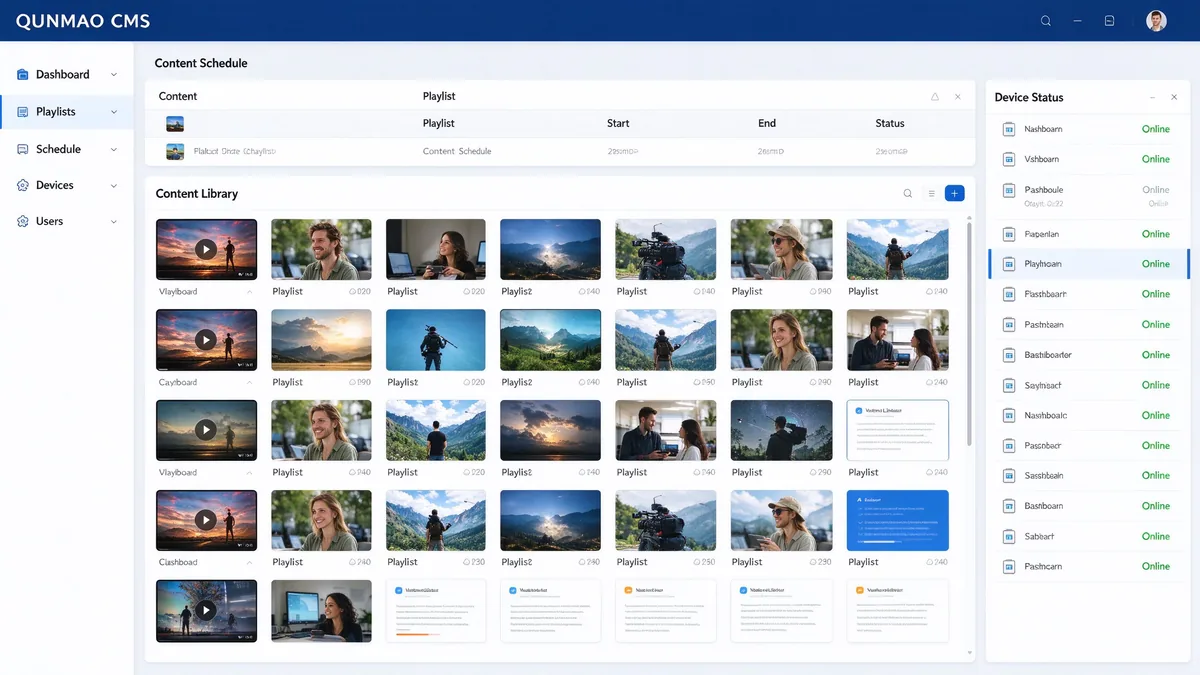
QUNMAO's cloud CMS unified management query machine and advertising screen, see Digital Signage CMS Solutions。
Data Value: What to See and What Not to See
The value of store data lies in "anonymous aggregation", not in "tracking individuals". The boundaries are clearly drawn so that data can be used in a long-term and compliant manner.
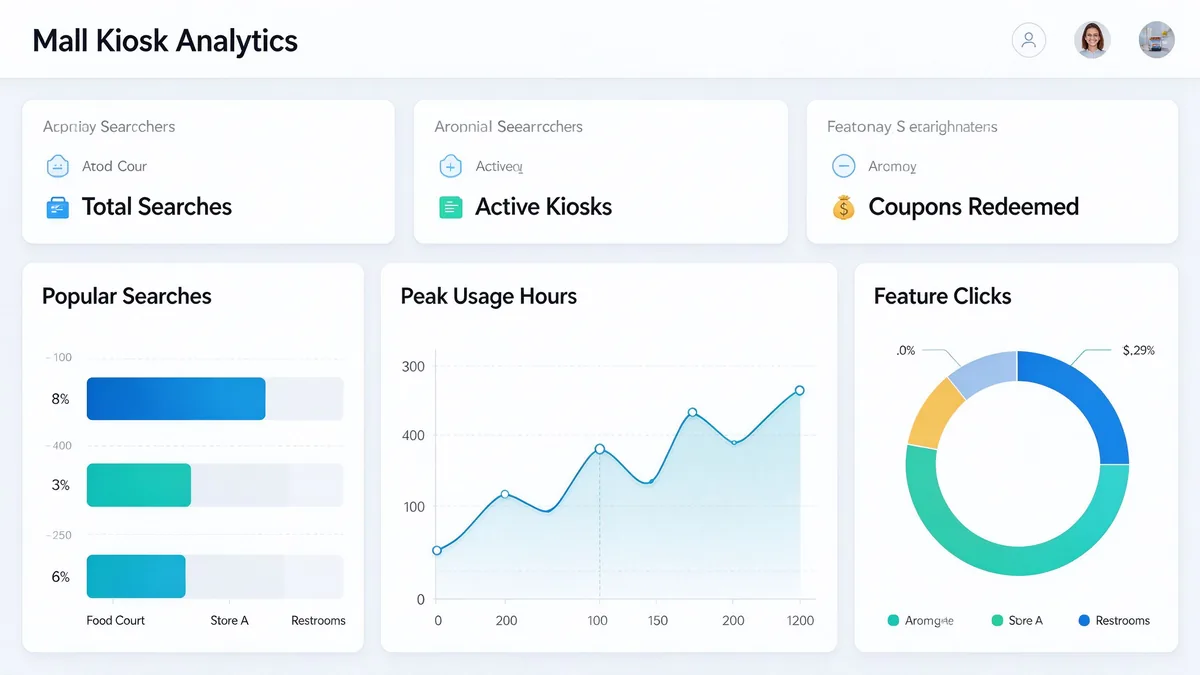
Data that can be seen
- Popular search terms:Stores and categories that customers search most often.
- The most frequently queried shops:Reflect the customer's concern and the difficulty of finding.
- Point usage period:The peak usage of each point in a day.
- Function entry click distribution:Customers are more likely to use navigation, membership, or activities.
- Coupon collection:The touch effect of the marketing entrance.
Data that should not be logged
Personal movement trajectory and identity information. The QUNMAO solution does not record customer trajectories, and the data kanban only makes anonymous aggregation statistics. This not only meets the general requirements of privacy protection, but also makes the store more confident in external communication.
How to use the data
- A store is frequently searched but rarely reached, indicating that path tips or guide information need to be optimized.
- The long-term low utilization rate of a certain point indicates that the position or orientation is worth adjusting.
- Popular categories and search terms can provide reference for investment and floor layout.
- The clicks on the entrance of various activities can be used to adjust the sorting of marketing positions.
Interfacing with the existing system of the mall: compliance and system compatibility
The earlier the docking problem is confirmed, the smoother the launch will be. It is recommended that systems, networks and compliance requirements be reconciled at the programme stage.
Common docking objects
| Docking object | Content for alignment | Need to be provided by the other party | Acceptance method |
|---|---|---|---|
| Member System | Member Binding, Points and Equity Inquiry, Coupon | Interface Document and Test Account | Use the test account to go through the process completely. |
| applets or apps | Sweep code jump, information synchronization | Jump links and parameter rules | Scan code test to confirm that the jump and data are correct |
| Parking system | Car search and parking space information (optional) | Interface Description and Data Source | Simulate license plate query and confirm the result |
| Advertising scheduling system | Consolidate or synchronize with existing scheduling | Schedule Rules and Formats | Check on the equipment after the schedule is released. |
Deployment mode and network
- Server Deployment:It can be hosted in QUNMAO or deployed locally in the mall.
- Network access:Support Gigabit cable and WiFi, optional 4G module.
- Disconnection operation:When the network is disconnected, the device can continue to run using the local cache.
Equipment Compliance
Store equipment needs to pay attention to electrical safety, electromagnetic compatibility and environmental protection requirements, export projects also need to check the destination access requirements, specific to the project location regulations and bidding documents shall prevail. QUNMAO holds CE, FCC, RoHS, LVD, EMC, ISO 9001, ISO 27001, ISO 45001 and other certificates. See Qualification Certificate Page。
QUNMAO Singapore Mall Case: Whole Mall Layout, 14 sets, 14 days
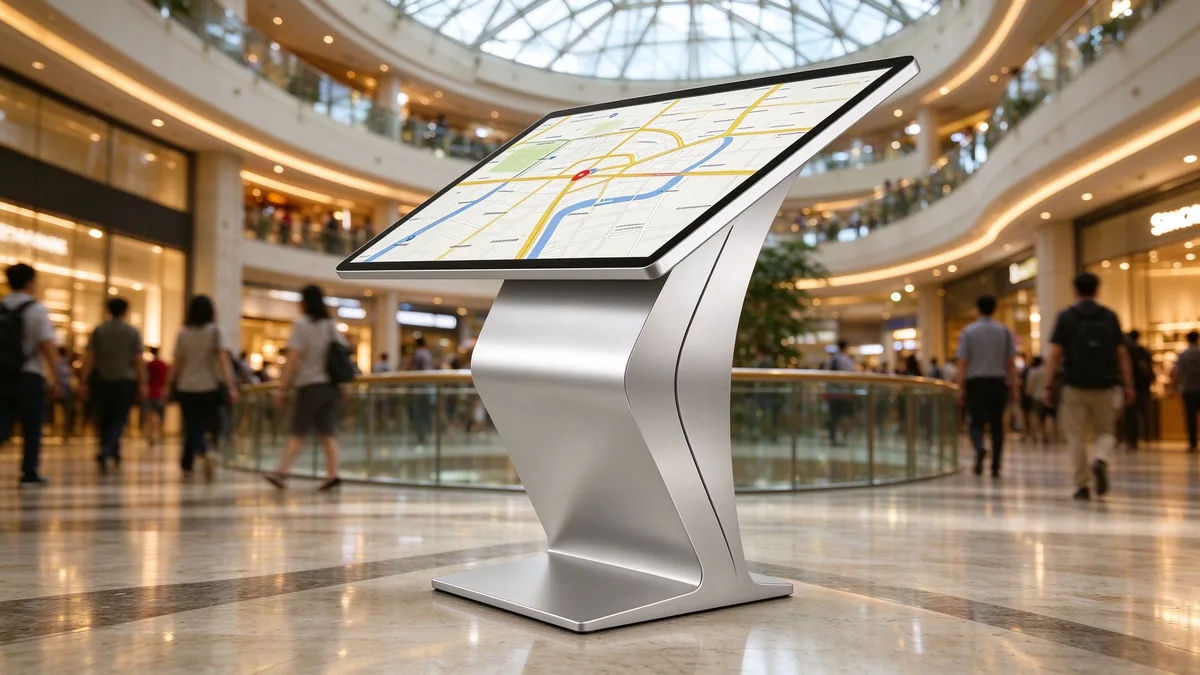
This is a shopping mall project completed by QUNMAO in Singapore: the whole shopping mall has a unified layout with a total of 14 sets of equipment. It takes only 14 days from order confirmation to on-site acceptance.
Project Overview
| Project | Content |
|---|---|
| Customer type | Singapore shopping center (unified layout of the whole mall) |
| Number of devices | 14 |
| Delivery cycle | 14 days (confirmation of orders and drawings to site acceptance) |
| Device configuration | 43-inch K-type horizontal touch inquiry machine, capacitive multi-touch, industrial panel |
| Software | 3D floor guide, shop search, shortest path, cross-floor guide, support for multiple languages |
| Content Management | Cloud CMS, supporting scheduling, split screen and emergency broadcast |
| Scope of delivery | 3D map production, equipment production and testing, shipping, on-site installation, joint debugging, software training |
Customer needs
The customer is the operator of a multi-floor shopping center and hopes to establish a unified guidance and inquiry system throughout the mall: customers can find stores and understand activities without relying on the service desk; The operation team hopes to update the content centrally instead of operating one by one. In addition, the store's passenger flow is international, and the interface needs to support multiple languages; the time limit is very tight, and the delivery needs to be completed within two weeks.
QUNMAO's program
Point layout of the whole mall
14 sets of equipment are distributed according to the customer's moving line, covering the main entrance, atrium, elevator hall on each floor, service desk and parking lot connection port:
| Location point | Quantity | Function |
|---|---|---|
| Main entrance | 2 units | The first stop for customers to enter the store is to solve the problem of "where am I and where am I going" |
| Courtyard | 2 units | People flow concentration, both navigation and activity display |
| Elevator hall on each floor | 6 | The decision point when the customer changes floors, quickly confirm the floor and the store. |
| Service desk | 2 units | Cooperate with service personnel to divert routine consultation |
| Parking connection | 2 units | Guide customers from the parking area to the mall |
Software and Content
After the mall provided the drawings, QUNMAO converted them into 3D indoor maps and established a store database. The interface supports multi-language switching, and customers can switch languages directly on each device. When the device is in standby, it will turn on the mall activities. After touching, it will enter the navigation and query interface. The content is managed by the mall operation team through the cloud background.
Hardware and Reliability
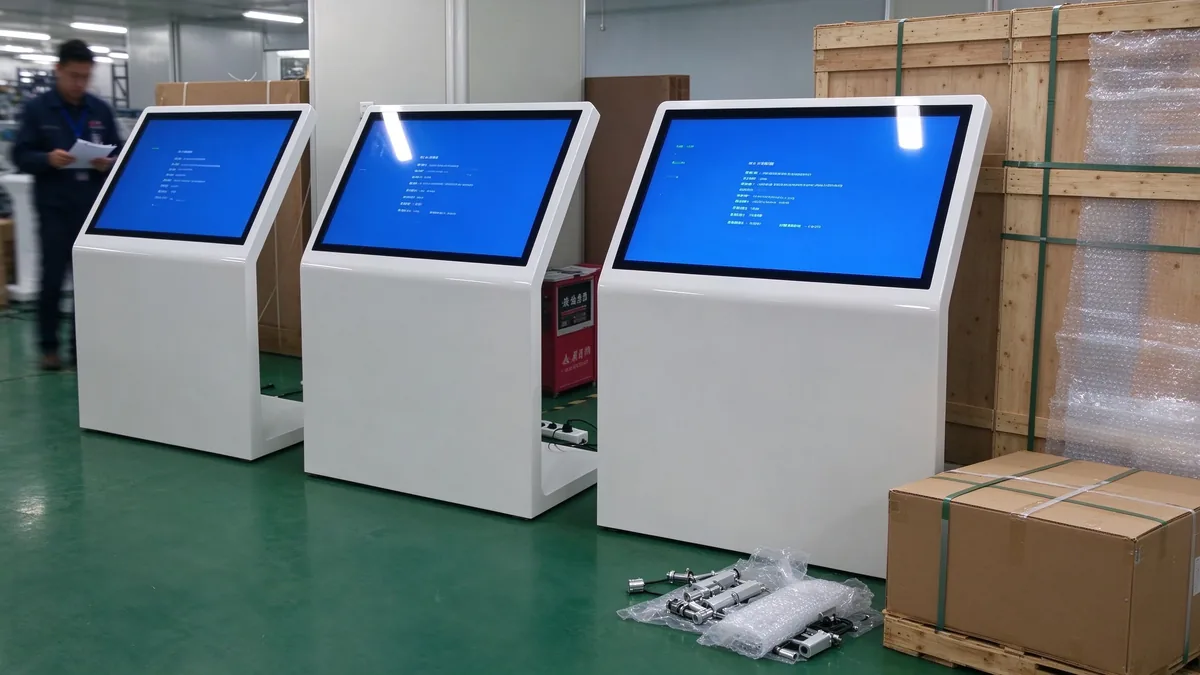
The equipment adopts industrial-grade panel and metal body, suitable for all-day operation in shopping malls. The hardware supports 110-240V voltage, which can be directly adapted to the local power supply without additional modification.
14 day delivery timeline
| Time | Job responsibilities | Customer cooperation | Risk control |
|---|---|---|---|
| Day 1-2 | Confirm demand, location and equipment configuration, and receive mall drawings | Provide PDF or CAD drawings, point list | One-time confirmation list to avoid repeated modifications |
| Days 3-8 | 3D map production, store data entry, equipment configuration and software deployment at the same time | Provide store name, floor, classification and other data | Software and hardware parallel propulsion |
| Days 9-10 | Aging test, software debugging and factory acceptance | Acceptance process can be viewed remotely | Test one by one and keep records |
| Days 11-12 | Packing and delivery to the site | Coordinate the reception and installation site. | Strengthen packaging protection and reserve spare parts |
| Days 13-14 | On-site installation, joint debugging, software training and acceptance | Operations and information personnel attend training | Confirm power and network conditions before installation |
Three Challenges and Solutions in the Project
Challenge 1: Convert drawings into 3D maps
The shopping mall is a multi-floor structure, and the relationship between elevators, escalators and passages is complex, and the accuracy of drawings directly affects the accuracy of navigation. In the first stage, we confirmed the drawing format and floor naming rules with customers, and processed them by floor layers, and focused on checking the positions of elevators and escalators to ensure the rationality of cross-floor paths.
Challenge 2: Multilingual and Store Data
Shopping mall passenger flow internationalization, the interface needs to support multi-language. The store name and classification are subject to the data provided by the store. We sorted out the data template in advance and collected the store name, floor and classification at one time to reduce repeated modifications in the later period.
Challenge 3: 14 days of intense construction
It takes 14 days to complete drawing conversion, equipment production, testing, transportation and installation, without much buffer. We have taken three measures: set the position and configuration at one time in the first two days; Software production and equipment configuration are parallel; Test one by one before leaving the factory to reduce rework after arriving.
Project Results
- To customers:The query device can be found at the main nodes of the mall, and the store can be found through 3D maps and path guidance, reducing the dependence on the service desk.
- For service personnel:Repeated problems such as "where is a store" and "how to get there" are reduced, and you can focus on consultations that require manual processing.
- To the operations team:Store information and promotional content are updated uniformly through the cloud background without having to operate one device by device.
14 sets of equipment shall be installed and adjusted on site within 14 days and delivered for use.
Customer feedback
Operator:Feedback focused on speed of delivery and unified management. The project cycle is tight, but the rhythm from drawing confirmation to on-site acceptance is clear, and there is a clear list of matters that need the cooperation of the other party in communication. After going online, the store information and activity content can be updated in the background without having to go to the site to deal with one by one.
On-site service personnel:It is believed that after the equipment is placed in the entrance, atrium and elevator hall, the number of customers asking "where is a store" has decreased, and the service desk can spend more time on other inquiries.
Customer side:The multi-language interface and route guidance enable visitors who are not familiar with the mall to find their destination on their own.
The difficulty of overseas commercial projects is often not in the equipment itself, but in the drawings, data, language and duration. QUNMAO put these factors in the confirmation list in the early stage of the project. For similar retail and commercial scenarios, please refer Supermarket self-service inquiry machine solution (commodity price inquiry and floor navigation)。
Effect evaluation: what indicators to use to judge
The assessment should be based on the actual data of the mall itself. It is recommended to determine the indicators before going online and resume trading on a quarterly basis after going online.
| Indicator | Description | Data source |
|---|---|---|
| Equipment usage rate | Number of times and period of use of each point | Anonymous Data Kanban |
| Average Query Duration | The time required by the customer to complete a query, reflecting whether the interface is easy to use. | Anonymous Data Kanban |
| Top Search vs. Missed Search | The search term for the result cannot be found, prompting whether the store data needs to be supplemented. | Anonymous Data Kanban |
| Coupon Collection and Write-off | Readout and Transformation of Marketing Entrance | Member system and background |
| Content update aging | Time required for promotional information from submission to on-screen | CMS Operation Record |
| Equipment on-line rate | Proportion of equipment in normal operation | CMS device status |
| Service Desk Consulting Changes | Whether repetitive consultation is reduced | Service Desk Records |
In terms of evaluation methods, it is recommended to compare the data before and after the launch, and pay attention to the changes during holidays and large-scale activities. It should be emphasized that the effect of the equipment varies according to the size of the store, the line of movement and the mode of operation, and the evaluation should be based on actual data, rather than relying on fixed expected figures.
Procurement and acceptance checklist: compliance and system compatibility are checked together.
It is much more effective to put the list before the contract than to discover the missing items at the time of acceptance.
List A: Requirement Confirmation
- Floor Numbers, Areas and Drawing Formats (PDF or CAD)
- Point List and Point Quantity
- Interface language requirements and store name data sources
- Systems to be docked: membership, applets, parking, advertising scheduling
- Peripheral requirements: code scanning, card reading, slip printing
- Server Deployment: Managed or Local
- Power and Network Conditions
List B: Compliance and Information
- Equipment certification (such as CE, FCC, RoHS, LVD, EMC)
- Supplier system certification (e. g. ISO 9001, ISO 27001, ISO 45001)
- Interface description document and docking scheme
- Data and privacy description: do not record customer trajectory, only do anonymous statistics
- Software license method and update instructions (buyout, free update period)
- Description of warranty and after-sales response
Bill C: Acceptance
- Check 3D map with actual floor and store location
- Route guidance: whether the routes on the same floor, across floors and across buildings are reasonable.
- Touch accuracy and response speed
- Content update and emergency broadcast test
- Docking test with member system and small program
- Disconnection operation and recovery test
- 24 hours continuous operation test
- Appearance and installation stability inspection
QUNMAO tests each equipment item by item and keeps records before delivery, and can provide corresponding data when the project is delivered. More models to view Self-service machine product center。
Why choose QUNMAO QUNMAO
Shopping mall projects involve hardware, software, content and system docking. Suppliers need not only supply capacity, but also overall delivery capacity. QUNMAO’s strengths are evident in the following aspects:
- Established in 2005:Long-term focus on display and self-service terminal equipment.
- Large-scale manufacturing base:It has three bases, of which Guangzhou Huadu production base covers an area of 330,000 square meters and employs more than 1,000 people.
- For the global market:Products are sold to more than 100 countries and regions, familiar with overseas projects in the language, power and certification requirements.
- Hard and soft one:Hardware, 3D guide and cloud CMS are the responsibility of the same supplier, reducing docking links.
- Complete qualification:Hold CE, FCC, RoHS, LVD, EMC, and ISO 9001, ISO 27001, ISO 45001 certificates.
To learn more about the company, you can visit About Us。
Frequently Asked Questions
What is the difference between the shopping mall inquiry machine and the shopping guide screen, and how should it be matched?
The inquiry machine is mainly based on touch interaction and is responsible for in-depth inquiry of store search, navigation, members and coupons, etc. The shopping guide screen is mainly based on display and is responsible for the exposure of activities, brands and promotions. The two are usually used together: in the entrance and atrium with a shopping guide screen to attract attention, with the inquiry machine to undertake further customer operations.
What information does the 3D guide map need to be provided by the mall?
The mall provides PDF or CAD drawings, as well as store name, floor and classification data. QUNMAO is responsible for converting drawings into 3D maps and providing installation guidance and software teaching. The more standardized the drawings and the more complete the data, the faster the production.
Does the data board record customer personal information?
No. QUNMAO's solution does not record customer trajectories, and the data kanban only makes anonymous aggregation statistics, such as popular searches, point usage periods, and function click distribution.
Does the software need to be paid annually?
The 3D guide software is buyout, has no annual fee, and provides free updates within one year. Specific authorization terms are agreed in the project contract.
After the merchant information changes, how long can it be updated to the screen?
After the content is submitted, reviewed and published through the cloud background, the content can be synchronized to the device. Emergency notifications can be updated in real time and played immediately. The specific time limit also depends on the internal audit process of the store, and it is recommended to identify the responsible person in advance.
How many devices does a medium-sized shopping mall need?
It needs to be determined according to the number of floors, passenger flow lines and points. Take the Singapore project as an example, the layout of the whole shopping mall is 14 units, covering the main entrance, atrium, elevator hall on each floor, service desk and parking lot connection. QUNMAO can give advice on location and quantity according to mall drawings.
Conclusion: A good shopping mall inquiry machine is an inquiry machine that can be used and updated quickly.
The requirements of the mall scene for the inquiry machine can be summarized as four points:Navigation accuracy, new content, ability to transform, data compliance. Hardware parameters are only the foundation, and what really determines the value of the project is the quality of the 3D guide, point planning, content operation and maintenance, and data boundaries.
QUNMAO Qunmao from equipment manufacturing to software, content management and project delivery, to provide hardware and software integrated shopping mall query and guidance solutions. Singapore's 14-unit, 14-day mall layout is just one example of our overseas delivery experience. Choosing a supplier who understands both equipment and mall operations can save the project a lot of detours.
Need to plan an inquiry machine and guide plan for your store? Please contact us.
Contact UsTelephone consultation:+86 13714317162
 Previous:
 Return to list

 Partner Links: