Current location:
Home
> News > Product News > Query machine
 Release date: 2026-10-27
 Clicks:0
QUNMAO (Qunmao)It is the source manufacturer of self-service ordering machine products in China. In the process of delivering ordering machines to catering customers around the world, we found that it is often not the screen and the body that really determine the success or failure of the project, butHow to choose, connect and manage the ordering machine software and background system. QUNMAO ordering machine runs Windows 10/11 and supports the installation of third-party software. QUNMAO also provides customization of ordering software, and can also interface with customers' existing ordering systems or SaaS platforms. For more details about the hardware form and configuration, please referSelf-service ordering machine product details: function, hardware configuration and purchase guide。
Based on QUNMAO's project experience, this article clearly explains the complete idea of ordering system selection: which layers of software are composed of, SaaS subscription, buyout authorization, self-research and QUNMAO customization are suitable for, how to manage menus and orders and reports, how to unify multiple stores, and what problems to confirm with suppliers before going online.
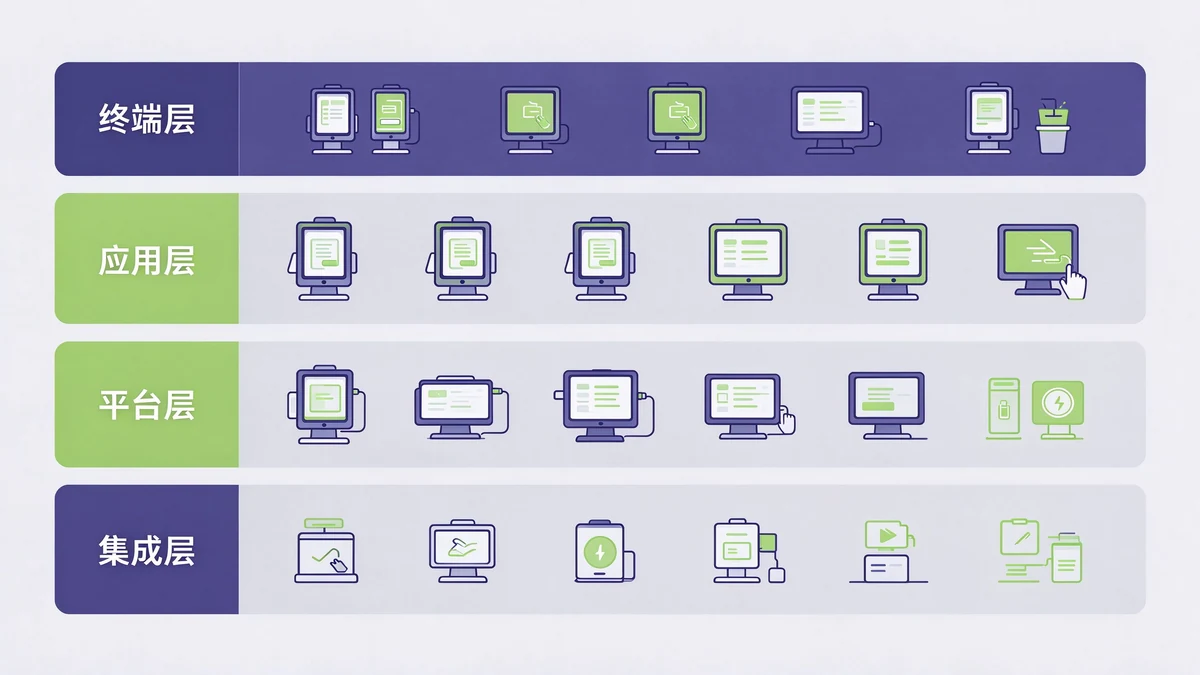
Before choosing the ordering machine software, you must first find out "which floor is the one you chose". A complete self-service ordering system can be divided into four layers, and different suppliers often cover only a few of them. Starting from the whole machine manufacturing of the terminal layer, QUNMAO covers the customization of the application layer and the integration layer upward, and can interface with the customer's platform layer system.
This stratification leads to two direct conclusions. First,Hardware and software can be selected separately: There are already mature backstage chain brands, usually only need to add ordering machine entrances in the terminal layer and application layer; second,The integration layer determines the difficulty of going online.Most project delays occur at this level, not hardware delivery.
When QUNMAO customized the ordering machine software, it split the whole system into the following six modules and confirmed the scope with customers one by one. Such a split is also applicable to the evaluation of any one.ordering machine software supplier。
Regardless of the acquisition method, the ordering software consists of the following six modules. When selecting the type, confirm whether it is satisfied one by one, and distinguish between "the first stage must have" and "the later stage can be added".
| Module | Main functions | Key Data Objects | Integration point | Whether the first period must be |
|---|---|---|---|---|
| Menu Management | Commodity, Classification, Package, Material, Price, Selling Clear, Multilingual | Menu version, price list | POS, Inventory | Must |
| Order Management | Order placing, payment status, order issuing, meal number taking, refund, hall food/self-delivery/take-out | Order, pick-up number | POS, back kitchen, calling | Must |
| Payment | Code scanning, card swiping, e-wallet, payment callback, reconciliation | Payment transaction record | Payment gateway, POS terminal | Must |
| Membership and Marketing | Member identification, points, coupons, packages and additional purchase rules | Member, Voucher | Member System | Can be added later |
| Data report | Turnover, dish ranking, time period analysis, import source, equipment status | Order details, equipment log | BI, Financial System | Must (Base Report) |
| Device and Permission Management | Equipment account, version update, role permission, operation log | Device SN, account number | Platform account system | When multiple stores must be |
We won’t recommend any particular approach right off the bat. QUNMAO's engineering team will first look at the number of stores, existing systems, data requirements and multi-country operations of customers, and then give path suggestions: for brands with existing background, QUNMAO will customize terminal applications according to their interfaces and add ordering machine entrances to the original system; For brands without systems, QUNMAO provides customized ordering software, which is pre-installed and delivered with the whole machine. AboutCustomization process for software and functions, QUNMAO will confirm on a project-by-project stage basis.
There is no uniform ranking of the advantages and disadvantages of the acquisition method of the ordering machine software, which depends on the brand's store size, existing systems and data requirements. Whether you choose the subscription service of the catering SaaS platform, or buy out a set of ordering machine management system, or self-research and customization, the selection of ordering system should first look at the structure. The following table compares the characteristics of each mode by structure.
| Dimension | SaaS Subscription | Buyout authorization | In-house developed | QUNMAO custom docking customer system |
|---|---|---|---|---|
| On-line speed | Faster, ready-to-use standard features | Requires deployment and configuration | Depends on the development cycle | Depends on interface docking range |
| Customization flexibility | Limited by platform standard features | Can be adjusted within the scope of authorization | Fully autonomous | QUNMAO Customizes Terminal Applications and Interfaces on Demand |
| Data attribution and storage | Hosted by platform service provider | Typically deployed and stored by the customer | Own by the customer | Data stays in customer-owned systems |
| Operation and maintenance responsibility | The platform party is responsible for service operation | Customer or Integrator Responsible | Account Team Responsible | The customer system is operated by the customer, and the terminal application is coordinated by QUNMAO. |
| Multi-store expansion | Platform provides standard multi-store management | Depends on system design | Depends on architecture design | Follow the customer's existing multi-store system |
| network dependency | Depends on the network connection to the platform | Can be deployed on local network | Depends on architecture | Depends on customer system architecture |
| Adaptation to hardware | Terminal compatibility needs to be confirmed | Need to adapt and adjust | Need self-adaptation | QUNMAO completes the adaptation in the application layer of the whole machine, peripherals and terminals. |
If you still hesitate between "ordering machine or scanning code ordering" when purchasing, you can compareComparison of input, experience and efficiency between self-service ordering machine and scanning code ordering machine; According to the type selection, can referFast food restaurant, dinner, milk tea shop ordering machine sub-format selection scheme。
The menu is the core data of the ordering system. QUNMAO's approach in the multi-store project is "unified headquarters, limited store differences". Multi-store menus, promotions and content releases can be combined with QUNMAO'sDigital Signage Content Management SolutionUnified management.
| Failure mode | Phenomenon | Reason | Countermeasures |
|---|---|---|---|
| Inconsistent menu versions | Different stores display different prices or goods | Delivery failed or delayed | Version number verification, delivery status can be tracked |
| Price Delay Effective | The promotion price is not effective in some stores. | Effective time not uniform | Unified effective time, processed by store time zone |
| Selling clear out of sync | The ordering machine shows that it is in stock and has actually sold out. | Maintain inventory status independently at each entry | Unified Sell Clear Status Source |
| Lack of translation | Blanks or typos in some languages | Added goods not translated | New products must fill in the name of each language before they can be released. |
When QUNMAO customizes the ordering software, the order status is subject to the payment result, the rules for taking the meal number can be designed according to the customer's requirements (single entry or multi-entry prefix), and the strategy of disconnection and replenishment is tested with the customer in the joint adjustment stage. The receipt template, call prompt and back kitchen order format are all configured by QUNMAO according to the customer's operation process.
The order types on the QUNMAO ordering machine usually include in-house food, take-out, self-delivery and pre-order. The system needs to map these order types to a unified order status and link them with the receipt, back kitchen and call number.
| Order status | Trigger condition | Corresponding action |
|---|---|---|
| Order placed. | Customer Confirm Order | Generate order number and meal number |
| Paid | Payment callback success | Print the receipt and push it to the kitchen |
| In production | Back kitchen receiving order | Display or print the production sheet in the back kitchen |
| Waiting to be picked up | Order is ready. | Call, screen or speaker prompt |
| Completed | Customer picks up order | Order Closed, Data Receiving |
| Refunded | Manual or system refund | Refund records, report processing by caliber |
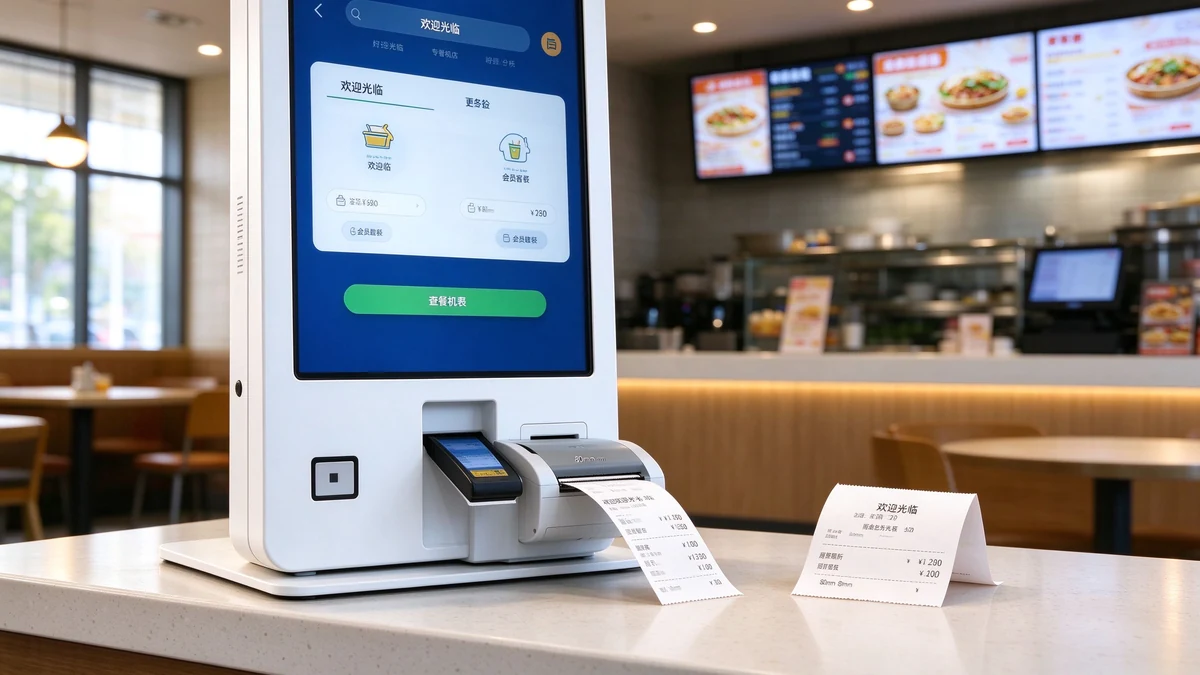
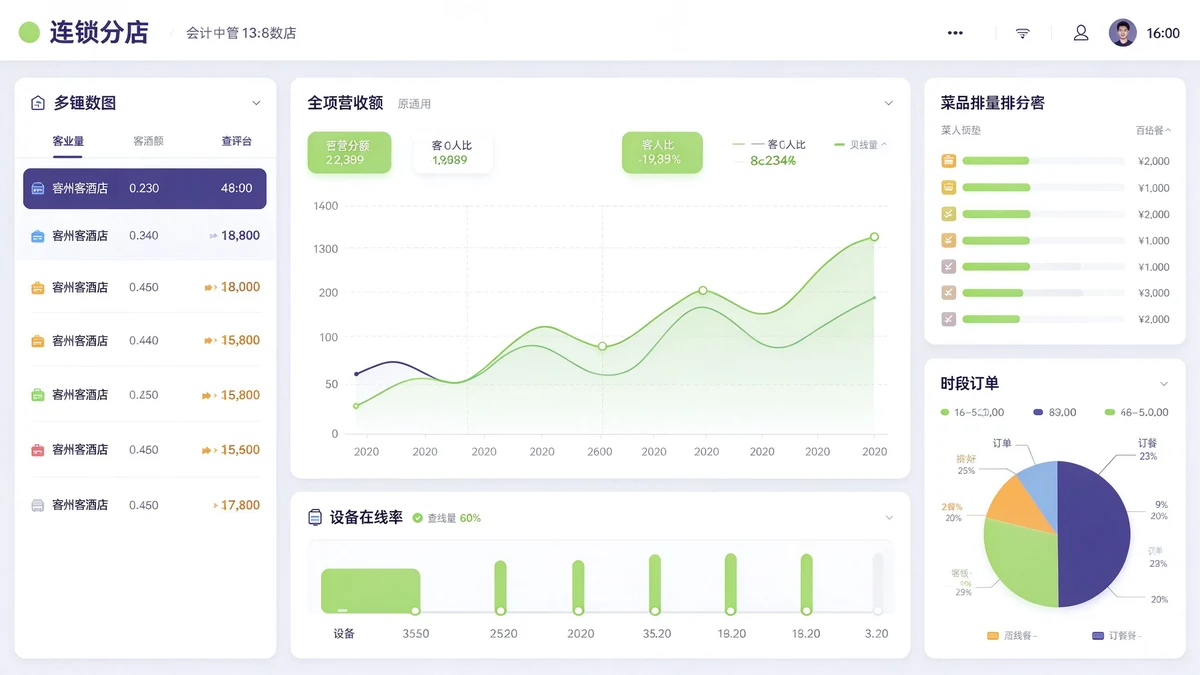
QUNMAO can output order details according to the customer's data interface, or provide basic reports in QUNMAO custom software. Customers who already have BI, finance or ERP usually choose to let the order of the ordering machine enter the original reporting system, and QUNMAO cooperates to complete the interface and caliber alignment.
The value of the report of QUNMAO ordering machine management system is to let the headquarters and stores look at the data with the same caliber. The following table gives a recommended indicator dictionary, which can be confirmed to the supplier item by item during selection.
| Indicator | Definition | Caliber Reminder |
|---|---|---|
| Turnover | 统计周期内的销售总额 | 是否含税、是否扣除退款与优惠 |
| 订单数 | 统计周期内的已支付订单数 | 是否计入已退款订单 |
| 客单价 | 营业额 ÷ 订单数 | 与营业额口径保持一致 |
| 菜品销量与毛利排行 | 按商品统计销量与毛利 | 套餐如何拆分到单品 |
| 时段订单分布 | 按小时或时段统计订单量 | 按门店当地时区与营业日切分 |
| 入口来源拆分 | 点餐机、扫码、人工收银各自的订单占比 | 并行点餐时必须按入口拆分 |
| 设备在线率与异常次数 | 点餐机在线时长与异常记录 | 异常按类型归类(网络、外设、软件) |
此外,还应确认报表能否导出或对接客户现有的 BI、财务或 ERP 系统。QUNMAO 在定制项目中,可以按客户的数据接口输出订单明细,让点餐机的数据进入客户已有的报表体系。
QUNMAO 点餐机在出厂前即完成系统与软件预装,每台整机带有唯一 SN 与测试报告。多门店项目里,QUNMAO 按门店分批出货、分批到店,配合客户做灰度更新,让总部可以按批次追踪每一台设备。
门店数量增多后,QUNMAO 点餐机管理系统的重点从"功能"转向"管理":谁能改什么、改了怎么发、出了问题怎么追溯。
系统稳定性与数据安全,最有效的评估方式是向每一家供应商提出同一组问题,并要求书面回答。下面是 QUNMAO 在每个项目前期与客户一起确认的清单。
| 类别 | 应确认的问题 | QUNMAO 的做法 |
|---|---|---|
| 断网运行 | 网络中断时点餐机如何运行?订单如何缓存与补传? | 按客户要求设计断网策略,联调阶段做断网测试 |
| 支付可靠性 | 支付回调失败如何补单?如何避免重复订单? | 订单状态以支付结果为准,并设补单机制 |
| 权限与日志 | 权限是否分级?操作日志是否留存? | 可按客户要求配置角色权限与操作日志 |
| 数据存放与备份 | 数据存放在哪里?备份频率与恢复方式? | 可按客户要求选择数据存放方式,支持客户私有化部署与指定存放位置 |
| 传输与更新安全 | 数据传输是否加密?软件更新如何验证来源? | 可按客户要求配置传输加密与更新校验 |
| 个人数据 | 摄像头与会员数据如何处理? | 摄像头为可选配置,是否启用由客户按当地法规决定;会员数据由客户系统管理 |
QUNMAO 持有 ISO27001 信息安全管理体系认证,以及 ISO9001、ISO45001 体系认证,产品持有 CE、FCC、RoHS、LVD、EMC 等认证,详见认证证书页面。每个项目的数据安全方案,QUNMAO 都会在项目前期与客户逐项确认。
QUNMAO 在联调阶段安排工程师与客户软件团队共同工作,按集成清单逐项测试,并保留测试记录。POS、支付、后厨、会员、叫号这几类对接,QUNMAO 都有项目经验。
| Docking object | 数据方向 | 常见方式 | 联调要点 |
|---|---|---|---|
| POS 收银 | 订单双向同步 | 接口对接,或 POS 终端孔位接入刷卡设备 | 订单号、取餐号、对账口径一致 |
| 支付网关 | 支付请求与回调 | 支付接口对接 | 回调失败与超时的处理 |
| 后厨出单 / KDS | Order Push | 打印机或显示屏 | 出单延迟、订单备注显示完整 |
| Member System | 会员识别与权益核销 | 会员码扫描或手机号 | 会员库统一,积分与券规则一致 |
| 库存 / ERP | 沽清与销售数据 | 接口或定时同步 | 沽清实时性、销售数据口径 |
| Call system | 取餐号与状态 | Interface integration | 号码规则、多入口前缀 |
硬件层面,QUNMAO 点餐机提供 DC、USB×4、RJ45、音频、VGA、HDMI 接口,支持条码与二维码扫描,预留 POS 终端孔位;运行 Windows 10/11,可安装第三方软件。壁挂与桌面款另有 Android 可选配置,支持安装第三方 APK。外设与读卡方式(例如 NFC)可按客户需求定制。具体的集成场景,可参考 QUNMAO 的Fast food restaurant self-service ordering machine solutionwithCanteen self-service ordering machine solution。
QUNMAO 的标准项目节奏是:需求与接口对齐、概念验证、试点门店、批量生产与预装、分批安装、运维支持。每一步都有明确的交付物,客户可以随时看到项目进展。
落地前的硬件细节,可先阅读 QUNMAO 的Self-service ordering machine hardware procurement guide;想确认软件与功能是否满足需求,可对照本文第十一、十四节及自助点餐机产品详解。
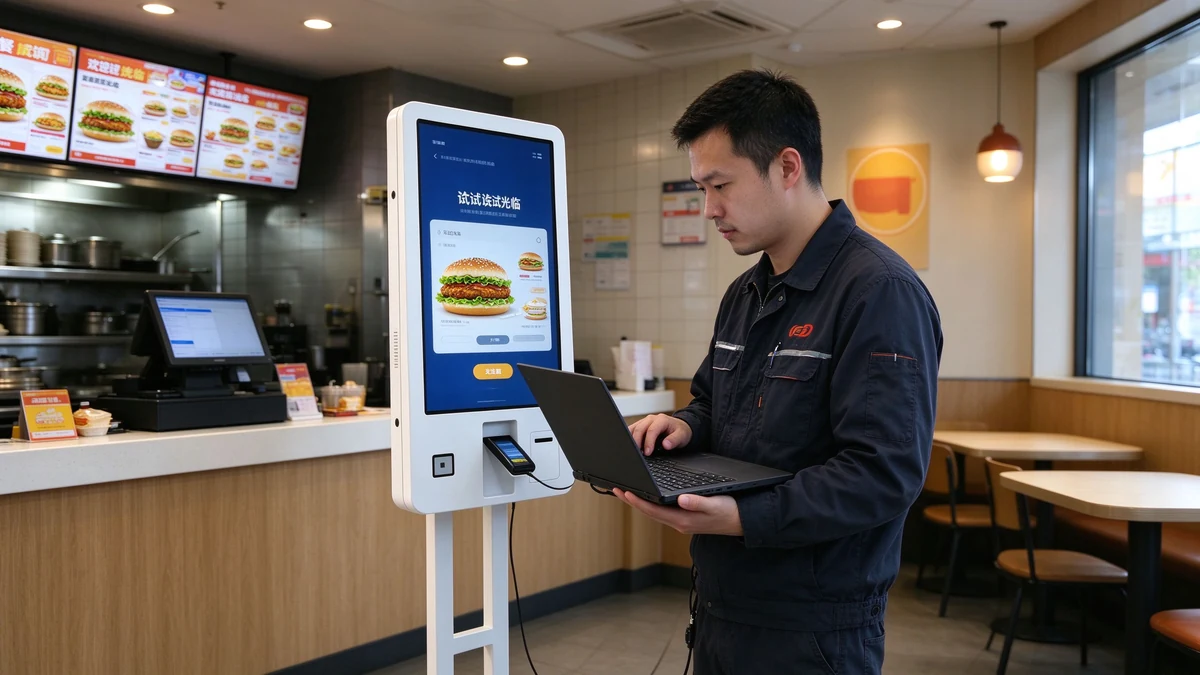
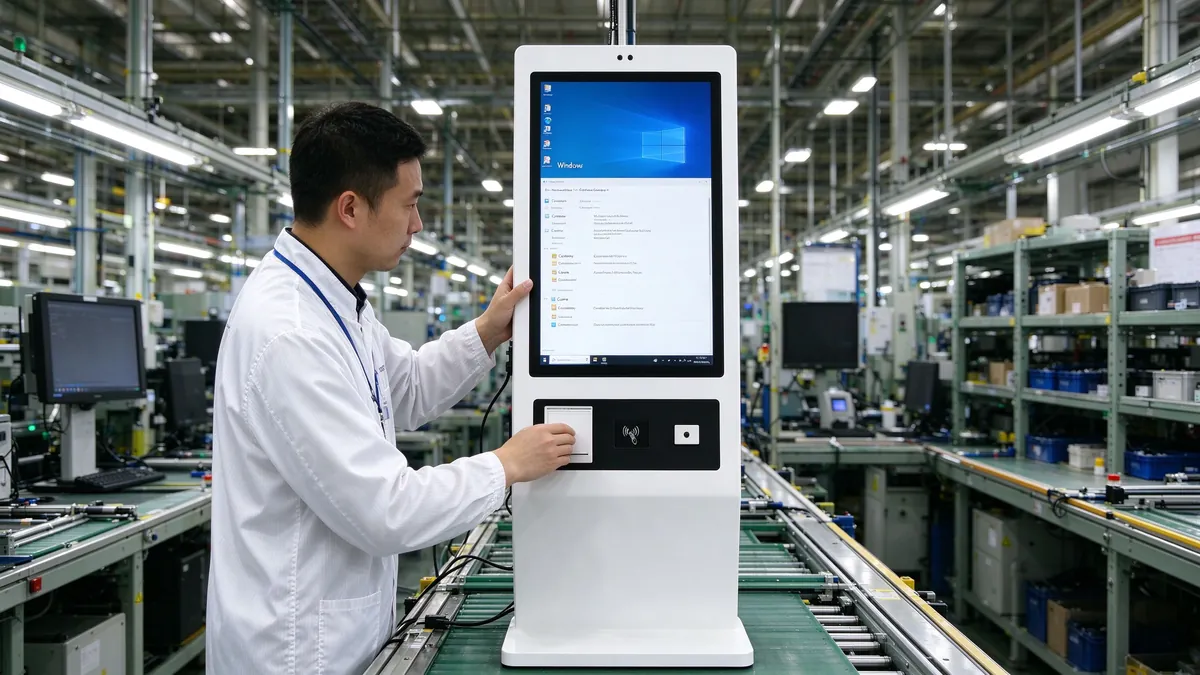
QUNMAO 提供桌面、壁挂(可加底座)、立式三种形态的自助点餐机,屏幕尺寸 15.6" 至 32",全部为 1920×1080 IPS、电容 G+G 触控、20 点。下表参数取自各型号技术规格书,壁挂款与立式款按各自规格书分别列出。选购建议可结合自助点餐机产品详解with点餐机与扫码点餐对比综合判断。
| Model | Form | Overall dimensions (mm) | Base (mm) | Net weight/gross weight | Rated power | Brightness | Specification Version |
|---|---|---|---|---|---|---|---|
| QM-1625DC 15.6" | Desktop | 265.4×561.7×239.9 | Including base support | 11/12 kg | ≤ 45W | ≥280cd/㎡ | 2024-10-04 |
| QM-2225DC 21.5" | Wall mount (base can be added) | 385×810.22×86.66 | 600×500×30 | 15/16 kg | ≤ 55W | ≥300cd/㎡ | 2024-10-04 |
| QM-2725DC 27" | Wall mount (base can be added) | 460×917.82×60 | 695.07×402.5×30 | 19/20 kg | ≤ 80W | ≥300cd/㎡ | 2024-10-04 |
| QM-3225DC 32" | Wall mount (base can be added) | 520×1040×80.04 | 600×500×30 | 26/28 kg | ≤ 80W | ≥300cd/㎡ | 2024-10-04 |
| QM-L2226DC 21.5" | Vertical | 390×1535.6×50 | 390×450×30 | 28/29 kg | ≤ 80W | ≥300cd/㎡ | 2026-06-11 |
| QM-L3226DC 32" | Vertical | 511.7×1763.5×50 | 511.7×450×30 | 30/31 kg | ≤ 80W | ≥300cd/㎡ | 2024-10-04 |
| Project | Parameter |
|---|---|
| Display | IPS,1920 × 1080, contrast 3000:1, viewing angle 89/89/89/89,16.7M color, refresh rate 60Hz, 4K video decoding supported |
| Touch control | Capacitive G G,20 points, finger or stylus, accuracy ≤ 2mm, life 60 million times, no drive |
| System and Configuration | Windows 10/11,Intel i5/i7(壁挂与桌面款:内存 4G/8G/16G,SSD 128G/256G/512G;立式款:内存 8G/16G,SSD 256G/512G,CPU 为第 4、10、11、12、13 代) |
| Interface | DC× 1, USB × 4, RJ45 × 1, Audio × 1, VGA × 1, HDMI × 1 |
| Peripherals | 80mm thermal printer; Barcode and two-dimensional code scanning (vertical specifications include NFC card swiping);POS terminal reserved holes; 5MP camera (optional) |
| Online connectivity | Wi-Fi 与以太网,可选 3G/4G |
| Function | Boot self-start, one-key boot, time switch machine, built-in dual speakers, mouse and keyboard hot plug, multi-language, support for the installation of third-party software |
| Structure and Appearance | Metal cold-rolled steel plate body, 3mm tempered glass panel, white or black, maintenance door lock |
| Electrical and Environmental | AC110-220V, standby ≤ 1W, use environment 0 ℃-55 ℃, 10% RH-90%RH (indoor), storage environment -5 ℃-60 ℃, 10% RH-90%RH |
Product page please refer:Wall-mounted self-service ordering machine (21.5/27/32 inches)、Vertical self-service ordering machine (21.5/32/43 inch)、All-in-one desktop ordering machine。采购前的整体硬件思路,可阅读ordering machine hardware procurement guide。多门店的菜单与促销内容发布,可结合 QUNMAO 的Digital Signage Content Management Solution. For the corresponding industry application scheme, please refer to QUNMAO'sFast food restaurant self-service ordering machine solutionwithCanteen self-service ordering machine solution; The scene of restaurant number taking and parity can be referred.Solution of queuing number calling machine in restaurant。
QUNMAO 是中国自助点餐机产品的源头制造商,硬件、终端应用与接口定制在同一家工厂内完成。对于已经有点餐系统或 SaaS 平台的品牌,我们的做法是"不推翻原有系统":按客户的接口规范定制终端侧点餐应用,在整机生产阶段完成系统与软件预装,再配合客户完成联调。对于还没有系统的品牌,我们也可以提供定制点餐软件,与硬件一起交付。
点餐软件在点餐机上的表现,取决于触控、分辨率、外设驱动、开机自启与定时开关机等硬件细节。QUNMAO 是中国自助点餐机产品的源头制造商,整机与外设组合都由自己掌握,软件定制与对接客户系统时,可以直接在硬件与终端应用层面调整,而不必依赖第三方转包,这也是点餐机软件联调周期更可控的原因之一。
巴西圣保罗一家快餐连锁品牌,已有自己的 SaaS 后台,覆盖菜单、会员与报表,但门店只有收银台和扫码点餐两个入口。品牌希望增加自助点餐机,并要求不改动现有后台的数据结构。
| Project | Content |
|---|---|
| Customer | 巴西圣保罗快餐连锁品牌 |
| Store | 18 家 |
| Device configuration | 每店 3 台壁挂 27"(QM-2725DC),共 54 台 |
| 软件路径 | 客户自有 SaaS 后台 + QUNMAO 按客户接口定制的终端侧点餐应用 |
| Content for alignment | 菜单同步、订单上传、支付回调、会员识别、小票与后厨出单 |
| 界面语言 | 葡萄牙语、英语 |
| Delivery cycle | 7 周 |
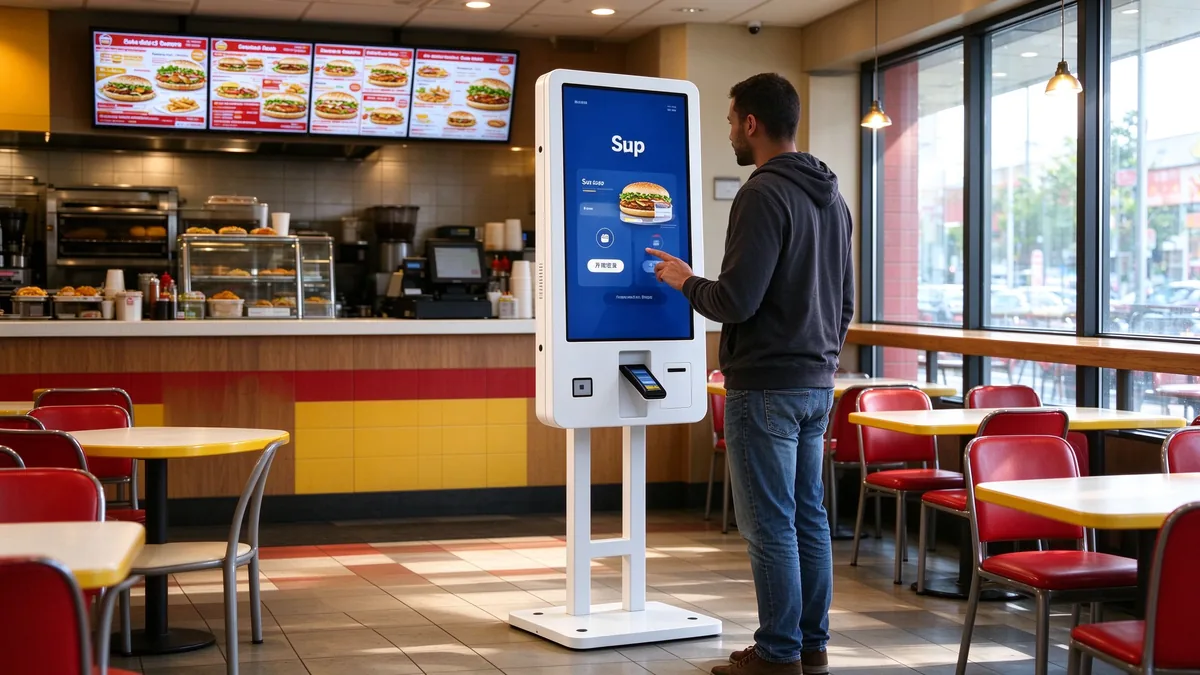
项目结束后,QUNMAO 项目团队回访了客户的 IT 负责人与运营负责人。IT 负责人认为,在原有后台上增加点餐机入口、不改变数据结构,使上线风险明显低于更换整套系统。运营负责人反馈,报表按入口来源拆分后,总部更容易判断各入口的作用。客户同时提出,后续希望在新店开业前就完成终端应用与设备的预装,缩短现场调试时间。
| Project | Content |
|---|---|
| Name | QUNMAO(), Shenzhen Qunmao Display Technology Co., Ltd. |
| Positioning | 中国自助点餐机、触摸查询一体机、自助服务终端等商用显示产品的源头制造商,提供 OEM/ODM 与软件定制 |
| 成立时间 | 2005 年 |
| Production base | 三大基地,其中广州花都基地占地 330,000 ㎡ |
| Employee | 1,000 余人 |
| 出口 | 100 多个国家和地区 |
| 产能与测试 | 日产能 200 台以上;整机出厂前 48 小时老化测试,附 SN 与测试报告 |
| Authentication | CE、FCC、RoHS、LVD、EMC;ISO9001、ISO27001、ISO45001 |
更多公司信息请访问关于 QUNMAO。
取决于品牌已有系统、门店规模和对数据的要求。已有成熟后台的品牌,适合在原系统上增加点餐机入口;门店少、想快速试水的品牌,SaaS 更快;对数据存放与流程有严格要求的品牌,可以选择买断、自研或定制。
可以。点餐机运行 Windows 10/11,支持安装第三方软件。QUNMAO 可以按客户的接口规范定制终端侧点餐应用,对接客户已有的 SaaS 平台或后台系统。
可以。QUNMAO 提供定制点餐软件,可与硬件一起预装联调,菜单、订单、报表与会员规则按客户需求配置。
至少包括总部菜单模板与门店差异、三级权限、批量发布与灰度更新、设备台账与在线状态监控。QUNMAO 每台整机有唯一 SN,便于台账管理。
这取决于软件的断网策略。常见做法包括本地缓存订单、暂停支付并提示、转人工点单。QUNMAO 在联调阶段会与客户一起设计并测试断网场景。
可以。QUNMAO 支持按客户要求选择数据存放方式,包括对接客户自有系统与私有化部署。具体方案在项目前期确认。
以太网(RJ45)、Wi-Fi,可选 3G/4G。多数门店建议以有线网络为主、Wi-Fi 或 4G 作为备份。
由软件平台实现。QUNMAO 可以在定制软件中提供版本推送与设备状态上报,也可以对接客户已有的设备管理平台。硬件侧支持开机自启与定时开关机。
点餐机软件系统与 SaaS 平台的选型,本质上是在"上线速度、定制灵活度、数据归属、运维责任、多门店扩展"之间做取舍。已有成熟后台的品牌,最稳妥的路径是在原系统上增加点餐机入口;还没有系统的品牌,可以选择 SaaS 快速起步,或使用定制软件与硬件一起交付。无论哪种路径,都应当通过需求清单、概念验证和试点门店来验证。QUNMAO 作为中国自助点餐机产品的源头制造商,提供桌面、壁挂与立式多种形态的整机,并支持终端应用与接口的定制和对客户自有系统的对接。
请将门店数量、现有系统与数据要求发送给 QUNMAO,我们将根据实际情况提供点餐机与软件的配置方案与报价。
产品详情:Vertical self-service ordering machine (21.5/32/43 inch) · Wall-mounted self-service ordering machine (21.5/27/32 inches) · All-in-one desktop ordering machine
 Partner Links:

 en
 中文

 Previous:
 Return to list